King of the Hill Standings Calculator
Rank a ladder night, rotating champion table, club league, or crown challenge by match points, defense bonuses, opponent strength, and cut line.
Standings Result
| Rank | Player | Total | Tiebreak | Status |
|---|---|---|---|---|
| 1 | Mara | 18.0 | 68.0% | Hill holder |
| 2 | Noel | 16.0 | 61.0% | In cut |
| 3 | Iris | 14.5 | 64.0% | In cut |
| Player | Match | Defense | Crown | Needed |
|---|---|---|---|---|
| Mara | 15.0 | 2.0 | 1.0 | 0.0 |
| Noel | 15.0 | 1.0 | 0.0 | 2.0 |
| Iris | 12.0 | 1.5 | 0.0 | 4.5 |
wins x win value + draws x draw value + byes x bye value.
min(successful defenses, cap) x defense bonus per defense.
match points + defense bonus + crown holder bonus.
chosen method sorts tied totals by resistance, games, defense, or head-to-head.
Blank rows and comment rows are ignored.
One active holder gives a clean pressure read.
Switch modes to compare close ladders.
Rounds multiplied by minutes per table.
| Profile | Win | Draw | Bye |
|---|---|---|---|
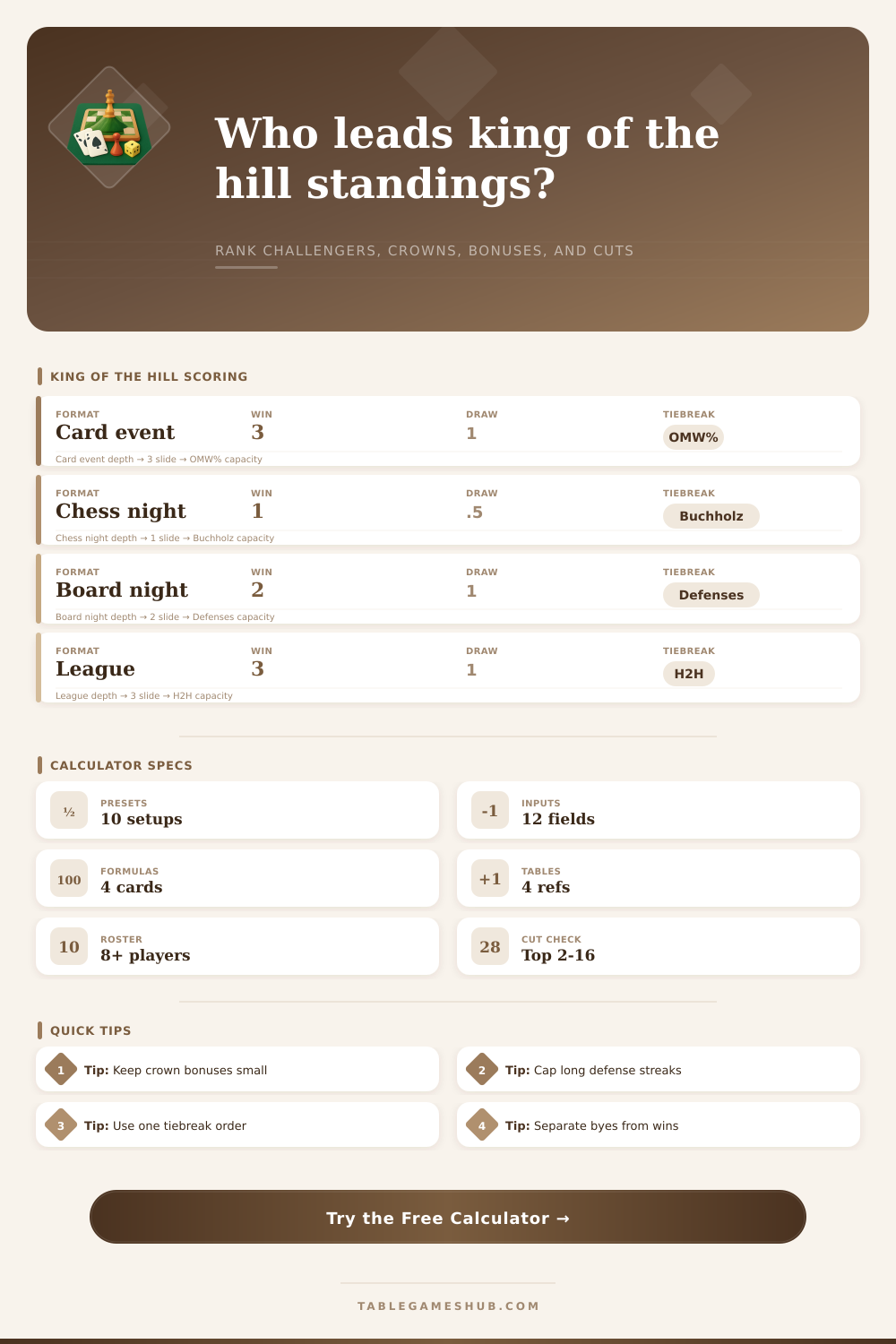
| Card event | 3 | 1 | 3 |
| League match | 3 | 1 | 2 |
| Board game | 2 | 1 | 2 |
| Chess style | 1 | 0.5 | 1 |
| Method | Best use | Input | Sort |
|---|---|---|---|
| Opponent strength | Card events | Opp % | High |
| Buchholz-style | Swiss-like nights | Opp % x rounds | High |
| Game win % | Multi-game matches | GW % | High |
| Head-to-head | Small tied groups | Edge | High |
| Event | Defense bonus | Cap | Crown bonus |
|---|---|---|---|
| Casual table | 0.25 | 4 | 0.5 |
| Club ladder | 0.5 | 4 | 1 |
| Store event | 0.5 | 3 | 0.5 |
| Final night | 1 | 2 | 1 |
| Players | Cut | Rounds | Use |
|---|---|---|---|
| 4-8 | 2 | 3-5 | Final table |
| 9-16 | 4 | 4-6 | Semis |
| 17-32 | 8 | 5-7 | Top cut |
| 33+ | 16 | 6-9 | Large event |
As time ticks down to the last cut line, we’re all wondering where we stand, and the atmosphere get tense in the game store. Challengers encircle you like vultures. Defenses stack up. The math isn’t so easy any longer. It’s not just simple arithmetic any longer, it’s a point threshold and tiebreaker hierarchy puzzle, and how much does it matter who beat whom? In that moment, the whole room seem to freeze as each person figures out if another win will do the trick, or if the ladder was already set against them.
King of the hill scoring sounds like an elegantly simple idea on its surface. Reward consistency, punish stagnation, but don’t make it so complicated that it falls over itself. For most organizers, this mean beginning with match points. These are easy to tally and feel right. A win gets points, a draw splits them, and a loss get nothing. This creates a starting order most players agree upon without much fuss.
How to Set Up Fair Scoring Rules
Things get tricky when two or more fighter finish the night tied for the lead. This is where most casual setups begin to stumble, and where the true design work occur. When scores are tied, you get to make a call. Do you go by opponent strength percentage? That’s a way for the tournament to tell you they value players who made it through a tougher test. Or do you look at head-to-head records. The idea that if you beat someone directly, they shouldn’t be ranked ahead of you even with odd scheduling?
Every decision you make will communicate a certain message: this event values that style of player. If you’re doing a Buchholz tiebreaker, it value depth of field. If you do game win percentage, it values raw efficiency in a tight spot. There isn’t one correct answer, just whichever works best for your particular events and prevents the final round from being derailed over who wins.
The second wrinkle in strategy is defense bonuses. The idea here isn’t just to rush by as fast as possible, there’s incentive to hold the hill with these bonuses. Build up enough defenses and not only do you create a buffer against your pursuers, but you also make it more difficult for anyone else to catch up. But without capping that bonus, it become a distortion on the competition. Without a ceiling on the defense bonus, it lets an early frontrunner set down their record and refuse to engage any further, which kills the momentum of the nights story. With a decent ceiling, though, the hill will still be contested right up to the end.
Crown bonuses are similar but at a lower level. They’re there to provide a slight edge to the reigning champion, just large enough to make a difference when it counts, and not so large that it shields them from being legitimately beaten. In other words, they are insurance against ties instead of a victory lap. You must recognize the mental gain of having the crown and ensure that no single competitor can dominate for too long by skewing the scoring. But keep those bonuses small. They should be small enough to factor into tight races without negating obvious superiority.
All this prep comes together (or disintegrates), in the cut lines. The number of players who advance depends on available rounds as well as depth of that particular roster. If there are too many people in the cut it becomes a logjam which prolongs the night. On the flip side if you have too little it takes away from the late-round scramble for position drama. A good organizer makes the adjustments so that you has enough data points to sort out the contenders and then declare the final group without going overboard.
When you set up your parameters, the calculator does all the work for you (above), so you can worry about playing people, not filling out spreadsheets by hand. It crunches match points, calculates defense caps, adjusts for crowns, then runs through all the tiebreakers. In one fell swoop. That’s time-saving at live events where you have to make quick decisions that hold water. But more importantly, it offers transparency: How did someone’s standing get calculated?
The key to running a good ladder night is less about luck and much more about being prepared. Clearly establish your guidelines at the start. Explain your tiebreaks at the start. Then follow through with what was set at the start and let the system do its thing throughout the event. Players value fairness far more then they care about minor point variations. They value fairness over points by a long shot. The more fair everybody knows it will be scored, the fewer arguments there will be because then people know the criteria up front and can see it all the way through.
In summary, the winner is the one who understands how to play the system best, but also competes hard enough to stay important. Your structure determines the behavior of the people on the floor, whether it’s about defense volume or opponent strength. The way you score doesn’t just reflect performance, but directs it towards clarity and excitement versus confusion and gridlock. Adjust your modifiers slightly and set your tiebreaks early. Let the math sort the chaos into a clear, readable order that everyone can accept without second-guessing the outcome.