Consolation Bracket Calculator
Estimate bracket size, byes, drop-down feeds, placement games, table waves, and total event time for a consolation or playback tournament.
Consolation Bracket Results
| Championship round | Actual matches | Losers fed | Consolation note |
|---|
| Block | Matches | Stations | Waves | Time |
|---|
| Placement target | Likely source | Extra games | Planner note |
|---|
| Format | Who drops down | Best for | Watch point |
|---|---|---|---|
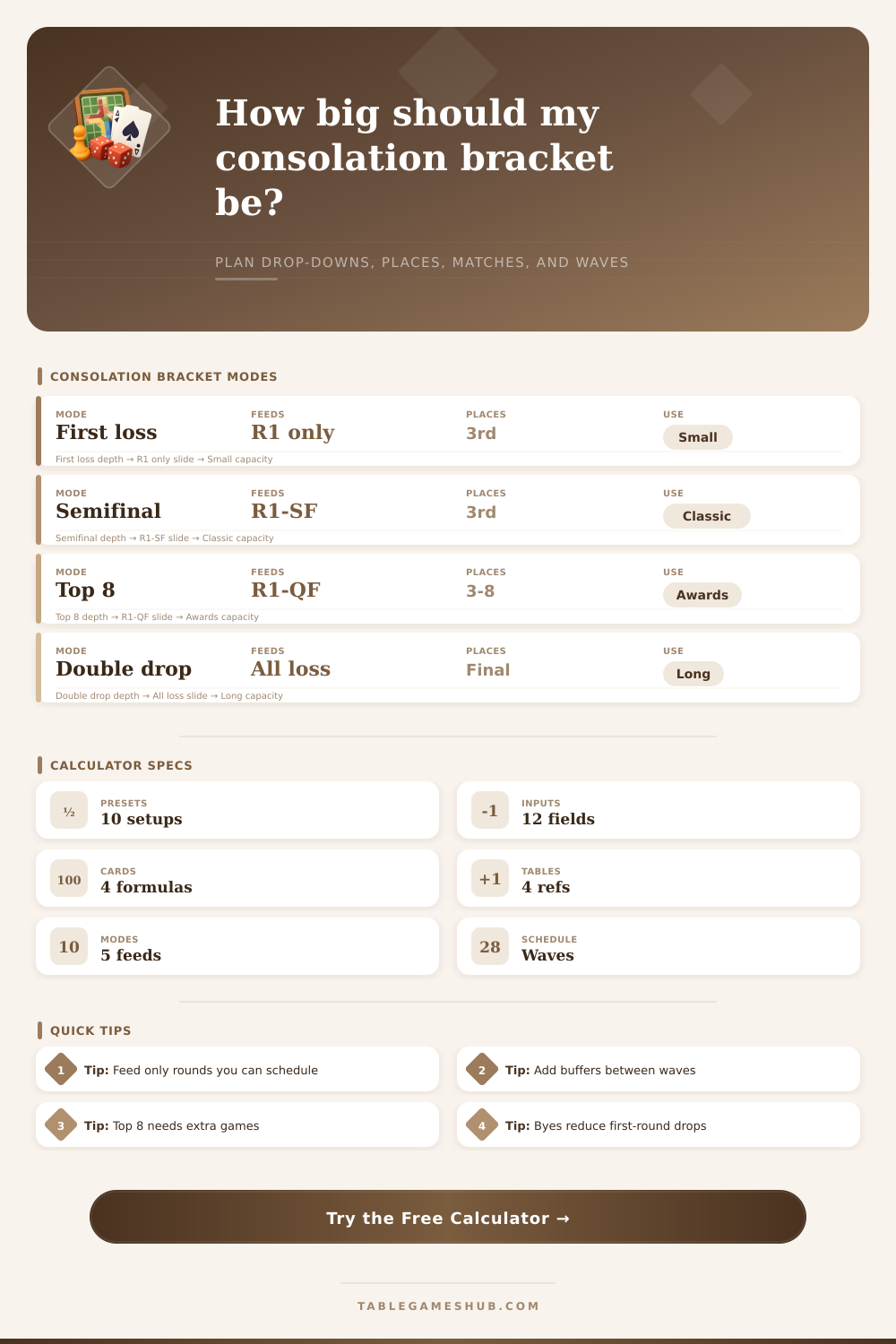
| First-round consolation | Only opening-round losers | Small events needing a second game | Byes reduce entrants sharply |
| Playback to 3rd | Losers through semifinal | Classic third-place planning | Late drops need clean pairing slots |
| Top-8 classification | Early losers plus placement paths | Award-depth tournaments | Extra placement games add waves |
| Double-drop style | Most championship losers | Longer competitive events | Schedule can exceed one day |
This is a different kind of panic. It hits when you realize that you’ve got a broken bracket before the tournament even begins. You’re running a board game competition with 16 players, but you only has four tables available. Running it in a normal single-elimination fashion means half your field departs by the end of the first hour. And there they sit, the ones who paid to play and can do nothing but watch as everyone else wins.
So instead of being an optional add-on, this becomes a structural requirement; it is more of a consolation bracket system than just a single bracket. It’s a great way to manage crowd flow and keep players engaged. When you plug in your station limits and number of participant, the calculator do all the math for you (see above). That eliminates the guesswork around conversions and coefficients.
How to Fix a Full Tournament With Few Tables
However, you need to look past the raw totals to understand what these numbers mean. You’re trying to find that sweet spot between fairness and density. Too much volume fed through the consolation pathway too rapidy creates a bottleneck. There aren’t enough open station to clear the wave, so matches start piling up. The feed is too restrictive, and the bracket appears empty. In this case, participants recieve fewer games than expected.
The other big choice is which feed mode you’ll use. Classic tournament modes feeds from the semifinals onward. That gives you more of the meaty competition on the top half, then passes it down. It keeps some heat in the championship race. It also give those late losers a reason to still be fighting. Unfortunately, that also means that they enter into a consolation bracket with a lot of depth. So the pairing logic becomes much more rigid.
First-loss consolation is a specific mode that only takes players who lost their very first match. They drop off any player who loses his or her initial game. Great if you’re running a couple of small groups together at home, but not what most tournament would want. It is simple and quick.
The quiet assassin when it comes to tournaments is timing. Maybe you think you’ve got enough match capacity. Then what happens if every match can’t begin until the previous round concludes? It’s a domino effect. On the page, it’s laid out well in the reference table with waves labeled main and consolation. Why does it matter? Well, you can’t feed someone who didn’t lose into a consolation game. If your championship quarterfinals run too long, then your consolation bracket grind to a halt. Having enough time between waves is critical to keep things flowing.
This also distorts the math, though perhaps more subtly, through byes. If there’s a sixteen-slot bracket and a dozen players, there are four byes in the first round of that event. So you’re looking at fewer initial drop-downs than you’d expect with a full 16-player list. That’s accounted for automatically with the tool, but it’s nice to know what happened to those missing matches so you understand why the number of entries dropping down seems lower. They weren’t lost, they just didn’t play, the top seeds got a free pass.
The other wrinkle is how deep they get placed. Finishing in third or fourth place require significantly fewer total matches than finishing in sixth or eighth. Running all placement games allows everyone to know exactly where they stand. That feeds competitive desires. However, every placement game adds a change to the schedule. If you’re shooting for complete classification, that might be enough to put you into overtime if you’ve only got an eight-hour day. In many cases, it’s best to cap it at third or fourth unless the prizes specifically require deeper differentiation.
The final shape of an event is often limited by physical reality. How many courts/tables do you have? That determines how much parallel processing you can get away with. No matter how luxurios your bracket logic, it won’t make more than two stations magically appear. So you’ll run waves sequentially instead; that’s gonna stretch out the timeline bigtime. A key sanity check is to compare the estimated schedule time from the calculator to the time window at your venue. Did the calculator say this would fit into a six-hour timeframe? But you’ve got just five? Then bump up the expectation for match speeds, or trim down on placement depth.
A consolation bracket is far less of a perfect science and much more a way to manage expectations. What you’re looking for here is to ensure each player receives enough games to feel like he/she has gotten his/her money’s worth. You don’t want anybody exhausted. To that end, establish a pace that seems natural, not frantic, by adjusting your buffer times against your station count and feed rates. If in doubt, start with the presets. From there, tweak your inputs until the schedule begins to seem manageable. The numbers will show whether or not you’ve constructed an event that lasts as long as you intend it to.