🃏 Quiddler Score Calculator
Total a Quiddler hand from word points, unused cards, longest-word and most-words bonuses, challenge adjustments, running score, and round outlook.
1Named Score Presets
Pick a realistic hand state, then adjust the word, unused-card, bonus, and challenge fields for the score sheet in front of you.
2Round, Player, and Bonus Setup
3Words, Unused Cards, and Challenges
4Four Formula Cards
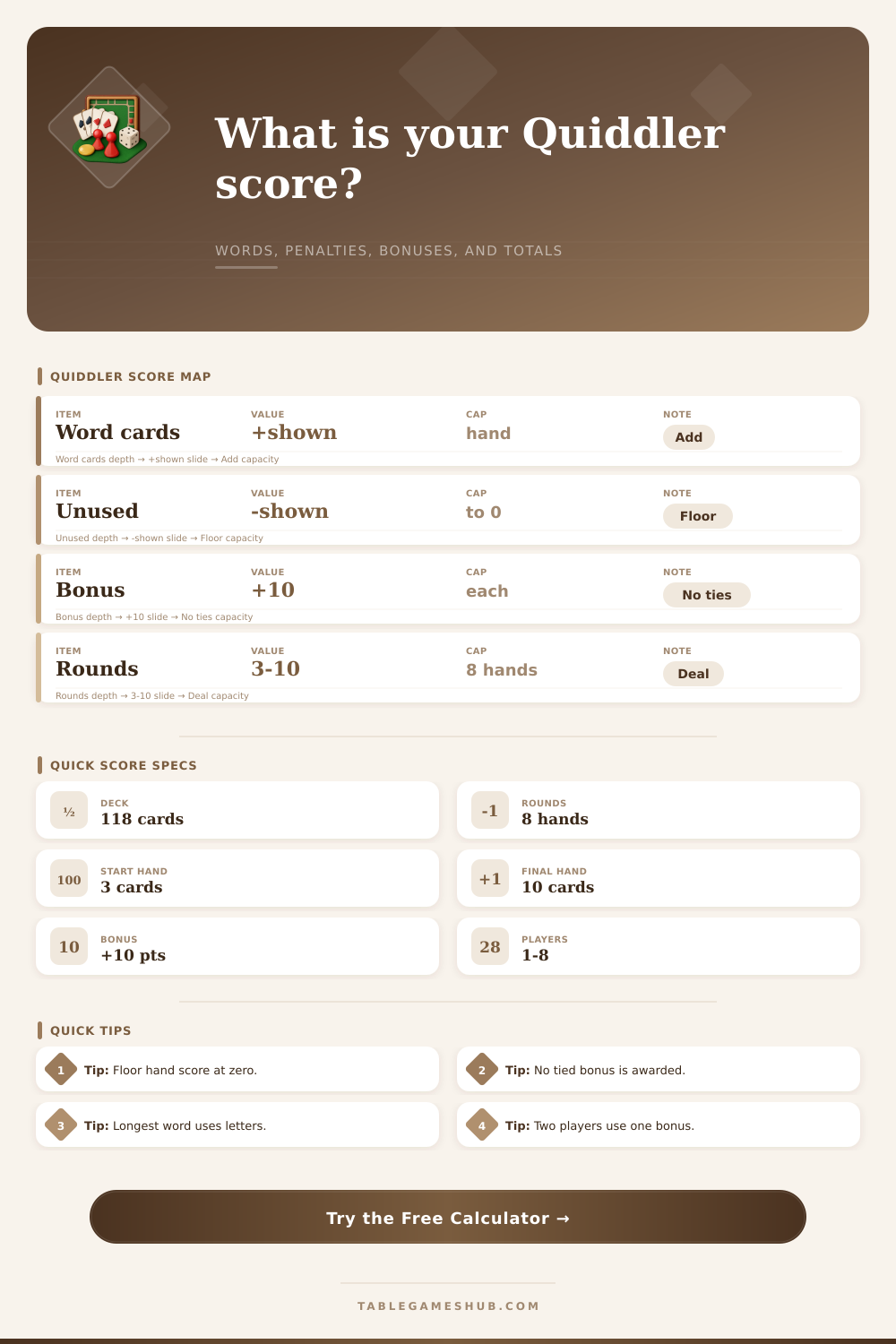
Start with word-card points, then subtract unused-card points from the same round.
Normal hand score cannot drop below zero before the scorekeeper adds eligible bonuses.
Award ten for longest word or most words only when that bonus is not tied.
New score equals the prior score plus this calculated hand, including challenge changes.
5Component and Spec Grid
6Scoring Reference Tables
| Scoring input | Official basis | Calculator field | Score effect |
|---|---|---|---|
| Allowable words | Words made from hand cards score their shown card values. | Points in allowable words | Added before the floor rule. |
| Unused cards | Cards not used in words subtract their shown card values. | Points in unused cards | Subtracted before normal zero floor. |
| Longest word | Ten-point bonus goes to the word with the most letters, not most cards. | Longest word status | Adds 10 when won and eligible. |
| Most words | Ten-point bonus goes to the player with the most words. | Most words status | Adds 10 when won and eligible. |
| Tied bonus | If players tie for a bonus, that bonus is not awarded. | Tied, no bonus option | Adds 0 for that category. |
| Challenge loss | The losing side subtracts the challenged word value. | Challenge adjustment points | Can create a negative hand result. |
| Round | Cards dealt | Common scoring pressure | Calculator reminder |
|---|---|---|---|
| 1 | 3 cards | Small words and low unused risk. | Expect tight scores unless a high card is stranded. |
| 2 | 4 cards | First real chance to split into more than one word. | Track word count if the most-words bonus is live. |
| 3 | 5 cards | Longest-word bonus starts to swing sheets. | Enter letters, not cards, for longest word. |
| 4 | 6 cards | Unused-card penalties can offset a good word. | Use the zero-floor mode for official scoring. |
| 5 | 7 cards | Multiple short words often compete with one long word. | Compare word count and longest-letter result separately. |
| 6 | 8 cards | Bonus ties become more common at full tables. | Choose tied status to cancel that bonus. |
| 7 | 9 cards | High-card leftovers matter late. | Projection uses remaining rounds and future average. |
| 8 | 10 cards | Final score swing and challenge audit. | Print or copy the full breakdown before declaring winner. |
| Example hand | Words minus unused | Bonuses | Hand score |
|---|---|---|---|
| Clean five-card go-out | 31 - 0 = 31 | +10 longest | 41 |
| Most words winner | 24 - 3 = 21 | +10 most | 31 |
| Both bonuses | 43 - 0 = 43 | +20 total | 63 |
| Tied bonus table | 28 - 5 = 23 | +0 tied | 23 |
| Unused-card floor | 12 - 25 = -13 | +0 | 0 |
| Lost challenge | 35 - 0 = 35 | -18 challenge | 17 |
| Reference | Used for | Quality note | Link |
|---|---|---|---|
| PlayMonster official Quiddler rules PDF | Round count, scoring, bonuses, challenges | Publisher rule sheet | Rules PDF |
| PlayMonster official Quiddler product page | Components, players, product overview | Publisher product data | Product page |
| BoardGameGeek Quiddler listing | General game identity cross-check | Board game database | BGG listing |
7Scorekeeper Tips
Separate base score from bonuses: First total word cards and unused cards, apply the normal zero floor, then add only the bonuses that were won without ties.
Audit longest word by letters: A double-letter card can make a word longer in letters than it looks by card count, so count the letters before awarding that bonus.
In the last round of Quiddler, that particular panic can kick in where someone plays a 10-card hand and suddenly it’s not clear how much of a lead you have over them. Maybe you’ve got twenty points on the board and they play six word and they still have one low value card left. It’s hard to do the math fast. So you need a handy way to score so you keep things going and it doesn’t turn into some kind of complex accounting process.
Scoring is at the heart of Quiddler. It seems like you just add up your word points and subtract the points from unused cards in your hand, but that is where the trap lie. Many people who play casually will forget that the raw score could be less than zero before applying floor rule. That’s the sort of thing the calculator takes care of without fuss. It makes sure a bad hand doesn’t result in -30 points on paper. Instead, it only knocks you back to zero for that round, with no round score, unless you also suffer a penalty from a challenge. That way you don’t have to bicker about how a negative point carryover should of count toward your running total; it makes the math honest.
How to Score Correctly in Quiddler
A second source of contention around the table is bonuses. Two bonus categories (most words and longest word) carries 10 points apiece, but you don’t win them just for playing most words or the longest word. Rather, they reflect achievements relative to your fellow player: you win them only when you absolutely and strictly outperform all other players at the table in those areas. So just because you wrote down five-letter words doesn’t mean you win the bonus, someone else also might have written five-letter words. The app makes it clear what happened here by checking a box to show if a bonus was won, tied, or lost. Too often, people mistakenly give themselves points based off what they did personally instead of how they did different than others.
Thinking about the game in phases will help. For the first few rounds, there isn’t much pressure. Most of what you’re doing is just getting used to making word out of whatever combination of three or four cards you’ve been dealt. But once it moves into those larger hands (seven, eight, nine, then finally ten), the pressure start moving more strategically. Because now, every card that isn’t used becomes a liability. If you have an N or an R leftover after round eight, it’s gonna cost you half a round’s worth of planned wordplays. That’s where being efficient comes into play, because you’ll want to make sure to get max value for each card you use and minimize the damage from cards left behind.
It has a handy projection feature. This shows you roughly how far from the top position you are and whether you should plays it safe or take a chance by using all your remaining tiles on a long shot word. The wildcard in every game, and something that can turn the tide at any moment, is the challenge. When someone challenges an invalid word, the point value of that word gets deducted from person who had used it, and boom, a winning hand becomes a losing one overnight. Understanding how this impacts your scores in relation to the rest of the points system is essential if you want to keep track of things properly. Our calculator lets you enter the negative adjustments independently to help you identify how far behind you are and if they is enough to change result.
In the end, though, Quiddler is a game of quantity versus length. It is also about risk versus reward and individual effort versus group competition. When things get tight, it’s easy to lose track of the score and botch it as emotion starts to come into play. Having a reliable scoring tool for which bonuses are awarded and how penalties are applied removes the friction from the game and allows players to focus on making their own words rather than arguing over math. It’s not so much about winning or losing as it is about playing the game smoothly enough where everyone enjoy themselves right down to the final flip of the last card.