Bananagrams Score Calculator
Score Bananagrams house rounds with clean-grid checks, leftover penalties, Dump and Peel pressure, longest-word tiebreaks, timed solo pace, and best-of match progress.
1Named Round Presets
Load a complete scoring situation, then adjust the tiles, timing, validation, and match settings for your table.
2Round, Tile, and Scoring Inputs
3Formula Cards
Official Win Gate
0 leftovers + clean + Bunch < players
Classic play declares a clean Bananas hand only after the remaining Bunch cannot supply every player.
Managed Tiles
start + peels + dumps x 2
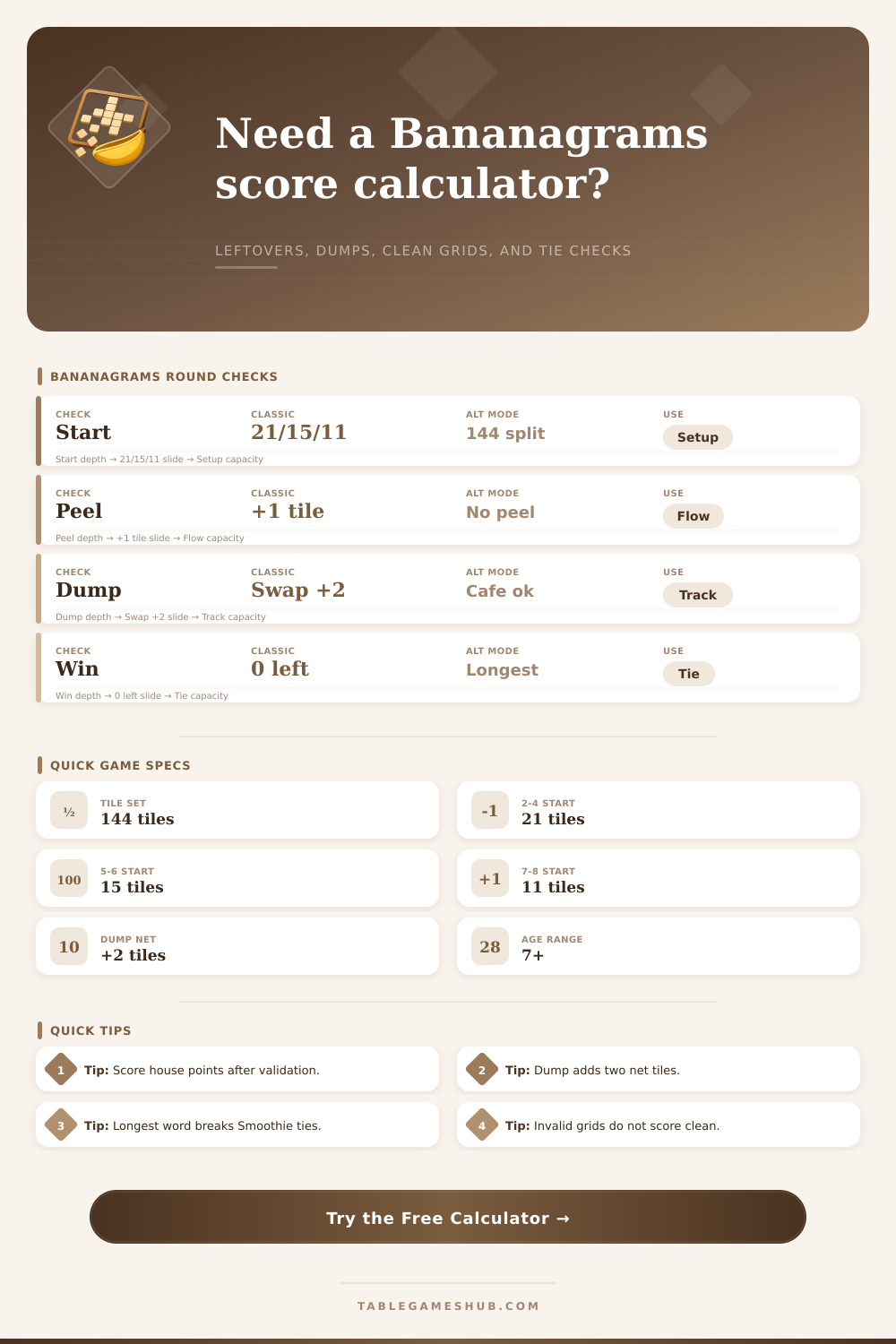
A Dump returns one tile but draws three, so the player manages two extra tiles after each Dump.
House Score
grid pts - leftovers - dumps + bonuses
The house layer turns a win-or-lose hand into repeatable league or classroom round points.
Efficiency and Pace
grid / managed, score / minutes
Use tile efficiency for grid cleanliness and pace for timed solo or tournament-style comparisons.
4Component and Spec Grid
5Reference Tables
| Players or Mode | Opening Tiles | Peel Rule | Scoring Note |
|---|---|---|---|
| 2 to 4 players | 21 each | Classic Peel active | Fastest normal race setup |
| 5 to 6 players | 15 each | Classic Peel active | Balanced for larger tables |
| 7 to 8 players | 11 each | Classic Peel active | Shorter hands, more crowd pressure |
| Banana Smoothie | 144 split evenly | No Peel or Dump | Longest word can break ties |
| Banana Cafe | 21 each | No Peel, Dump allowed | Compact quick-play variant |
| Solitaire | 21 total | Player choice | Beat time or fewest words |
| Letter Group | Counts | Score Impact | Grid Pressure |
|---|---|---|---|
| High supply vowels | A 13, E 18, I 12, O 11 | Usually easier to place | Supports longer crossings |
| Common consonants | N 8, R 9, S 6, T 9 | Strong grid builders | Often unlocks Peel speed |
| Medium letters | D 6, L 5, G 4, U 6 | Moderate flexibility | Useful for cleanup words |
| Three-copy letters | B C F H M P V W Y | Can slow weak grids | Watch leftover penalties |
| Two-copy letters | J K Q X Z | Hardest to absorb | Often triggers a Dump |
| Profile | Tile Points | Penalties | Best Use |
|---|---|---|---|
| Clean classroom hand | 1 per valid tile | -2 leftover, -1 Dump | Simple repeat scoring |
| Speed table | 1 per valid tile | -1 leftover, -2 Dump | Rewards low-hesitation play |
| Word quality table | 1 per tile plus longest word | -5 invalid word | Favors careful validation |
| Solo time trial | 2 per valid tile | -1 per minute over target | Compares personal runs |
| Family best-of | Round win plus house points | Light leftover penalty | Keeps short hands meaningful |
| Situation | Calculator Status | Primary Tiebreak | What to Enter |
|---|---|---|---|
| Clean classic Bananas | Top Banana | None needed | 0 leftovers, 0 invalid, low Bunch |
| Called too early | Still Racing | Continue play | Bunch not below player count |
| Rejected grid | Rotten | Resume without caller | Invalid words above zero |
| Smoothie stalemate | Tiebreak | Longest accepted word | Leftovers and longest word |
| Solo challenge | Time Result | Minutes and word count | Elapsed time and clean grid |
6Scoring Tips
Validate before scoring. In classic Bananagrams, the win check comes first: leftover tiles, challenged words, and the Bunch threshold decide whether the hand is clean.
Keep house points consistent. Use the same tile value, leftover penalty, Dump penalty, and clean bonus for every hand in a session so standings stay fair.
In that same situation, where you’re running out of tiles but have some awkward consonants left, house scoring model comes in. You’re so near the end, but everyone else has already gone Bananas. You’re stuck with the final few tiles and they weighs heavily on your round. It doesn’t have to be all-or-nothing; it could be a subtle way of measuring performances. Even if you didn’t win, you still got points for getting closer then anyone else.
Here’s what the math looks like in those scenarios. The calculator on this page will crunch numbers for you. Input the time, the size of the grid, and the penalty for any leftover tiles, and find out just how good your hand was compared to your competitors’
How to Score Your Game at Home
The format of official play is straightforward: clear your rack, call Bananas when the bundle expires, and if no one finishes, continue playing until somebody does. With such a winner take all format, it can be discouraging for people who is more casually inclined after a couple round. Many tables will instead create their own rules, giving each tile a point value and punishing players for making aggressive Dump calls or leaving leftover tiles on the table. It transforms into a strategy puzzle of both speed and efficiency.
You’ll make a quick two pointer but forfeit the chance to set up a huge crossing further down the board. Did it pay off in points? That’s what score sheet is for.
Peel and dump: We include reality of tile management in the tool. A Dump looks like free tiles on the surface, but it adds complexity to your grid and costs time. You pay a small penalty per dump because using it add complexity and costs time, and we don’t want people to abuse this just because it’s an easy way to get rid of some tiles quickly. A Dump gives everyone new tiles (speed), and rewards them for being quick on their feet. It speeds up the game, forcing people to make quicker decisions when placing words. These can be set at the player level and adjusted according too your group’s play style.
Rules vs House Rules: The scoring doesn’t force a rigid official standard upon you; it reflects YOUR house rules. When folks only tally the first place winners they lose the variable of time pressure. Elapsed minutes help create a sort of personal pace measure to better play over time. For example if you always finish in less than ten minutes but end up with three tiles left on the table you may be rushing your validation. Or perhaps you are making careless errors?
The efficiency score from managed tiles vs valid grid tiles reflect how well one can absorbs the random distribution of consonants and vowels. It’s not about how quickly you move but how smart you move based off what the pouch hands you. Those choices depend greatly on letter distribution. This is especially true if you get a few Qs or Zs drawn first thing in the round.
Those are some of the hardest-to-work-into-a-connected-grid letters, which makes them all the more high-stakes. They tend to yield weak words. These words scream “challenged!” If one isn’t accepted, you lose those tiles. It also throws off your train of thought. That means you may have sacrificed any hope at being clean, too.
The calculator comes packaged with reference tables that list letter distributions. These help explain how some hands seem unsolvable and others just click into shape easily. Having an idea what’s plentiful will let you get the most out of crosses instead of stashing vowels for potential future use.
While this tracking doesn’t slow down game play, it does give an added level of depth for each session. That means you can still push to fill out your grid as quickly as possible, but now each round feeds into an even bigger story about competition and self-improvement. Whether it’s competing against friends in a series of hands or challenging yourself to improve on your own personal best time, there’s always something to strive toward.
Data takes away all the second guessing after games. Those frustrating rounds when you thought you were close become real learning points toward how you should of proceed next time. It also offers structure for players looking for a more rigorous competition, but maintains the element of chaos that makes word games so fun to shuffle around.
Even if you don’t want to compete in tournaments, there’s no reason not to try to track your pace and efficiency. It’s all about having fun with making words on the fly, learning from your mistakes and playing better next time. Remember how valuable each last tile was to your performance the next time you’re tempted to grab one.