Muggins Dominoes Score Calculator
Total a Muggins or All Fives turn from exposed open ends, spinner ends, missed-score claims, end-hand pips, adjustment points, and the race to your match target.
1Named Muggins Presets
Load a common board state, then edit open ends, claimed points, hand pips, and match totals to fit your table.
2Game and Board Inputs
Exposed Open Ends
3Claims, Hand Count, and Table Setup
4Formula Cards
Open Ends Formula
score = open sum if sum is multiple of 5
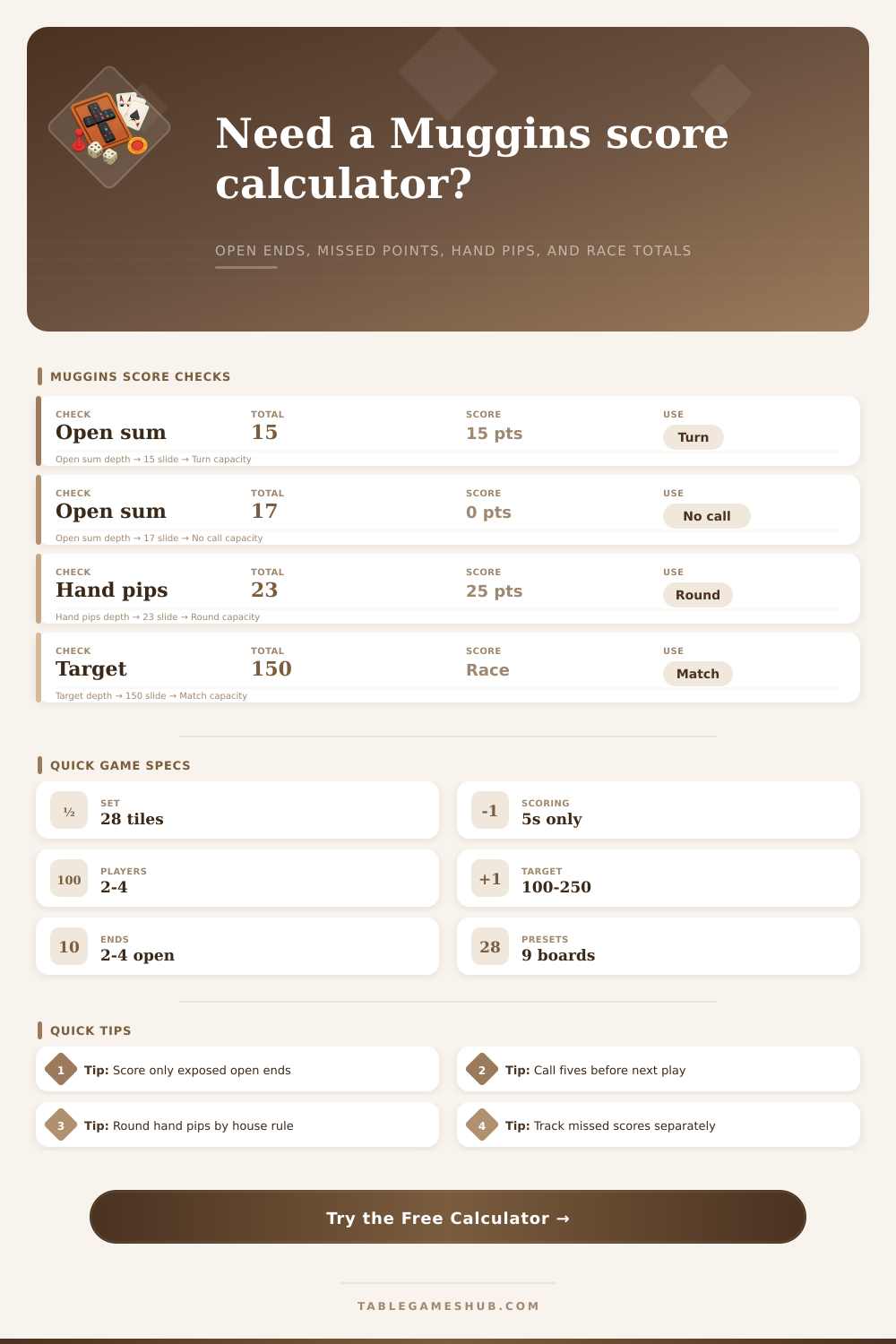
Add only the exposed ends that your table treats as live. If the total is 5, 10, 15, 20, or 25, it scores that many points.
Muggins Claim Formula
claim = missed score x claim factor
Strict Muggins tables allow the next player to claim missed points. Use full, half, or no claim depending on the house agreement.
Hand Count Formula
hand = round(opponent pips to house rule)
At a domino or blocked finish, enter the losing pips and choose nearest, down, up, or raw scoring.
Race Formula
new score = current + turn + claim + hand + adjustment
The calculator compares the new score with the target and the leader so the next scoring call is obvious.
5Component and Spec Grid
6Reference Tables
| Exposed Ends | Open Sum | Muggins Score | Calculator Use |
|---|---|---|---|
| 6 + 4 | 10 | 10 points | Basic two-ended board after a scoring play. |
| 6 + 4 + 5 | 15 | 15 points | One spinner side or branch adds a live end. |
| 6 + 5 + 5 + 4 | 20 | 20 points | Four live ends are counted together. |
| 6 + 5 + 4 + 2 | 17 | 0 points | No score because 17 is not a multiple of five. |
| Mode | Example Pips | Score Given | When to Use |
|---|---|---|---|
| Nearest 5 | 23 pips | 25 points | Common All Fives end-hand approach. |
| Round down | 23 pips | 20 points | Conservative house count. |
| Round up | 21 pips | 25 points | Generous house count or quick casual games. |
| Raw pips | 23 pips | 23 points | Use only if the table scores exact pips. |
| Set | Tile Count | Total Pips | Typical Muggins Fit |
|---|---|---|---|
| Double-six | 28 tiles | 168 pips | Classic 2 to 4 player Muggins or All Fives. |
| Double-nine | 55 tiles | 495 pips | Longer draw games or larger casual tables. |
| Double-twelve | 91 tiles | 1092 pips | Large-set variant play, not the usual Muggins baseline. |
| Score sheet | 1 column per side | 5-point marks | Track calls, claims, and end-hand counts separately. |
| Players | Suggested Surface | Common Target | Scorekeeping Note |
|---|---|---|---|
| 2 players | 30 x 30 in | 100 or 150 | Track individual scores and boneyard draws. |
| 3 players | 36 x 36 in | 150 | Keep missed-score claims clear because turn order rotates fast. |
| 4 players | 48 x 36 in | 150 or 200 | Partners share a score column in many tables. |
| 4 players plus tray | 60 x 36 in | 200 or 250 | Extra space helps visible open-end checking. |
7Table Tips
Scoring call: Count only exposed live ends after the tile is placed. A spinner can add ends, but closed branches should not stay in the total.
Claims: Keep missed Muggins points separate from normal open-end points so disputed calls can be checked without changing the board total.
Mental arithmetic during play can lead to domino heartburn, where you believe you have scored fifteen points but your opponent claims that’s only ten. Tiles is scattered about board. Players do their own mental maths as the next person waits. The whole thing look chaotic. Tension arises here: in All Fives or Muggins, you need to keep track of more than one set of exposed ends. Tracking all these manually are prone to error. Then there’s a spinner, which adds extra limbs to the growing layout.
Enter the digital scorekeeper. Plug in your missed claims and your open ends, and let calculator do the math. No more table disputes for you. It’s a straightforward yet tricky-to-remember-in-pressure-situations mechanic: lay down your tile and add its pips to the ones already visible on any exposed open end. If it adds up to a multiple of five, you get those pips. Otherwise, nada. This binary result makes a psychological trap in which players chases big points and forget about safety.
Use a Calculator to Keep Score Easily
Inputting your open-end pip values into the tool lets you know whether or not total counts as points. It also reveals whether the total remain hanging out as potential danger to your opponent. Removing hesitancy from game frees you to concentrate on strategy instead of math.
That’s where the Muggins comes in, it introduces an element of social accounting to the math. During a round in which other people have turned their tiles, you might take points that were overlooked by your opponents. You might even get half-points, if your group has adopted such a rule. These “Muggins” points are accounted for in the calculator, with options to modify their value. They must also be tracked independently, since a well-observed 10 points might outweigh a sloppy 15 point miss. Nobody wants to lose out on deserved payback, but the primary score should of remain uncluttered. It’s as much about who notices what as placing things correctly.
As you get closer to your goal. Say, one-hundred-and-fifty points, the pressure shifts from raw scoring to race management. How far have I come? How close am I now that I’ve made this move? What’s my lead over the closest competitor? To figure it out, you’d need to do some math (and maybe an argument?). This little gadget does all that for you. It instantly takes into account what you just earned and your position now to figure out how many points remain between you and first.
It’s great if you’re down to a few endgame scenarios and want to know how many pips are still available in other peoples hands. This can change depending on your rules of play. Are they rounded up? Rounded down? Do you take them as-is? If there’s any disagreement on how to count those last few pips, having a space to enter those numbers should solve things.
One misstep people often take is confusing their actualy live endpoints. If there’s a block on one end of a double-ended spinner, then that endpoint no longer counts when determining score, yet that’s not reflected in the tally. If a player doesn’t account for that, they’ll pad their scores, only to see them melt away later when they’re held accountable. The calculator’s presets handles typical board configurations such as an empty start position or a dense spiderweb surrounding a spinner. That way, instead of having to restart from scratch whenever a player alters the board, they can use the preset as a baseline and modify from there. It reflects how a real game plays out, too; the board isn’t totally rewritten at the beginning of each round. It evolve incrementally.
You want to play with confidence, not counting dots on stray tiles. Having clear visibility into your totals will help you decide if it’s time to play defensively, or risk making a high score play. It keeps things fair by being an impartial referee of the rules you establish at the beginning of the game. Everyone should leave table knowing the result was fair.
After you’ve placed the last tile, laid out the hands and tallied up the scores, all you’ll be left with is math. You will no longer wonder who won.