Bonfire Score Calculator
Total Bonfire end scoring across printed bonfires, stationed guardians, adjacent portals, matching path crystals, common tasks, unused fate tiles, leftover action tiles, resources, novice progress, and tie-break notes.
🔥Score Presets
📝Table State and Current Points
Enter VP already scored during play separately from final scoring. Elder VP, countdown pass VP, gnome rewards, and Great Bonfire 2 VP rewards can be kept here so the final audit stays readable.
🔥Ignited Bonfires and Printed Values
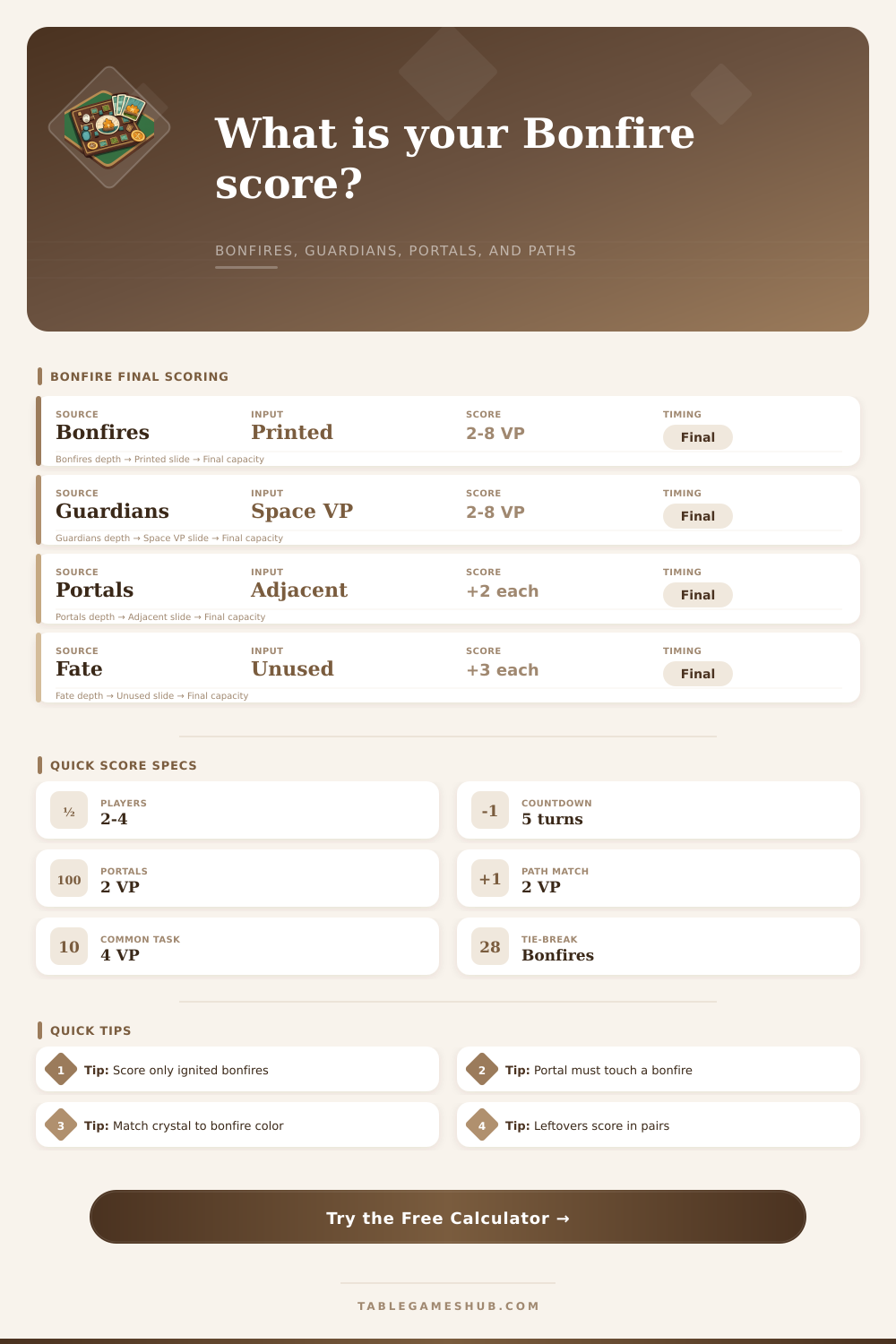
Only count fulfilled tasks flipped to their Bonfire side. Each ignited bonfire scores its printed value from 2 to 8 VP during final scoring.
Printed Bonfire VP Slots
🚪Guardians, Portals, Paths, and Procession
A guardian scores only when the procession places it next to a Bonfire. Portals and matching path crystals score only when adjacent to an ignited Bonfire.
🧙Novices, Common Tasks, Fate Tiles, and Leftovers
🧮Live Bonfire Audit Grid
Only flipped fulfilled tasks score printed bonfire VP.
Sum of printed values plus any manual slot adjustment.
Guardians score the value beside their Bonfire spaces.
Each portal adjacent to a Bonfire scores 2 VP.
Each matching crystal path next to its Bonfire scores 2 VP.
Regular common tasks are 4 VP, with a separate 7 VP special.
Unused fate tiles left in supply score 3 VP each.
Action tiles and resources score 1 VP per complete pair.
📚Reference Tables
| Final source | Input | Formula | Note |
|---|---|---|---|
| Bonfires | Printed values | 2 to 8 VP each | Only ignited |
| Guardians | Space values | 2 to 8 VP each | Next to Bonfire |
| Portals | Adjacent count | Count x 2 VP | Touching Bonfire |
| Path crystals | Matching count | Count x 2 VP | Color match |
| End trigger | 2 players | 3 players | 4 players |
|---|---|---|---|
| High Council novices | 7 | 10 | 13 |
| Countdown length | 5 tiles | 5 tiles | 5 tiles |
| Pass option | Tile VP | Tile VP | Tile VP |
| Tie-break | Bonfires | Bonfires | Bonfires |
| Common task type | Calculator field | Score | Audit |
|---|---|---|---|
| Regular common task | Common tasks | 4 VP each | Neutral novice |
| Seven tasks/bonfires | Special toggle | 7 VP | Seven bonfires |
| Unfulfilled task | Task tiles held | 0 VP | Planning only |
| Novice placement | Own novices | Reward only | Not final VP |
| Audit item | Useful range | Scoring impact | Watch for |
|---|---|---|---|
| Fate tiles left | 0 to 7 | 3 VP each | Supply only |
| Leftover pieces | Any count | Pairs score 1 | Ignore odd one |
| Path tiles built | 0 to 6 | Only matches score | Crystal color |
| Guardians on path | 0 to 7 | No final guardian VP | Need portal step |
💡Scoring Tips
That’s why I get such a particular kind of panic when the High Council is full, and someone yells “Game’s over.” Racing heart, you look around the table: this is going to come down to numbers, not nice plastic bits. And that last phase of the game, the final scoring, will decide a winner … sometimes just one point buried somewhere in your plan until it comes out at the very end.
While most people think of engine as the main part of the game, leftover and adjacency aspect matter a lot toward the endgame’s score. Seven lit bonfires may seem like an unbeatable advantage, yet you could very well be losing because you neglected to position guardian near them or missed out on portal bonus.
How to Score Points at the End of the Game
Plug in your current board state and the calculator do the rest; no more arithmetic mistakes while your opponent counts wood. It sums up the printed scores of all the ignited tasks plus the points gained by having guardians nearby, plus any portals and/or paths near those bonfires.
Knowing when something is or isn’t a score source can be a bit tricky though. It has to end up next to one of your lit bonfires or it’s worth nothing. This applies to things like guardians who sits on a path tile in the middle of nowhere and do nothing for you at the end. Portals don’t count either unless they’re touching a fire, so placement during the procession phase becomes more about placing the pieces in spots where they’ll produce points further down the line.
You have to think two steps ahead. Moving a guardian now only to find you can’t push it next to a bonfire before the game ends wastes your potential.
Other small things like this collect points in the background. Each common task is worth four points, and they feel pretty low-key… Until you remember that doing just three of those tasks will net you more points than someone who only did low-value bonfires. Each fate tile sitting in your supply bag is worth three points, too. Even if you can’t do anything with them, like get an effect from them, it’s worth keeping some around. It may not seem like much, but at the game’s end, when the difference is narrow, every point counts. So next time you look at your remaining fate tiles, be sure to count the number of unused ones: leaving any points on the board costs you something.
Players can also lose points by being careless with leftover action tile and resources. Action cards and wooden tokens scores in pairs; one lone action card or one extra wood token is useless. You want an even spread of leftover resources and action tiles, so that it all neatly stacks up into matching pairs of two, since otherwise you’ll wind up with two actions and three wood and just get one point from the pair of actions. The odd one goes away, which incentivizes planning and making sure you don’t overstock yourself on one type of resource but instead go after even amounts.
And, as with all games of this type, it’s worth noting that while lights are clearly important in terms of their points on the tile, they’re ultimately only as good as the number of bonfires that have been lit: if your total points come out to exactly the same as someone else’s, whoever has more lights wins. As such, building up your network and spreading those lights around can actualy feel safer than trying to get maximum value out of any one space.
All this adds up to one thing: The game favors people who view the board not as a series of individual goals but a cohesive system, where one action affects another and everything must be considered together. By breaking down all those categories, from leftover pairs to guardian placements to portals and paths… The calculator allows you to see that total, making what would otherwise be a chaotic endgame into a controlled audit.
It’s like that specific kind of panic that sets in when the High Council fills up and someone shouts that the game is over. Once you begin viewing each move with an eye towards its interaction with the eventual scoring conditions, the pressure eases. Instead of grabbing for points willy-nilly, you’re constructing a board that will create them organically once the lights come up.
The fire goes out. The council seats are filled. Your score comes into focus.