San Juan Score Calculator
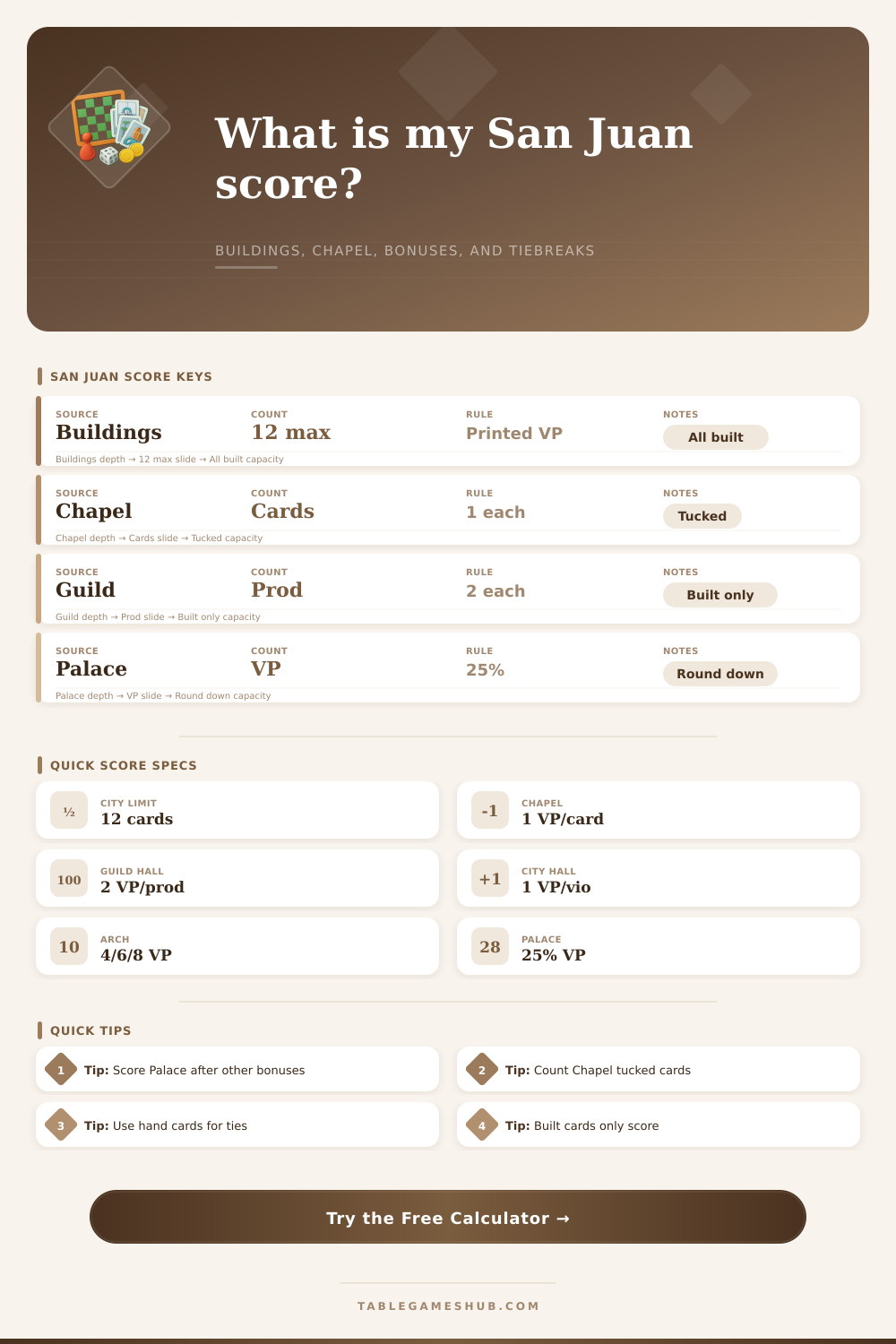
Score printed buildings, Chapel tucked cards, six-cost building bonuses, Palace timing, and hand-card tiebreaks for a finished San Juan tableau.
| Score Source | Formula | Input Used | Timing |
|---|---|---|---|
| Printed production VP | Sum printed VP | Production VP field | Before bonuses |
| Printed violet VP | Sum printed VP | Violet VP field | Before bonuses |
| Chapel | Tucked cards x 1 | Chapel tucked cards | Before Palace |
| Hand cards | Compare only if tied | Your hand vs rival hand | Tiebreak step |
| Six-Cost Building | Endgame Bonus | Calculator Input | Example |
|---|---|---|---|
| Guild Hall | +2 VP per production building | Production building count | 6 production = 12 VP |
| City Hall | +1 VP per violet building | Violet building count | 7 violet = 7 VP |
| Triumphal Arch | +4, +6, or +8 VP | Monuments built | 3 monuments = 8 VP |
| Palace | +25% of subtotal, rounded down | All non-Palace VP first | 47 subtotal = 11 VP |
| Tableau Type | Typical Build Mix | Likely Bonus Focus | Audit Check |
|---|---|---|---|
| Production heavy | 6-8 production, 4-6 violet | Guild Hall | Do not miss low-VP producers |
| Violet engine | 3-5 production, 7-9 violet | City Hall, Palace | Count Chapel as violet if built |
| Monument finish | Mixed city plus monuments | Triumphal Arch | Monuments must be built |
| Chapel storage | Any mix with tucked cards | Chapel, Palace | Tucked cards score once |
| Validation Point | Expected Range | Why It Matters | Calculator Note |
|---|---|---|---|
| Buildings built | 0 to 12 | Ends at 12 buildings | Warns if category sum differs |
| Chapel tucked cards | 0 or more | Cards under Chapel add VP | Not counted as buildings |
| Palace subtotal | Before Palace only | Avoids self-multiplying Palace | Rounds down cleanly |
| Tiebreak hand | Compare after VP tie | More cards in hand can decide ties | Shown only as tie guidance |
To score a finished city in the game San Juan, a player must account for many differents scoring systems for the city. Each player must make sure that they includes every scoring system within the total that they calculate for there city. Beyond the points that are printed on each of the building in a players city, there are additional scoring systems for Chapel cards, six-cost building, and the Palace.
Additionally, any hand cards will contribute to a players total score only if a player has achieved an even total for their finished city; thus, any player who has achieved an even total should include any hand cards in their calculation of their total score. A calculator provided for the game can account for each of these scoring systems; the calculator will calculate a players total score if the player inputs their production count, their violet buildings, their tucked cards, and their monuments or bonuses. In Scoring Systems for San Juan, the scoring for production buildings and violet buildings must be accounted for; however, production buildings and violet buildings functions in slightly different ways within the game.
How to Score Your City in San Juan
Production buildings contribute to a players total score according to the printed values of the buildings; however, players also receives additional points from each production building if a player owns a Guild Hall. In this case, each production building is worth two additional point. Violet buildings do not contribute to a players total goods output; however, each violet building is worth one point if a player owns a City Hall.
Thus, a player can focus upon either production buildings (to gain the bonus from a Guild Hall) or violet buildings (to gain the bonus from a City Hall and the Palace). The Chapel provides points for a city if a player decides to tuck one or more cards underneath the Chapel. Each card that is tucked underneath the Chapel is worth one point for the players city.
Thus, the Chapel provides points to a player who use many cheap building cards within their city. However, tucked cards are not represented within a players city by buildings on the game table; thus, it is essential for a player to remember to account for tucked cards in their total score calculation. A player acquires the Palace bonus to a players score by taking twenty-five percent of the total of all of a players other scores (before the Palace bonus is calculated) and rounding that value down to the nearest whole number of points.
Thus, a player must calculate the scores of the Guild Hall, the City Hall, the Triumphal Arch, and the Chapel before calculating the bonus that the Palace provide to a players city. If a player calculates the Palace bonus prior to calculating the other bonuses for their city, the total score that is calculated will be incorrect. The calculator displays the total score of a players city before the Palace bonus is applied; thus, a player can determine the value of the Palace bonus by reviewing this number prior to the Palace bonus in the calculator.
The Triumphal Arch bonus also relies upon the number of monuments that a player has built within their city. The more monuments that a player has built, the more points that the player will score from the Triumphal Arch. The Triumphal Arch provides a maximum of eight points to a persons city if they have built three monuments with their city.
Because most monuments have low values of points for their goods output, the Triumphal Arch is the primary way in which a player may score points from the monuments that they build in their city. Thus, any player that use the Triumphal Arch must ensure that the player has enough monument cards and enough other building cards to fill all of the building slots (there are twelve building slots in total for each player in the game). In the case that two or more players have the same number of victory points from their cities, tiebreakers are used to determine the winner of that game.
The tiebreaker in this instance is the number of cards that each player have left in their hand. Thus, a player who has more cards in their hand is the winner of the game; this indicates that players must manage their hand and cycle their cards efficienty to gain more points in their total score. The calculator for the game displays each players total score and the size of each players remaining hand; thus, a player can use this information to determine if there is a chance that the game will end in a tie.
Many players may make mistakes calculating their score; however, a player may make mistakes if they calculate the bonus provided by the Palace before calculating their other scores, or if they do not account for any cards that are tucked underneath the Chapel. Additionally, a player may calculate the score of a city that includes monuments that the player has not built. A player can review the reference tables provided for the game to ensure that they remember the order of each scoring system.
The most important part of calculating a players score is to ensure that they have accounted for each bonus that they own with their city, as well as to account for each tucked card and each monument. The calculator helps to ensure that a player does not make an arithmetic error when calculating their score, and thus allows a player to focus upon the composition of their city.