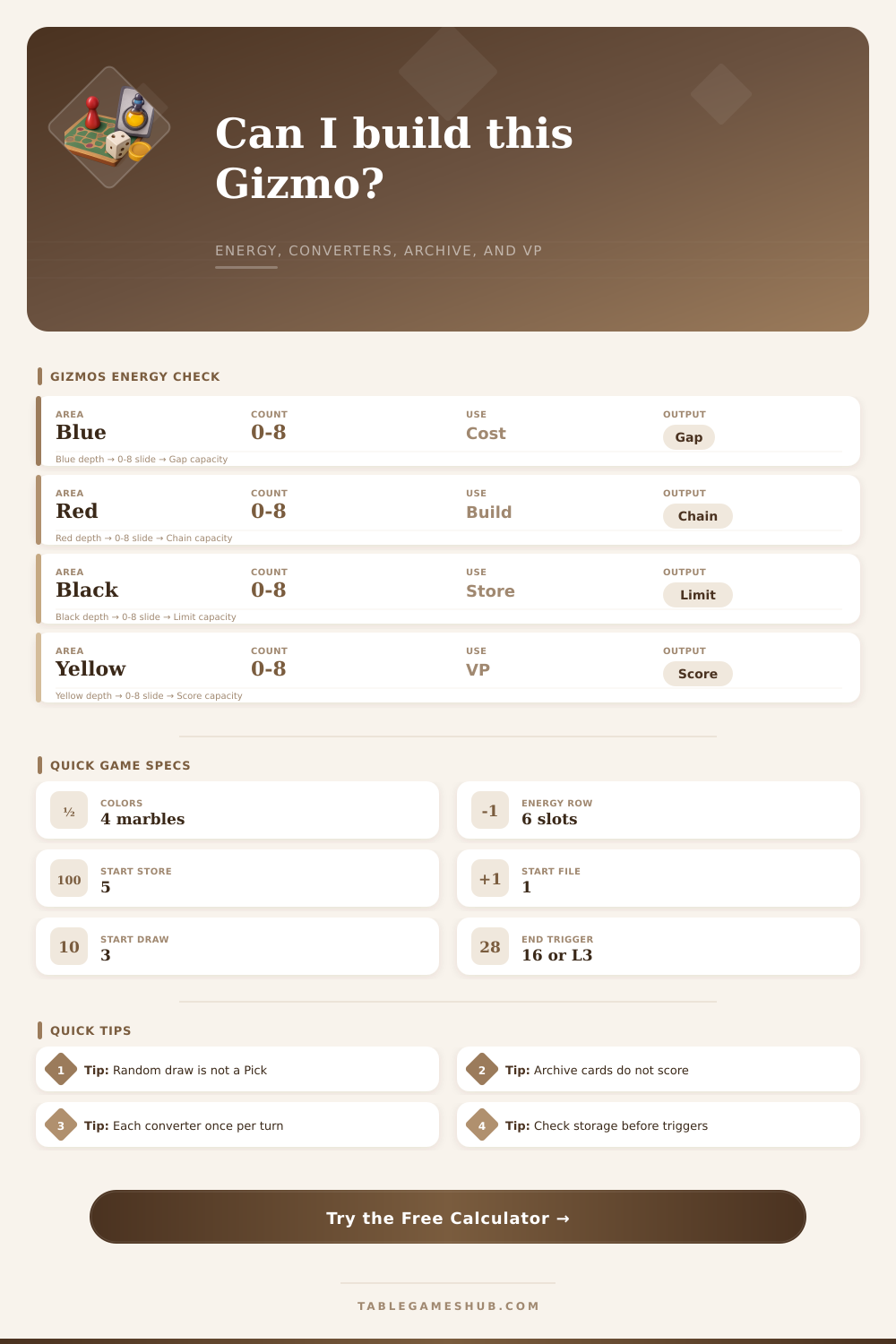
Gizmos Energy Calculator
Check whether your marble pool, storage limit, archive space, converters, and File, Pick, Build, or Research triggers can complete the next Gizmo.
| Energy Color | Common Use | Calculator Input | Build Check |
|---|---|---|---|
| Blue | Printed card costs and pick triggers | Blue Marbles in Ring | Counts directly for blue builds |
| Red | Printed card costs and pick triggers | Red Marbles in Ring | Counts directly for red builds |
| Black | Printed card costs and pick triggers | Black Marbles in Ring | Counts directly for black builds |
| Yellow | Printed card costs and pick triggers | Yellow Marbles in Ring | Counts directly for yellow builds |
| Action | Base Limit | Calculator Field | Important Rule |
|---|---|---|---|
| File | 1 card in archive | Archive Used and Limit | You cannot File when archive is full |
| Pick | Storage starts at 5 | Storage Limit and Row Hits | Choose one visible row marble |
| Build | Display or archive | Build Source and Cost | Spend matching energy after converters |
| Research | Draw 3 cards | Research Draw Amount | Choose one to File or Build |
| Converter Type | Modeled As | Once Per Turn? | Calculator Effect |
|---|---|---|---|
| Any to any | Wrong color becomes target | Yes | Adds flexible matching energy |
| Color counts as two | One target marble pays two | Yes | Adds one extra target per use |
| Build discount | Covered cost | By effect text | Reduces printed cost in the formula |
| Random draw | Dispenser marble | By trigger | Estimated as one third target value |
| Endgame Check | Threshold | Calculator Input | Scoring Note |
|---|---|---|---|
| Built Gizmo count | 16 built cards | Built Gizmo Count | Candidate card can trigger final round |
| Level III count | 4 Level III cards | Level III Gizmos Built | Only Level III cards count here |
| Printed VP | Built cards only | Printed VP Already Built | Filed but unbuilt cards do not score |
| VP tokens | Collected tokens | Victory Point Tokens | Add to printed and bonus VP |
To use an calculator for Gizmos, one must understands the role of energy, marbles, and card in the game. Energy are used to build cards, but its limited by the number of marble contained within the energy ring. Additionally, a player must also track the number of converter that a player controls.
A player must enter these three variables into the calculator, and the calculator will indicate whether or not a given card are reachable for that player. Converters is valuable to players because they allows for marbles to change colors and/or the total number of marble that a player controls. However, to use a converter, a player must use an action for that purpose.
How to Use the Gizmos Calculator
Actions cannot be used for other purposes if they is consumed using a converter. Thus, when using the calculator, the cost of using a converter to obtain the proper color of marble must be considered. In some instance, even if a player has a converter that will provide the proper color of marble, using that action for that purpose may make a players build less efficient than it would of otherwise been.
The actions taken by that player in the game determine the distribution of color of marbles within a player’s energy rings. For instance, if a player has many blue marbles but few yellow marble in there energy rings, they have a specific color distribution of marbles. The color of the next card that a player desire to build may not match the color that is contained within the energy rings.
In this case, the calculator will show how many marble a player has compared to how many is needed, if utilizing converters. A player must decide whether to use an action to even out the colors of marble within their energy rings or to rely upon the draw of a random marble from the dispenser. Although random draws from the dispenser are less reliable than Picks, they can still be accounted for in the calculation that the calculator performs.
Another constraint of the game is the space within the archive for card. There is only a limited number of card that a player can hold within the archive. Any card placed into the archive is safe from being picked, but it cannot score points until it is built.
Any card that is held within the archive is a card that is not scoring points for a player. The calculator can account for the number of slot still available within the archive for players to add their newly built cards. Additionally, the calculator can determine the source of those archived cards; whether they were obtained during research or from the display.
These two different source may have different effect when building those archived cards, which can change the projected trigger yield that the calculator determines for a player. The game ends when one of two condition is met. Either a player has built sixteen card, or they have built four Level III cards.
The calculator accounts for these two conditions so as to indicate if a single build may reach either of these threshold. Thus, a player must decide if reaching either of these thresholds is potentially beneficial for the player; reaching either threshold will end the game for all player. Some players desire to reach either threshold quickly, while others wants to continue the game to allow for more research to be performed.
In utilizing the calculator for Gizmos and in playing the game, there is rules that must be followed. For instance, a player can only use a converter once per turn; archived cards will never score for the player; and random draws are not the same as Picks. These rules can help a player determine whether or not a given build will succeed or fail as a result of having insufficient marble.
The calculator applies these rules automatically to help a player decide whether or not a given build is beneficial or inefficient with the energy that is available to that player. One of the most common mistake when using the calculator is treating all marbles as the same. The red marble that is stored does not provide the same value as if a converter could double it.
The calculator accounts for the value of using a converter, but players must remember to account for available converter. Additionally, players often forget to account for storage space within the energy rings. Any Pick will only produce energy if there is enough storage space to hold the energy within the energy rings.
Similarly, any random draw will also require storage space to be successful. The purpose of running the number through the calculator is to determine the difference between building a card that is affordable and one that is advantageous. A card that is affordable is one for which a player has enough marble to build it.
However, an advantageous card is one that will help the player win the game. Builds may close the energy gap, but do not leave enough storage space for the games trigger. Similarly, some builds cost more energy than the current build return, but are still beneficial due to the potential for meeting an end condition that is beneficial for the players.
The calculator does not determine which move is the best, but provides the information that is required for a player to make that determination.