Lisboa Score Calculator
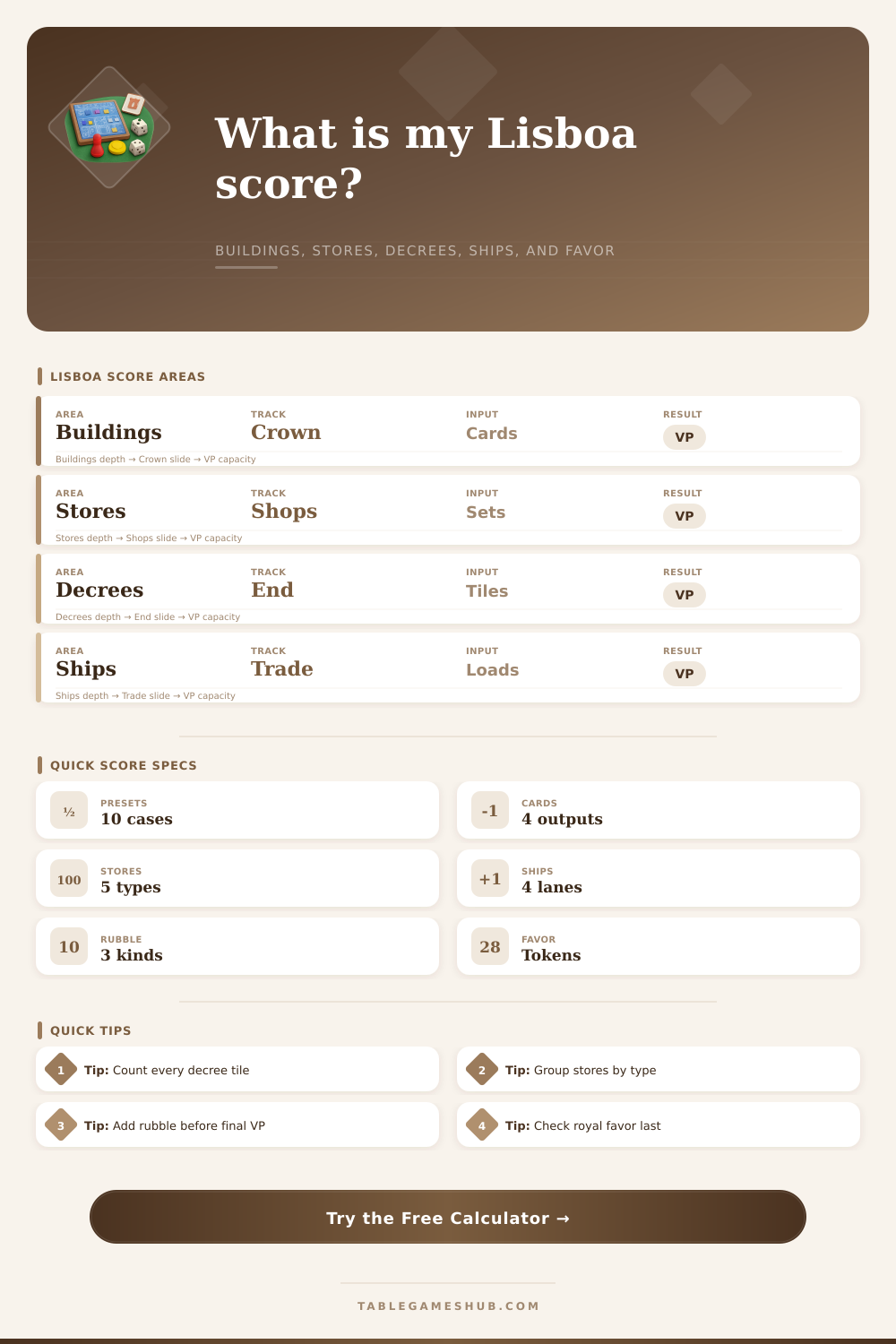
Score public buildings, stores, decrees, clergy, ships, rubble, treasury, influence, and royal favor for a full Lisboa endgame tally.
| Score Area | What To Count | Calculator Formula | Best Input Source |
|---|---|---|---|
| Public buildings | Completed building cards and crown value | Building crown value plus one VP per completed card | Your player board and built cards |
| Stores | Stores opened and full store families | Stores x 2 plus completed store sets x 5 | City grid and shop type markers |
| Decrees | All final decree tiles that qualify | Decree tiles x average decree VP | Personal decree row |
| Clergy | Cardinal or clergy scoring tiles | Clergy tiles x average clergy VP | Church and clergy scoring area |
| Ships | Ship uses, export lanes, or maritime entries | Ships x average ship VP | Ship display and export markers |
| Store Pattern | Typical Count | Set Treatment | Score Signal |
|---|---|---|---|
| Single street cluster | 4 to 6 stores | Usually 0 or 1 full type set | Stable middle scoring |
| Mixed Baixa spread | 6 to 9 stores | Two store families are common | Strong store base |
| Dedicated shop plan | 8 to 12 stores | Three or more sets possible | High city score |
| Low store rebuild | 2 to 4 stores | Few completed sets | Needs decrees or ships |
| Decree Type | Condition Style | Input Method | Common Range |
|---|---|---|---|
| Building decree | Checks public buildings | Count final VP, then average it | 3 to 8 VP |
| Store decree | Checks shops or goods | Count qualified stores | 2 to 10 VP |
| Clergy decree | Checks church presence | Use clergy average field | 2 to 7 VP |
| Royal decree | Checks favor and crowns | Use favor token value | 2 to 8 VP |
| Endgame Profile | Primary Driver | Secondary Driver | Calculator Watchpoint |
|---|---|---|---|
| Building focus | Public buildings and rubble | Stores beside rebuilds | Do not skip crown value |
| Store focus | Opened stores and type sets | Decrees tied to shops | Separate stores from sets |
| Decree focus | Qualified decree tiles | Clergy and royal favor | Average only scored decrees |
| Maritime focus | Ships and exported goods | Treasury and influence | Use ship average carefully |
To score a game of Lisboa, players must understanding how all of teh elements of the game interact with one another. Scoring a game of Lisboa isnt about focusing upon one number in particular. Instead, there are many component to the game that contribute to the score, and those components include score for public buildings, stores, decrees, clergy, ship, rubble, treasury, influence, and royal favor.
Each of these components contribute to the score in a different way, but a Lisboa score calculator can account for all of the components. When the game end, each of the individual components of the game should be understood as to what each of the inputs represent on the Lisboa score calculator. For instance, public buildings does not just refer to the public buildings that a player build during the game; they also have a crown value for each of the public buildings that the player constructed.
How to Score a Game of Lisboa
Stores is important both for the number of spaces that they take up on the board, but also for the number of store of each type that a player is able to construct in total. Decrees and clergy only provide a score for a player if the condition for those elements were met during the game. Finally, ships and exports score differently than some of the other components of the game, as well as the score for rubble and the remaining money during the game can have an impact upon the score that a player receives, even if many player forget to account for these components until the final score.
The Lisboa score calculator can help a player understanding how the different components of the game can interact with one another to create the final score. Additionally, the Lisboa score calculator allows a player to compare the different strategy within the game. For instance, a player who cleared more rubble during their game may score fewer points than a player with high-valued decrees.
A player who did not open as many stores may score more points if they constructed more set of stores of the same type than other players. A player can use the calculator to determine how many points they may score based off different strategies for the endgame of the game. Each of the components that can be accounted for on the Lisboa score calculator may not be equal to one another.
For instance, influence score differently from the treasury according to the type of table upon which players are playing, and royal favor token provide value only when they interact with decrees during the game. The Lisboa score calculator ensures that these different point of value are accounted for, and that the conversion between these points does not drift from a player as the game unfold and decisions is made. Additionally, the number of players can impact the scoring for the game, as well as some of the other aspect of scoring.
For instance, games that include fewer players will feature different type of decrees and clergy than games with four or more players. The Lisboa score calculator allows a player to select the number of players with whom they are to play, which will change the strategies that the other players use for setting up their game boards. These reference tables on the Lisboa score calculator allow for players to review which game component will score for each player, as well as the rules that relate to each of those components.
For instance, the reference tables will remind a player that decrees only provide value to a player if they were met at the appropriate time during the game, that a player must personally clear all of the rubble during the game, and that clergy bonuses may be applied to a player’s score more than once during their game. These reference tables are helpful in teaching new player about the game. A player who employs the Lisboa score calculator prior to determining the final score for the game will change the way in which they play the last round of the game.
A player who determine the score using the Lisboa score calculator may determine, for instance, that one decree is more valuable than one store, or that leaving money within the treasury is more valuable than giving it to a ship. These types of calculation are not immediately obvious to most player of the game, but the use of the calculator will allow for players to understand these different value of game components. Thus, the use of the score calculator during a game will allow a player to understand from which component of the game their points were derived during that game; the ability to understand the points of a player’s score will allow for that player to prepare for the next game of Lisboa.
Youll find that the calcualtion helps alot. Its a moddern way to play. A player should of used it sooner.