Teotihuacan Score Calculator
Total pyramid construction, Avenue of the Dead, temple tracks, mask sets, decorations, ascension points, resources, and cocoa counters.
| Pyramid Step Band | Calculator VP | Score Note | Best When |
|---|---|---|---|
| 0 to 3 steps | 2 VP each | Early construction | Temple setup |
| 4 to 7 steps | 3 VP each | Middle pyramid pace | Decoration support |
| 8 to 12 steps | 4 VP each | Strong construction lane | Pyramid focus |
| 13 or more steps | 5 VP each | Late pyramid finish | Dedicated builder |
| Temple Level | Temple VP | Track Meaning | Calculator Use |
|---|---|---|---|
| 0 to 2 | 0 to 3 | Low devotion | Small end bonus |
| 3 to 5 | 5 to 10 | Solid progress | Average scoring |
| 6 to 8 | 13 to 20 | High temple climb | Major scoring |
| 9 to 10 | 24 to 30 | Top temple finish | Elite scoring |
| Mask Types | One Set VP | Two Sets VP | Three Sets VP |
|---|---|---|---|
| 1 different | 1 | 2 | 3 |
| 3 different | 6 | 12 | 18 |
| 5 different | 15 | 30 | 45 |
| 7 different | 28 | 56 | 84 |
| Score Area | Input Count | Formula Summary | Common Check |
|---|---|---|---|
| Avenue of the Dead | Position and lowest temple | Position x low temple factor | Use final markers |
| Decoration Tiles | Placed tiles | Tile count x 3 VP | Count only placed |
| Dice Ascension | Ascended dice | 5 VP per ascension | Count completed rise |
| Resources and Cocoa | Remaining counters | Half resources plus cocoa | Keep separate totals |
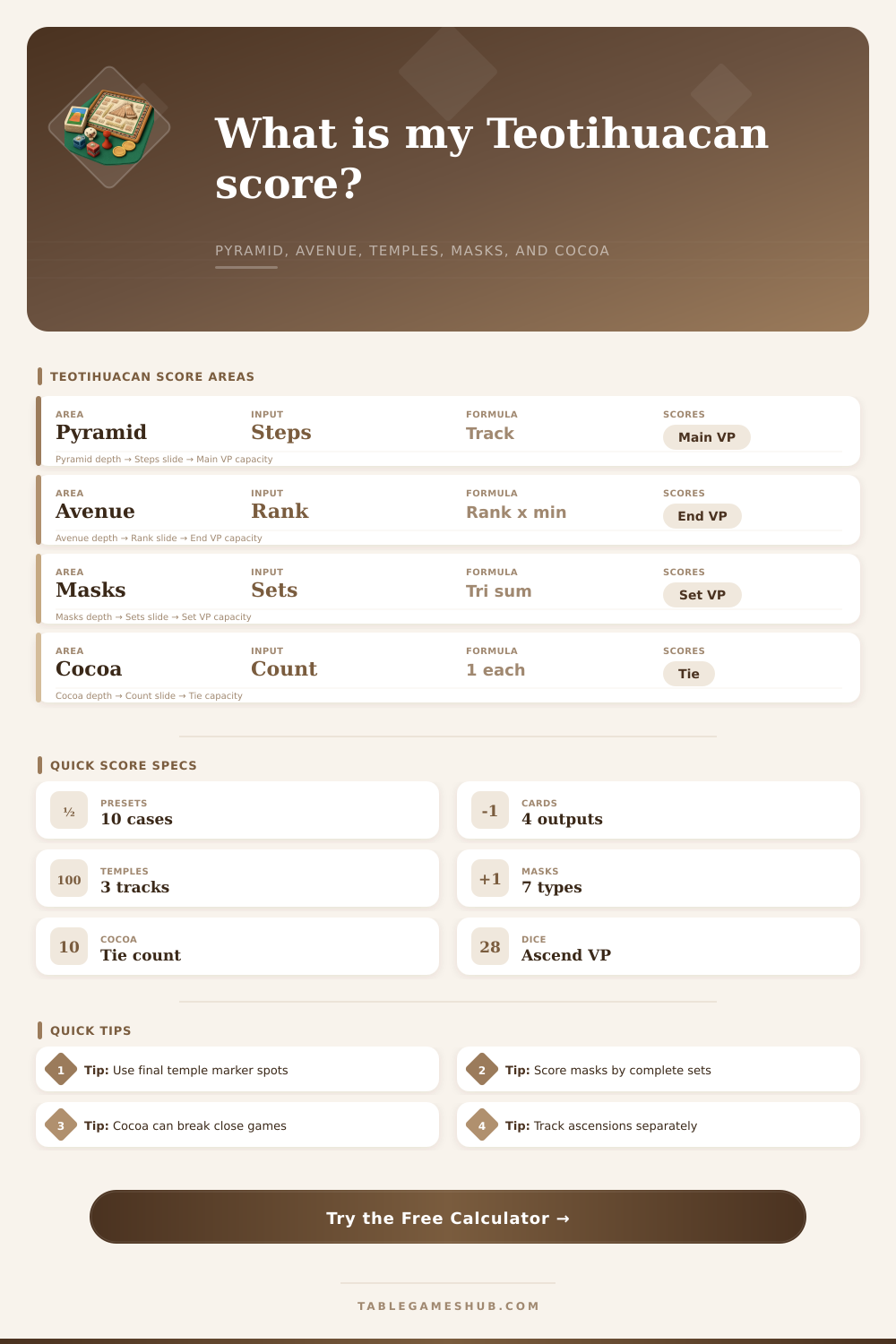
Teotihuacan is a game that require from a player a balance between a variety of scoring methods for that game. The score that the player earns in the game is based upon the player’s management of pyramid construction, temple construction, and mask collection. For instance, a player may construct a large pyramid to earn points for that construction, but if the player has not constructed any temple tracks, there will be few points earned from the Avenue of the Dead, leading to fewer points altogether for the player.
The calculator for the game helps the player to determine the final score for that player by calculating the score according to the game after the player enters their final score for the game; it also prevents error that may result from miscalculating the value of masks collected, or for forgetting that cocoa is used as a tiebreaker in the game. The pyramid in the game is comprised of a series of step that award points to a player according to the time during which the step is built. For instance, early steps on the pyramid score a player a small amount of points, but later steps score more points.
How to Use the Teotihuacan Score Calculator
Therefore, players who build their pyramid during the second half of the game score more points than those who construct their pyramid in the early steps of the game. In using the calculator for the game, the player must enter the total number of steps that are completed on the pyramid. The total number of steps on the pyramid indicates to the calculator the total score that the player earns from building the pyramid.
However, steps on the pyramid are not the only scoring method required by the game; players must also score in the decoration and temple track elements of the game to win. The temple tracks create a type of pressure for the player due to the way in which the Avenue of the Dead is scored. Each temple track has a different color, and each temple track scores differently.
However, the Avenue of the Dead uses only the value of the weakest of the three temple track. Thus, players may have to decide whether to focus their efforts on only one temple track, or to focus their effort on each of the three temple tracks. For instance, if a player does not focus upon one of the three tracks, it is possible that the score that the player earns from the Avenue of the Dead will be small, leading to small points for the player altogether.
The calculator automatically identifies the lowest level of the three temple tracks, as this can help to ensure that the player does not overcount their score from the Avenue of the Dead. Masks are another method of scoring points in the game. Each mask scores a player points according to a triangular curve.
For instance, players can collect four different types of masks, and these four type of masks can earn a player a certain number of points. However, if a player completes a second set of those same four types of masks, the value of the masks double. In using the calculator, the player must enter the number of different types of masks that the player collects, as well as the number of sets of masks that are collected.
The calculator requires that the player enters both of these numbers; many players only track one of the numbers, and are often surprised by their total score after the game is over. In addition to the mask scoring methods, there are also scoring methods associated with the ascensions of the player, as well as the remaining resource that the player has in the game. For instance, each ascension awards the player a certain number of points, but each ascension also cost the player a worker.
Any remaining resources at the end of the game are converted to points at half their value; however, this can be an inefficient scoring method if the player does not earn enough points from the resources to justify the losing of the remaining resources. Additionally, cocoa is another resource that differs from the other resources within the game; cocoa is used for scoring in the game, as is used for tiebreakers between players. Thus, while the points from cocoa may not impact games in which a winner is determined by a large margin of victory, it can impact the outcome of a game if the players is tied in a four-player game.
The tables included in the game provide a means of quickly translating the rules of the game into a player-readable format. For instance, each table can show a player how the rate at which a player scores change when moving from five steps to six steps on the pyramid, or the rate at which players score when reaching level eight in their temple tracks. Additionally, another table shows how decoration tiles may score in the game, and why they may be beneficial to players who utilize them in their game.
Common error can occur when players enter information into the calculator. For instance, a player may enter seven different types of masks collected in the game, but enter zero for the number of completed sets of those masks. This would result in a low score for the player.
Another common error is placing a high value for the Avenue of the Dead position in the game, yet having both of the player’s temple track at level two. In this case, the player will be surprised by the low score earned in the game. The calculator surfaces these errors due to the same rules used within the game.
The calculator cannot show the dynamics of the game that occurred during gameplay. Thus, while the calculator will show the final position of the player in the game, it will not be able to show how the player gain that score. However, the score can provide information about which elements of the game score the player well, and which elements did not.
Using the score calculator can help a player to understand the pattern of the game, which can help the player to determine in which temple track they should focus their efforts; the numbers within the game are simple, but the decisions that players make become clearer after playing the game a few times with the score calculator. Teotihuacan is a game that require from a player a balance between a variety of scoring methods for that game. The score that the player earns in the game is based upon the player’s management of pyramid construction, temple construction, and mask collection.
For instance, a player may construct a large pyramid to earn points for that construction, but if the player has not constructed any temple tracks, there will be few points earned from the Avenue of the Dead, leading to fewer points altogether for the player. The calculator for the game helps the player to determine the final score for that player by calculating the score according to the game after the player enters their final score for the game; it also prevents error that may result from miscalculating the value of masks collected, or for forgetting that cocoa is used as a tiebreaker in the game. The pyramid in the game is comprised of a series of step that award points to a player according to the time during which the step is built.
For instance, early steps on the pyramid score a player a small amount of points, but later steps score more points. Therefore, players who build their pyramid during the second half of the game score more points then those who construct their pyramid in the early steps of the game. In using the calculator for the game, the player must enter the total number of steps that are completed on the pyramid.
The total number of steps on the pyramid indicates to the calculator the total score that the player earns from building the pyramid. However, steps on the pyramid are not the only scoring method required by the game; players must also score in the decoration and temple track elements of the game to win. The temple tracks create a type of pressure for the player due to the way in which the Avenue of the Dead is scored.
Each temple track has a different color, and each temple track scores differently. However, the Avenue of the Dead uses only the value of the weakest of the three temple track. Thus, players may have to decide whether to focus their efforts on only one temple track, or to focus their effort on each of the three temple tracks.
For instance, if a player does not focus upon one of the three tracks, it is possible that the score that the player earns from the Avenue of the Dead will be small, leading to small points for the player altogether. The calculator automatically identifies the lowest level of the three temple tracks, as this can help to ensure that the player does not overcount their score from the Avenue of the Dead. Masks are another method of scoring points in the game.
Each mask scores a player points according to a triangular curve. For instance, players can collect four different types of masks, and these four type of masks can earn a player a certain number of points. However, if a player completes a second set of those same four types of masks, the value of the masks double.
In using the calculator, the player must enter the number of different types of masks that the player collects, as well as the number of sets of masks that are collected. The calculator requires that the player enters both of these numbers; many players only track one of the numbers, and are often surprised by their total score after the game is over. In addition to the mask scoring methods, there are also scoring methods associated with the ascensions of the player, as well as the remaining resource that the player has in the game.
For instance, each ascension awards the player a certain number of points, but each ascension also cost the player a worker. Any remaining resources at the end of the game are converted to points at half their value; however, this can be an inefficient scoring method if the player does not earn enough points from the resources to justify the losing of the remaining resources. Additionally, cocoa is another resource that differs from the other resources within the game; cocoa is used for scoring in the game, as is used for tiebreakers between players.
Thus, while the points from cocoa may not impact games in which a winner is determined by a large margin of victory, it can impact the outcome of a game if the players is tied in a four-player game. The tables included in the game provide a means of quickly translating the rules of the game into a player-readable format. For instance, each table can show a player how the rate at which a player scores change when moving from five steps to six steps on the pyramid, or the rate at which players score when reaching level eight in their temple tracks.
Additionally, another table shows how decoration tiles may score in the game, and why they may be beneficial to players who utilize them in their game. Common error can occur when players enter information into the calculator. For instance, a player may enter seven different types of masks collected in the game, but enter zero for the number of completed sets of those masks.
This would result in a low score for the player. Another common error is placing a high value for the Avenue of the Dead position in the game, yet having both of the player’s temple track at level two. In this case, the player will be surprised by the low score earned in the game.
The calculator surfaces these errors due to the same rules used within the game. The calculator cannot show the dynamics of the game that occurred during gameplay. Thus, while the calculator will show the final position of the player in the game, it will not be able to show how the player gain that score.
However, the score can provide information about which elements of the game score the player well, and which elements did not. Using the score calculator can help a player to understand the pattern of the game, which can help the player to determine in which temple track they should focus their efforts; the numbers within the game are simple, but the decisions that players make become clearer after playing the game a few times with the score calculator. Teotihuacan is a game that require from a player a balance between a variety of scoring methods for that game.
The score that the player earns in the game is based upon the player’s management of pyramid construction, temple construction, and mask collection. For instance, a player may construct a large pyramid to earn points for that construction, but if the player has not constructed any temple tracks, there will be few points earned from the Avenue of the Dead, leading to fewer points altogether for the player. The calculator for the game helps the player to determine the final score for that player by calculating the score according to the game after the player enters their final score for the game; it also prevents error that may result from miscalculating the value of masks collected, or for forgetting that cocoa is used as a tiebreaker in the game.
The pyramid in the game is comprised of a series of step that award points to a player according to the time during which the step is built. For instance, early steps on the pyramid score a player a small amount of points, but later steps score more points. Therefore, players who build their pyramid during the second half of the game score more points then those who construct their pyramid in the early steps of the game.
In using the calculator for the game, the player must enter the total number of steps that are completed on the pyramid. The total number of steps on the pyramid indicates to the calculator the total score that the player earns from building the pyramid. However, steps on the pyramid are not the only scoring method required by the game; players must also score in the decoration and temple track elements of the game to win.
The temple tracks create a type of pressure for the player due to the way in which the Avenue of the Dead is scored. Each temple track has a different color, and each temple track scores differently. However, the Avenue of the Dead uses only the value of the weakest of the three temple track.
Thus, players may have to decide whether to focus their efforts on only one temple track, or to focus their effort on each of the three temple tracks. For instance, if a player does not focus upon one of the three tracks, it is possible that the score that the player earns from the Avenue of the Dead will be small, leading to small points for the player altogether. The calculator automatically identifies the lowest level of the three temple tracks, as this can help to ensure that the player does not overcount their score from the Avenue of the Dead.
Masks are another method of scoring points in the game. Each mask scores a player points according to a triangular curve. For instance, players can collect four different types of masks, and these four type of masks can earn a player a certain number of points.
However, if a player completes a second set of those same four types of masks, the value of the masks double. In using the calculator, the player must enter the number of different types of masks that the player collects, as well as the number of sets of masks that are collected. The calculator requires that the player enters both of these numbers; many players only track one of the numbers, and are often surprised by their total score after the game is over.
In addition to the mask scoring methods, there are also scoring methods associated with the ascensions of the player, as well as the remaining resource that the player has in the game. For instance, each ascension awards the player a certain number of points, but each ascension also cost the player a worker. Any remaining resources at the end of the game are converted to points at half their value; however, this can be an inefficient scoring method if the player does not earn enough points from the resources to justify the losing of the remaining resources.
Additionally, cocoa is another resource that differs from the other resources within the game; cocoa is used for scoring in the game, as is used for tiebreakers between players. Thus, while the points from cocoa may not impact games in which a winner is determined by a large margin of victory, it can impact the outcome of a game if the players is tied in a four-player game. The tables included in the game provide a means of quickly translating the rules of the game into a player-readable format.
For instance, each table can show a player how the rate at which a player scores change when moving from five steps to six steps on the pyramid, or the rate at which players score when reaching level eight in their temple tracks. Additionally, another table shows how decoration tiles may score in the game, and why they may be beneficial to players who utilize them in their game. Common error can occur when players enter information into the calculator.
For instance, a player may enter seven different types of masks collected in the game, but enter zero for the number of completed sets of those masks. This would result in a low score for the player. Another common error is placing a high value for the Avenue of the Dead position in the game, yet having both of the player’s temple track at level two.
In this case, the player will be surprised by the low score earned in the game. The calculator surfaces these errors due to the same rules used within the game. The calculator cannot show the dynamics of the game that occurred during gameplay.
Thus, while the calculator will show the final position of the player in the game, it will not be able to show how the player gain that score. However, the score can provide information about which elements of the game score the player well, and which elements did not. Using the score calculator can help a player to understand the pattern of the game, which can help the player to determine in which temple track they should focus their efforts; the numbers within the game are simple, but the decisions that players make become clearer after playing the game a few times with the score calculator.
Teotihuacan is a game that require from a player a balance between a variety of scoring methods for that game. The score that the player earns in the game is based upon the player’s management of pyramid construction, temple construction, and mask collection. For instance, a player may construct a large pyramid to earn points for that construction, but if the player has not constructed any temple tracks, there will be few points earned from the Avenue of the Dead, leading to fewer points altogether for the player.
The calculator for the game helps the player to determine the final score for that player by calculating the score according to the game after the player enters their final score for the game; it also prevents error that may result from miscalculating the value of masks collected, or for forgetting that cocoa is used as a tiebreaker in the game. The pyramid in the game is comprised of a series of step that award points to a player according to the time during which the step is built. For instance, early steps on the pyramid score a player a small amount of points, but later steps score more points.
Therefore, players who build their pyramid during the second half of the game score more points then those who construct their pyramid in the early steps of the game. In using the calculator for the game, the player must enter the total number of steps that are completed on the pyramid. The total number of steps on the pyramid indicates to the calculator the total score that the player earns from building the pyramid.
However, steps on the pyramid are not the only scoring method required by the game; players must also score in the decoration and temple track elements of the game to win. The temple tracks create a type of pressure for the player due to the way in which the Avenue of the Dead is scored. Each temple track has a different color, and each temple track scores differently.
However, the Avenue of the Dead uses only the value of the weakest of the three temple track. Thus, players may have to decide whether to focus their efforts on only one temple track, or to focus their effort on each of the three temple tracks. For instance, if a player does not focus upon one of the three tracks, it is possible that the score that the player earns from the Avenue of the Dead will be small, leading to small points for the player altogether.
The calculator automatically identifies the lowest level of the three temple tracks, as this can help to ensure that the player does not overcount their score from the Avenue of the Dead. Masks are another method of scoring points in the game. Each mask scores a player points according to a triangular curve.
For instance, players can collect four different types of masks, and these four type of masks can earn a player a certain number of points. However, if a player completes a second set of those same four types of masks, the value of the masks double. In using the calculator, the player must enter the number of different types of masks that the player collects, as well as the number of sets of masks that are collected.
The calculator requires that the player enters both of these numbers; many players only track one of the numbers, and are often surprised by their total score after the game is over. In addition to the mask scoring methods, there are also scoring methods associated with the ascensions of the player, as well as the remaining resource that the player has in the game. For instance, each ascension awards the player a certain number of points, but each ascension also cost the player a worker.
Any remaining resources at the end of the game are converted to points at half their value; however, this can be an inefficient scoring method if the player does not earn enough points from the resources to justify the losing of the remaining resources. Additionally, cocoa is another resource that differs from the other resources within the game; cocoa is used for scoring in the game, as is used for tiebreakers between players. Thus, while the points from cocoa may not impact games in which a winner is determined by a large margin of victory, it can impact the outcome of a game if the players is tied in a four-player game.
The tables included in the game provide a means of quickly translating the rules of the game into a player-readable format. For instance, each table can show a player how the rate at which a player scores change when moving from five steps to six steps on the pyramid, or the rate at which players score when reaching level eight in their temple tracks. Additionally, another table shows how decoration tiles may score in the game, and why they may be beneficial to players who utilize them in their game.
Common error can occur when players enter information into the calculator. For instance, a player may enter seven different types of masks collected in the game, but enter zero for the number of completed sets of those masks. This would result in a low score for the player.
Another common error is placing a high value for the Avenue of the Dead position in the game, yet having both of the player’s temple track at level two. In this case, the player will be surprised by the low score earned in the game. The calculator surfaces these errors due to the same rules used within the game.
The calculator cannot show the dynamics of the game that occurred during gameplay. Thus, while the calculator will show the final position of the player in the game, it will not be able to show how the player gain that score. However, the score can provide information about which elements of the game score the player well, and which elements did not.
Using the score calculator can help a player to understand the pattern of the game, which can help the player to determine in which temple track they should focus their efforts; the numbers within the game are simple, but the decisions that players make become clearer after playing the game a few times with the score calculator. Teotihuacan is a game that require from a player a balance between a variety of scoring methods for that game. The score that the player earns in the game is based upon the player’s management of pyramid construction, temple construction, and mask collection.
For instance, a player may construct a large pyramid to earn points for that construction, but if the player has not constructed any temple tracks, there will be few points earned from the Avenue of the Dead, leading to fewer points altogether for the player. The calculator for the game helps the player to determine the final score for that player by calculating the score according to the game after the player enters their final score for the game; it also prevents error that may result from miscalculating the value of masks collected, or for forgetting that cocoa is used as a tiebreaker in the game. The pyramid in the game is comprised of a series of step that award points to a player according to the time during which the step is built.
For instance, early steps on the pyramid score a player a small amount of points, but later steps score more points. Therefore, players who build their pyramid during the second half of the game score more points then those who construct their pyramid in the early steps of the game. In using the calculator for the game, the player must enter the total number of steps that are completed on the pyramid.
The total number of steps on the pyramid indicates to the calculator the total score that the player earns from building the pyramid. However, steps on the pyramid are not the only scoring method required by the game; players must also score in the decoration and temple track elements of the game to win. The temple tracks create a type of pressure for the player due to the way in which the Avenue of the Dead is scored.
Each temple track has a different color, and each temple track scores differently. However, the Avenue of the Dead uses only the value of the weakest of the three temple track. Thus, players may have to decide whether to focus their efforts on only one temple track, or to focus their effort on each of the three temple tracks.
For instance, if a player does not focus upon one of the three tracks, it is possible that the score that the player earns from the Avenue of the Dead will be small, leading to small points for the player altogether. The calculator automatically identifies the lowest level of the three temple tracks, as this can help to ensure that the player does not overcount their score from the Avenue of the Dead. Masks are another method of scoring points in the game.
Each mask scores a player points according to a triangular curve. For instance, players can collect four different types of masks, and these four type of masks can earn a player a certain number of points. However, if a player completes a second set of those same four types of masks, the value of the masks double.
In using the calculator, the player must enter the number of different types of masks that the player collects, as well as the number of sets of masks that are collected. The calculator requires that the player enters both of these numbers; many players only track one of the numbers, and are often surprised by their total score after the game is over. In addition to the mask scoring methods, there are also scoring methods associated with the ascensions of the player, as well as the remaining resource that the player has in the game.
For instance, each ascension awards the player a certain number of points, but each ascension also cost the player a worker. Any remaining resources at the end of the game are converted to points at half their value; however, this can be an inefficient scoring method if the player does not earn enough points from the resources to justify the losing of the remaining resources. Additionally, cocoa is another resource that differs from the other resources within the game; cocoa is used for scoring in the game, as is used for tiebreakers between players.
Thus, while the points from cocoa may not impact games in which a winner is determined by a large margin of victory, it can impact the outcome of a game if the players is tied in a four-player game. The tables included in the game provide a means of quickly translating the rules of the game into a player-readable format. For instance, each table can show a player how the rate at which a player scores change when moving from five steps to six steps on the pyramid, or the rate at which players score when reaching level eight in their temple tracks.
Additionally, another table shows how decoration tiles may score in the game, and why they may be beneficial to players who utilize them in their game. Common error can occur when players enter information into the calculator. For instance, a player may enter seven different types of masks collected in the game, but enter zero for the number of completed sets of those masks.
This would result in a low score for the player. Another common error is placing a high value for the Avenue of the Dead position in the game, yet having both of the player’s temple track at level two. In this case, the player will be surprised by the low score earned in the game.
The calculator surfaces these errors due to the same rules used within the game. The calculator cannot show the dynamics of the game that occurred during gameplay. Thus, while the calculator will show the final position of the player in the game, it will not be able to show how the player gain that score.
However, the score can provide information about which elements of the game score the player well, and which elements did not. Using the score calculator can help a player to understand the pattern of the game, which can help the player to determine in which temple track they should focus their efforts; the numbers within the game are simple, but the decisions that players make become clearer after playing the game a few times with the score calculator. Teotihuacan is a game that require from a player a balance between a variety of scoring methods for that game.
The score that the player earns in the game is based upon the player’s management of pyramid construction, temple construction, and mask collection. For instance, a player may construct a large pyramid to earn points for that construction, but if the player has not constructed any temple tracks, there will be few points earned from the Avenue of the Dead, leading to fewer points altogether for the player. The calculator for the game helps the player to determine the final score for that player by calculating the score according to the game after the player enters their final score for the game; it also prevents error that may result from miscalculating the value of masks collected, or for forgetting that cocoa is used as a tiebreaker in the game.
The pyramid in the game is comprised of a series of step that award points to a player according to the time during which the step is built. For instance, early steps on the pyramid score a player a small amount of points, but later steps score more points. Therefore, players who build their pyramid during the second half of the game score more points then those who construct their pyramid in the early steps of the game.
In using the calculator for the game, the player must enter the total number of steps that are completed on the pyramid. The total number of steps on the pyramid indicates to the calculator the total score that the player earns from building the pyramid. However, steps on the pyramid are not the only scoring method required by the game; players must also score in the decoration and temple track elements of the game to win.
The temple tracks create a type of pressure for the player due to the way in which the Avenue of the Dead is scored. Each temple track has a different color, and each temple track scores differently. However, the Avenue of the Dead uses only the value of the weakest of the three temple track.
Thus, players may have to decide whether to focus their efforts on only one temple track, or to focus their effort on each of the three temple tracks. For instance, if a player does not focus upon one of the three tracks, it is possible that the score that the player earns from the Avenue of the Dead will be small, leading to small points for the player altogether. The calculator automatically identifies the lowest level of the three temple tracks, as this can help to ensure that the player does not overcount their score from the Avenue of the Dead.
Masks are another method of scoring points in the game. Each mask scores a player points according to a triangular curve. For instance, players can collect four different types of masks, and these four type of masks can earn a player a certain number of points.
However, if a player completes a second set of those same four types of masks, the value of the masks double. In using the calculator, the player must enter the number of different types of masks that the player collects, as well as the number of sets of masks that are collected. The calculator requires that the player enters both of these numbers; many players only track one of the numbers, and are often surprised by their total score after the game is over.
In addition to the mask scoring methods, there are also scoring methods associated with the ascensions of the player, as well as the remaining resource that the player has in the game. For instance, each ascension awards the player a certain number of points, but each ascension also cost the player a worker. Any remaining resources at the end of the game are converted to points at half their value; however, this can be an inefficient scoring method if the player does not earn enough points from the resources to justify the losing of the remaining resources.
Additionally, cocoa is another resource that differs from the other resources within the game; cocoa is used for scoring in the game, as is used for tiebreakers between players. Thus, while the points from cocoa may not impact games in which a winner is determined by a large margin of victory, it can impact the outcome of a game if the players is tied in a four-player game. The tables included in the game provide a means of quickly translating the rules of the game into a player-readable format.
For instance, each table can show a player how the rate at which a player scores change when moving from five steps to six steps on the pyramid, or the rate at which players score when reaching level eight in their temple tracks. Additionally, another table shows how decoration tiles may score in the game, and why they may be beneficial to players who utilize them in their game. Common error can occur when players enter information into the calculator.
For instance, a player may enter seven different types of masks collected in the game, but enter zero for the number of completed sets of those masks. This would result in a low score for the player. Another common error is placing a high value for the Avenue of the Dead position in the game, yet having both of the player’s temple track at level two.
In this case, the player will be surprised by the low score earned in the game. The calculator surfaces these errors due to the same rules used within the game. The calculator cannot show the dynamics of the game that occurred during gameplay.
Thus, while the calculator will show the final position of the player in the game, it will not be able to show how the player gain that score. However, the score can provide information about which elements of the game score the player well, and which elements did not. Using the score calculator can help a player to understand the pattern of the game, which can help the player to determine in which temple track they should focus their efforts; the numbers within the game are simple, but the decisions that players make become clearer after playing the game a few times with the score calculator.
Teotihuacan is a game that require from a player a balance between a variety of scoring methods for that game. The score that the player earns in the game is based upon the player’s management of pyramid construction, temple construction, and mask collection. For instance, a player may construct a large pyramid to earn points for that construction, but if the player has not constructed any temple tracks, there will be few points earned from the Avenue of the Dead, leading to fewer points altogether for the player.
The calculator for the game helps the player to determine the final score for that player by calculating the score according to the game after the player enters their final score for the game; it also prevents error that may result from miscalculating the value of masks collected, or for forgetting that cocoa is used as a tiebreaker in the game. The pyramid in the game is comprised of a series of step that award points to a player according to the time during which the step is built. For instance, early steps on the pyramid score a player a small amount of points, but later steps score more points.
Therefore, players who build their pyramid during the second half of the game score more points then those who construct their pyramid in the early steps of the game. In using the calculator for the game, the player must enter the total number of steps that are completed on the pyramid. The total number of steps on the pyramid indicates to the calculator the total score that the player earns from building the pyramid.
However, steps on the pyramid are not the only scoring method required by the game; players must also score in the decoration and temple track elements of the game to win. The temple tracks create a type of pressure for the player due to the way in which the Avenue of the Dead is scored. Each temple track has a different color, and each temple track scores differently.
However, the Avenue of the Dead uses only the value of the weakest of the three temple track. Thus, players may have to decide whether to focus their efforts on only one temple track, or to focus their effort on each of the three temple tracks. For instance, if a player does not focus upon one of the three tracks, it is possible that the score that the player earns from the Avenue of the Dead will be small, leading to small points for the player altogether.
The calculator automatically identifies the lowest level of the three temple tracks, as this can help to ensure that the player does not overcount their score from the Avenue of the Dead. Masks are another method of scoring points in the game. Each mask scores a player points according to a triangular curve.
For instance, players can collect four different types of masks, and these four type of masks can earn a player a certain number of points. However, if a player completes a second set of those same four types of masks, the value of the masks double. In using the calculator, the player must enter the number of different types of masks that the player collects, as well as the number of sets of masks that are collected.
The calculator requires that the player enters both of these numbers; many players only track one of the numbers, and are often surprised by their total score after the game is over. In addition to the mask scoring methods, there are also scoring methods associated with the ascensions of the player, as well as the remaining resource that the player has in the game. For instance, each ascension awards the player a certain number of points, but each ascension also cost the player a worker.
Any remaining resources at the end of the game are converted to points at half their value; however, this can be an inefficient scoring method if the player does not earn enough points from the resources to justify the losing of the remaining resources. Additionally, cocoa is another resource that differs from the other resources within the game; cocoa is used for scoring in the game, as is used for tiebreakers between players. Thus, while the points from cocoa may not impact games in which a winner is determined by a large margin of victory, it can impact the outcome of a game if the players is tied in a four-player game.
The tables included in the game provide a means of quickly translating the rules of the game into a player-readable format. For instance, each table can show a player how the rate at which a player scores change when moving from five steps to six steps on the pyramid, or the rate at which players score when reaching level eight in their temple tracks. Additionally, another table shows how decoration tiles may score in the game, and why they may be beneficial to players who utilize them in their game.
Common error can occur when players enter information into the calculator. For instance, a player may enter seven different types of masks collected in the game, but enter zero for the number of completed sets of those masks. This would result in a low score for the player.
Another common error is placing a high value for the Avenue of the Dead position in the game, yet having both of the player’s temple track at level two. In this case, the player will be surprised by the low score