Warhammer 40K Saving Throw Calculator
Calculate armor saves, invulnerable saves, AP, cover, Feel No Pain rolls, damage, incoming wounds, failed save odds, and unit survival.
| Incoming wounds | At least one failed save | Expected final damage | Destroyed odds |
|---|
| AP value | Armor after cover | Best save used | Failed save odds |
|---|
| Damage each | Expected damage per wound | No damage after FNP | Destroy target odds |
|---|
| Save type | What modifies it | Common use | Math note |
|---|---|---|---|
| Armor save | AP worsens, cover improves | Most normal saves | Better number means higher success |
| Invulnerable save | Usually not AP or cover | High AP attacks | Use only if better than armor |
| Feel No Pain | After failed save | Damage mitigation | Roll once per damage point |
| Reroll 1s | Failed die face of 1 only | Defensive aura effects | Adds one-sixth of base success |
| Reroll fails | All failed save dice | Rare strong defense | Success becomes 1 - fail squared |
| Needed roll | No reroll success | Reroll 1s success | Reroll fails success |
|---|---|---|---|
| 2+ | 83.3% | 97.2% | 97.2% |
| 3+ | 66.7% | 77.8% | 88.9% |
| 4+ | 50.0% | 58.3% | 75.0% |
| 5+ | 33.3% | 38.9% | 55.6% |
| 6+ | 16.7% | 19.4% | 30.6% |
In the game of Warhammer 40,000, a model must pass several different defensive step in order to avoid being removed from the table. A model will survive an attack if it pass the necessary die rolls after the attack lands upon it. These die rolls are referred to as “saving throws,” and are the main means of a model avoiding take damage from an attacking enemy.
Each of these saving throws, however, is actualy a step in a specific order of defense for a model. The first of these saves is known as an armor save. Armor saves is used to represent the physical defenses that a model possesses for the game.
How Armor Saves, Invulnerable Saves and Feel No Pain Work in Warhammer 40,000
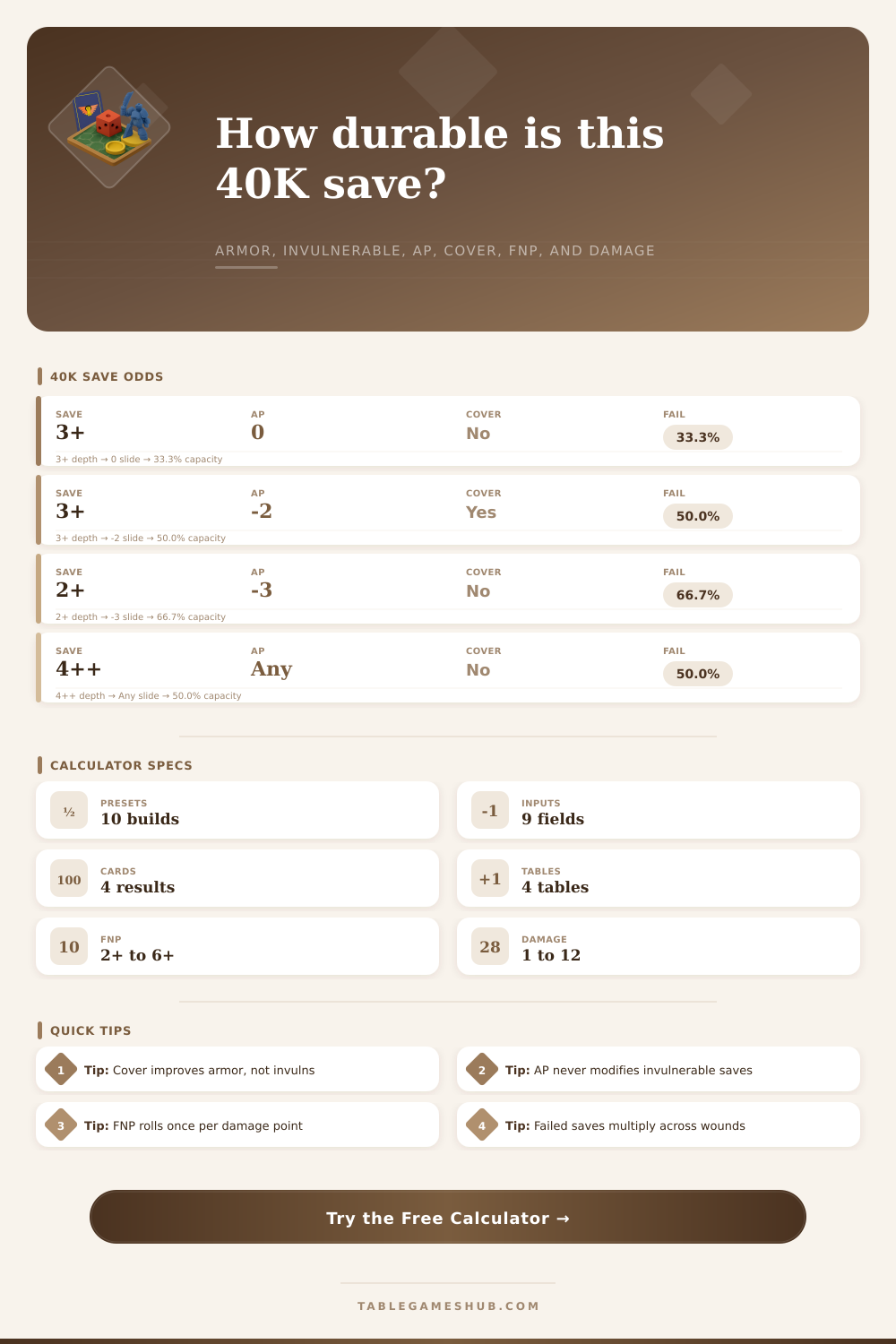
A models datasheet contain an armor save value, which indicate the target number that must be rolled on a die to succeed on an armor save. Other rules, such as Armor Penetration (AP) values, can modify this value, which make the armor save more difficultly to pass (increasing the armor save value that must be rolled), or rules like cover, which make an armor save easier to pass (decreasing the armor save value that must be rolled). The next save is known as an invulnerable save.
An invulnerable save is different than armor saves in that it is a separate save that is used to provide protection to a model in instances in which the armor save is too difficult to pass. Invulnerable saves have a fixed number that must be rolled on a die (usually a 2), but they ignore the Armor Penetration (AP) value of the incoming attack. Thus, an invulnerable save is often better then an armor save if the armor save is difficult due to the AP of the incoming attack.
In these cases, the unit and its player must choose between use the armor save or the invulnerable save, and must choose the defense that has the highest chance of success. Following the saving throws are layers of defense known as Feel No Pain. Feel No Pain saves do not help a model pass a saving throw; rather, it reduce the amount of damage that a model will take if it fails its saving throw.
Feel No Pain rolls are made for each individual point of damage that is landing upon the model. Thus, if a model take three point of damage, it will roll for Feel No Pain three times. Feel No Pain rolls are helpful for models whose saving throws fail, but whose damage value are reduced as a result of these rolls.
Another form of defense for a model is the use of rerolls for the saving throws. Rerolling ones mean that when a player rolls a die for a saving throw, if the value that is rolled is a one, they must reroll the die. Rerolling all failed saves is more powerful than rerolling only ones; with rerolling all failed saves, the player may take the saving throw as many time as necessary until they recieve a successful saving throw.
The use of rerolls can increase the chance that a model will survive an attack from an enemy model. The mathematical relationship between these saves can help to determine the likelihood that a model will survive its attacks. For instance, a model that is being attacked with a high volume of attacks may be able to overcome a strong invulnerable save because there is a chance that the high number of attacks will result in wound landing upon the model.
Additionally, Feel No Pain saves can overcome the damage value for the attacks in that high damage values are more difficultly to overcome than low damage values. It is possible that individuals may make mistake in applying each of these rules in the appropriate order. For example, an individual may attempt to apply cover to an invulnerable save, but such application will not work due to the rules of the game.
Other mistakes may be made forgetting to roll for Feel No Pain for each point of damage, or forgetting that Armor Penetration only affect armor saves. Each of these rules is specific, so each saving throw must be appropriately applied to the appropriate save for that model to determine if it will survive the attacks. Finally, the use of a calculator can help an individual to more easy understand the relationship of each of these defense rules.
A calculator can calculate the wound count, armor saves, AP value, cover, Feel No Pain, and damage values for each model. From these calculations, the calculator can provide information about the best save for the model, the damage that will hit the model after Feel No Pain rolls, and the chance that the model will be destroyed in the attack. These calculations help to provide insight into whether or not the model will survive the attacks from the enemy model.