Call of Cthulhu Skill Check Calculator
Calculate exact d100 odds for CoC skill %, regular, hard, extreme, bonus dice, penalty dice, fumbles, criticals, and opposed success levels.
| Dice Mode | Regular | Hard | Extreme | Critical | Fumble |
|---|---|---|---|---|---|
| Normal | 60.0% | 30.0% | 12.0% | 1.0% | 1.0% |
| Outcome Band | Roll Range | Declared Roll | Result Meaning |
|---|---|---|---|
| Regular | 31 to 60 | 43 | Regular success |
| Success Level | Threshold Formula | Example at 60% | Opposed Check Use |
|---|---|---|---|
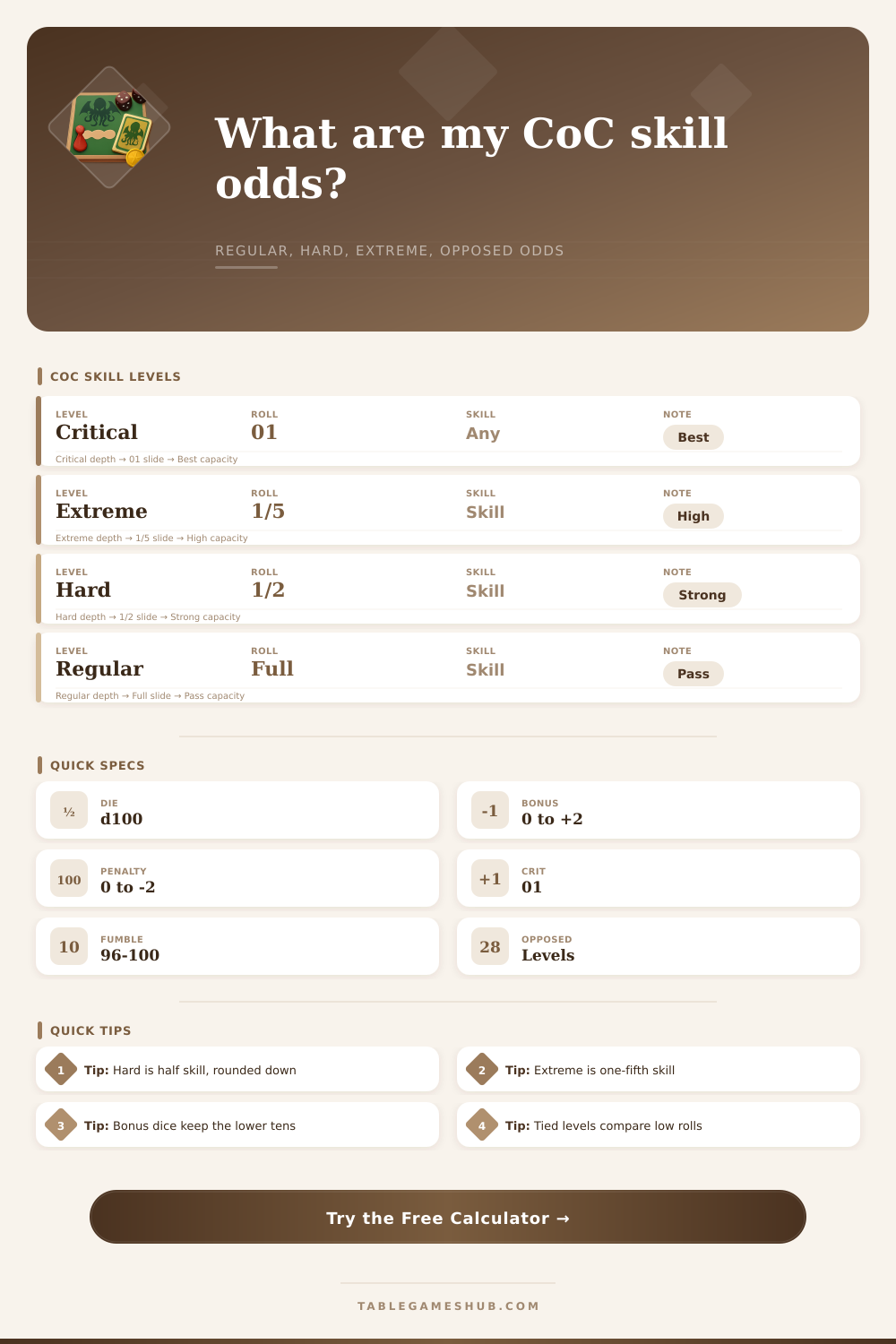
| Critical | Roll 01 | 01 | Beats all non-critical results |
| Extreme | Skill divided by 5, rounded down | 01 to 12 | Beats hard, regular, and fail |
| Hard | Skill divided by 2, rounded down | 01 to 30 | Beats regular and fail |
| Regular | Roll equal to or under skill | 01 to 60 | Beats fail, ties by lower roll |
| Failure | Roll over skill without fumble | 61 to 99 | Usually loses to any success |
| Skill Range | Fumble Range | Normal Chance | Important Note |
|---|---|---|---|
| 1% to 49% | 96 to 100 | 5.0% | Low skill fumbles on the top five rolls |
| 50% to 99% | 100 only | 1.0% | Skilled investigators only fumble on 100 |
| With bonus dice | Final result range | Lower than normal | Best tens die reduces high results |
| With penalty dice | Final result range | Higher than normal | Worst tens die increases high results |
| Opposed Situation | Primary Comparison | Tie Breaker | Calculator Treatment |
|---|---|---|---|
| Critical vs extreme | Critical wins | Not needed | Higher success level wins |
| Hard vs hard | Same level | Lower d100 roll wins | Exact paired roll enumeration |
| Regular vs fail | Regular wins | Not needed | Failure has level zero |
| Fail vs fail | No success | No clear winner | Counted as tie or stalemate |
The Call of Cthulhu skill check system use a roll of a d100 to determine whether or not an investigator were successful in there task. The investigator succeed if their roll are equal to or lower than the percentage associated with their skill. Three differents success levels is used within the game: regular success, hard success, and extreme success.
The investigator achieves a regular success when their roll is equal to or lower than the investigators skill percentage. A hard success is achieve when the investigator’s roll is equal to or lower than half of the investigator’s skill percentage (rounded down). An extreme success is achieved when the investigator’s roll is equal to or lower than one fifth of the investigator’s skill percentage.
How Skill Checks Work in Call of Cthulhu
Each of these success levels indicates different level of difficulty for the investigators in performing their task. A hard success or extreme success indicates that the task is more difficult then a regular success. Bonus dice and penalty dice alters the probability of the investigator rolling a number on the d100 that is equal to or lower than their skill percentage.
However, bonus and penalty dice does not alter the target number for achieving a success. Instead, a bonus die adds one extra tens digit to the investigator’s roll. The investigator is required to keep the lowest tens digit of the two tens digits.
By doing so, the investigator is more likely to achieve a lower number. A penalty die also add one extra tens digit to the investigator’s roll. However, the investigator must keep the highest tens digit of the two tens digit created by the penalty die and the investigators die.
This tactic makes it more likely that the investigator will roll a higher number with the d100. Thus, using a bonus die makes it more likely for an investigator to achieve a hard success or extreme success. Using a penalty die make it more likely for an investigator to fail their task or roll a fumble. A fumble occurs when an investigator rolls a very highly number on the d100. The number required to roll a fumble also varies according to the skill percentage of the investigator.
Investigators with a skill percentage under 50 percent will fumble on rolls between 96 and 100. Investigators with a skill percentage of 50 percent or higher will only fumble on a roll of 100. These rules ensure that investigators with low skill percentages will fumble more often than high skill percentage investigator.
An opposed roll occurs when two character are competing against each other to perform a task. The character who earns the highest level of success on their skill check will be the winner of the opposed roll. Should both characters achieve the same level of success on their rolls, the character with the lower number on the d100 win the opposed roll.
For instance, a character who rolls a 28 who achieve a hard success will beat an opponent who rolls a 47 who also achieves a hard success. The calculator also provides a way to view the distribution of the outcome of the opposed rolls. Luck point allow a player to change the outcome of a d100 roll.
Luck points can be used to change a failed roll to a success if the failed roll comes close to the target total. The calculator will compare the declared total to the threshold and calculate the number of luck points required to reach the threshold. Luck points cannot be used to fix a fumble.
Luck points are a player decision. Pushed rolls allow an investigator to attempt a skill check again after they have fail it. A pushed roll does not change the probability of the d100 roll.
However, the Keeper can assign a consequence to a pushed roll. The consequence can be noted in the calculator to show the investigator the consequence of the pushed roll. The stakes is higher for a pushed roll because there is a consequence to the failed roll if the investigator again rolls poorly on the d100.
The calculator and the reference tables contain all the information that is needed to perform skill checks.
The reference tables show the threshold for both hard and extreme successes on a d100 roll. Additionally, the reference tables also show the fumble range for each percentage of skill. The reference tables allow investigators and keepers to quickly find the information they need without having to use the calculator.
The calculator is helpful in quickly performing the mathematical calculations for each percentage of skill and modifier dice. With the calculator, investigators can determine how many bonus and penalty dice will affects their specific skill. Additionally, the calculator will calculate for the investigator how many luck points is required to reach the threshold for success on their skill check.
A common mistake is not understanding how bonus and penalty dice works. Players may believe that bonus and penalty dice will add or subtract from the players d100 roll. However, bonus and penalty dice will replace the tens digit of a players d100 roll.
This is important to understand because it will change a players success from a normal success to a hard or extreme success. The calculator displays all possible outcomes of a d100 roll to assist players in understanding the effect of bonus and penalty dice. Keepers may also make mistake in the assignment of difficulty for skill checks.
The calculator makes the difficulty settings visible to investigators and avoid any arguments over the outcomes of these skill checks.