MTG Mulligan Probability Calculator
Model opening hands, London mulligan hand size, land ranges, and target-copy odds with exact hypergeometric math.
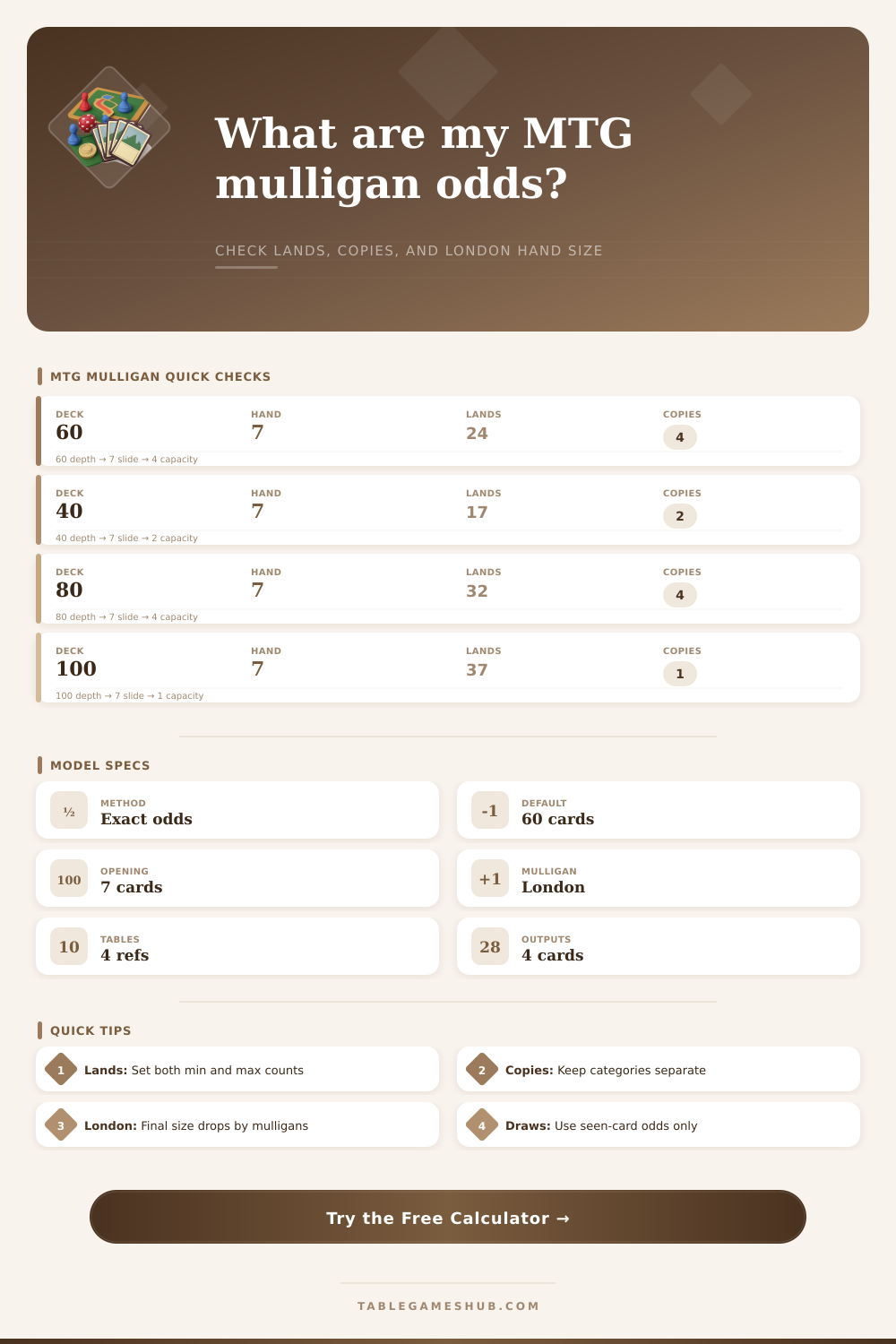
| Deck model | Typical deck size | Opening hand | Common land input |
|---|---|---|---|
| Constructed sixty-card model | 60 cards | 7 cards | 20 to 28 lands depending on shell |
| Limited forty-card model | 40 cards | 7 cards | 16 to 18 lands as a calculation range |
| Companion-size model | 80 cards | 7 cards | 30 to 34 lands for deck math checks |
| Commander library model | 99 or 100 cards | 7 cards | 34 to 40 lands as a broad input band |
| Mulligans taken | Cards inspected | Cards kept | Cards bottomed |
|---|---|---|---|
| 0 | 7 | 7 | 0 |
| 1 | 7 | 6 | 1 |
| 2 | 7 | 5 | 2 |
| 3 | 7 | 4 | 3 |
| Term | Calculator input | Meaning | Where used |
|---|---|---|---|
| N | Deck size | Total cards in the population | Denominator C(N, hand) |
| K | Lands, targets, support | Cards counted in a success category | Numerator category combinations |
| n | Opening or final hand size | Cards drawn or seen in the sample | Hand probability and draw extension |
| k | Minimum and maximum requirements | Accepted counts inside the sample | Keep criteria filter |
| Deck and copies | At least 1 in 7 | At least 1 in 6 | At least 1 in 5 |
|---|---|---|---|
| 60-card deck, 4 copies | 39.9% | 35.1% | 30.1% |
| 60-card deck, 8 copies | 65.4% | 59.3% | 52.8% |
| 40-card deck, 2 copies | 31.1% | 27.2% | 23.1% |
| 100-card deck, 1 copy | 7.0% | 6.0% | 5.0% |
The importance of the mulligan decisions in the game of Magic are important decisions because they can decide the entire game. All individual who play the game of Magic will shuffle the deck of cards and draw seven playing cards for themselves. These seven cards will either provide a good start for the game of Magic for those individuals, or the start into the game of Magic will not provide a good start for the players with that start of seven cards.
The introduction of the London mulligan change the math of the game of Magic, since the London mulligan changes the number of cards that the Magic players will keep. Instead of being able to draw seven cards and keep them, players will draw seven cards, but will only keep six cards after discarding one set of seven cards, and only five cards after discarding two set of seven cards. This structure makes decks that require fewer cards to play to be rewarded, but this structure will punish those decks that require specific cards to play.
How Mulligans Affect Your Starting Hand
The concept of a keepable hand is based off the requirement for each type of deck. Each type of deck has its own requirement for what type of cards it requires to play. Therefore, a seven-card hand might be considered a good start for one type of deck, but might be a start that would require a mulligan for another type of deck.
The calculator separates the lands and target copies because these category prevent the calculation of double counts for those categories. Each category represent a different function of the deck and the requirement of those functions to create an accurate calculation of the probabilities of drawing the necessary cards for play. The size of the deck changes the probabilities of drawing the cards needed for play, but few individual consider this factor when building their decks.
A sixty-card deck will draw more cards from the deck of cards than an eighty card or a hundred card deck. A sixty-card deck will also have more instances of the required cards than an eighty or a hundred card deck, due to the fact that the forty copies of the required cards will appear more often in the sixty-card deck than in the larger decks. This calculator allows individuals to set the total number of cards in their deck, and to define which cards will count towards each of the success rate of the deck.
After setting these values, the calculator will use a hypergeometric calculation to determine the chance that a random hand will contain the required cards. The introduction of the London mulligan changes the size of the hand that an individual will be dealt, but the number of cards that are inspected will remain at seven cards. The probability of receiving a good start with the London mulligan will change after two mulligans are discarded.
The calculation of the probabilities of receiving a start with the necessary cards when an individual is willing to mulligan once introduce the concept of sequence probabilities, wherein the chance of receiving one start or another will be calculated for an individual. This value is provided to individuals so that they can determine whether they would like to keep a weak start of seven cards, or whether they would like to take the chance at developing a six-card start. There are additional draws after the initial deal that can aid the players with their game, but the number of cards that an individual commit to after the London mulligan will not change.
The model accounts for the draws that you saw, but the model respects the final hand size that you chose to keep. Thus, while the model may suggest that each additional card that you see during mulligans is roughly equivalent to one free mulligan, the model does respect the final hand size that you will keep. Mulligan calculators tend to focus upon the worst-case scenario for the mulligans that a player experiences.
While players remember the few cases in which their mulligans resulted in a perfect starting hand, the calculator accounts for this by providing a distribution of the outcomes of each number of mulligans that can be drawn. Furthermore, the keep rate can be expected to shift with even small changes to your criteria; increasing the minimum land count by one land will shift the keep rate, for instance, as will decreasing the number of copies of one of your target spells by one. These shifts in keep rate allow you to determine if your current hand is close to the line for your desired keep rate, or if you are safely above it.
The reference tables on the page allow you to directly compare different type of decks. Each table compares different sizes of decks and different land counts with one another. For instance, a forty-card limited deck with seventeen lands will have a different keep rate than a sixty-card midrange deck with twenty-four lands.
These tables do not provide the answer to your deck building desires, but they may provide a sanity check in response to your deck building decisions. Actual games of the game often contain additional elements beyond the calculations of the model. The decks of your opponents can impact whether or not you find your opening hand to be playable, as can your sideboard games and your mana base.
Each of these element can impact whether or not your hand is playable and thus unkeepable. While the calculator will give you a baseline probability of success with your opening hand, your experience with the deck will provide you with a better idea of the adjustments to that baseline probability. The most useful use of the calculator is prior to the beginning of each game that you play.
If you are familiar with the keep rate for a normal hand and for a one-mulligan hand, you can decide in advance how many mulligans you are willing to take. By making this decision in advance, you will eliminate the emotional component of mulligans that might otherwise impact your decision during the game. The calculator is a tool that can assist you in formulating your assumptions about your deck’s success rates; however, the calculator is not the final answer.
You can use the calculator to determine if adding a second copy of one of your spells will improve your keep rate, for instance, or if your land count is an adequate support for your strategy. You can make these adjustments to your deck over the course of a long tournament or long season of play with your deck. Thus, while your intuitions will always play a role in your deck building decisions, the calculator will keep that intuition honest with the true capability of your deck.