Canasta Score Calculator
Total a Canasta hand with natural and mixed canastas, red threes, going out bonuses, card points, meld minimum context, and penalties.
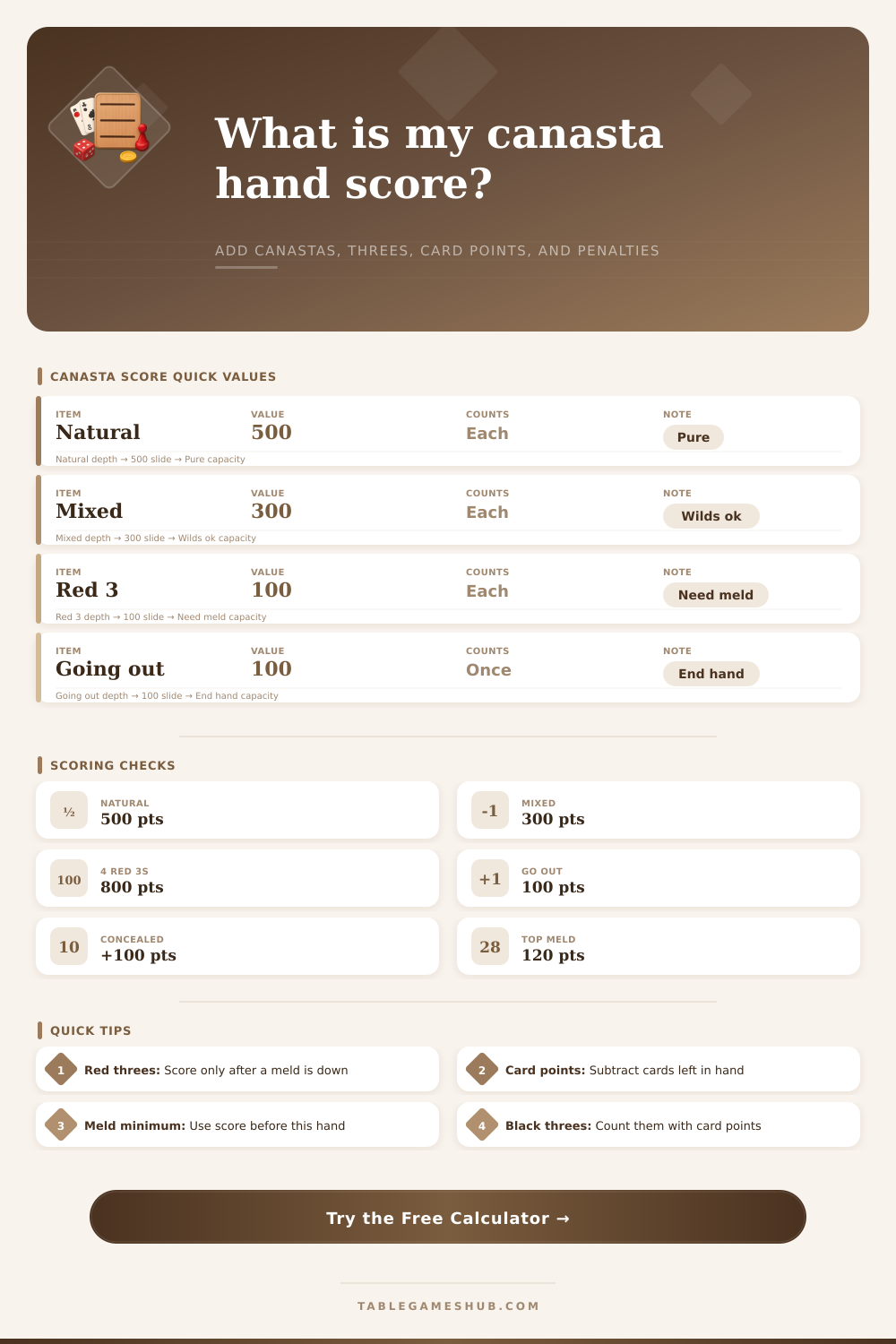
| Scoring item | Point value | When it applies | Calculator handling |
|---|---|---|---|
| Natural canasta | 500 points | Seven cards with no wild cards | Multiplies by natural canasta count |
| Mixed canasta | 300 points | Seven cards including wild cards | Multiplies by mixed canasta count |
| Red threes | 100 each, 800 for four | Positive only if your side melded | Turns negative when no meld is down |
| Going out | 100 points | Side ends the hand legally | Added from the going out selector |
| Concealed going out | 200 total | Out without prior melds in many tables | Uses the concealed selector value |
| Card group | Point value | Common scoring use | Reminder |
|---|---|---|---|
| Jokers | 50 each | Wild-card melds and hand penalties | High impact if trapped in hand |
| Twos and aces | 20 each | Wild twos and ace melds | Aces are natural cards |
| K, Q, J, 10, 9, 8 | 10 each | Most natural meld totals | Useful for opening meld math |
| 7, 6, 5, 4 | 5 each | Lower card meld totals | Still subtract if held |
| Black threes | 5 each | Can be melded only when going out in many rules | Otherwise count with hand points |
| Score before hand | Minimum meld | Calculator check | Common context |
|---|---|---|---|
| Below 0 | 15 points | Very low opening threshold | Recovery hands and early losses |
| 0 to 1,495 | 50 points | Standard opening range | Most early-game hands |
| 1,500 to 2,995 | 90 points | Middle-game pressure | Needs higher-value melds |
| 3,000 or more | 120 points | Late-game threshold | Often requires aces or wilds |
| Scenario | Strong inputs | Risk inputs | Score effect |
|---|---|---|---|
| Natural finish | Natural canastas and go out bonus | Few hand cards left | Large positive hand |
| Mixed recovery | Several mixed canastas | Wild cards trapped in hand | Depends on hand penalty |
| Red three sweep | Four red threes with melds | No canasta before opponents go out | Can swing 800 points |
| No meld hand | None | Red threes and hand cards | Often negative |
| Frozen pile miss | High table card points | Extra local penalty | Subtract in penalty field |
Canasta scoring is a process of calculating the points that are either earned or lost in a single hand of Canasta. The importance of Canasta scoring is that it determine the winner of the game. Many people find it to be difficult because there is alot of bonuses to calculate.
To properly calculate the score, people must take into account the number of natural canastas, mixed canastas, red threes, and the number of cards still left in their hand. If any of these value are incorrectly calculated, then the value of the Canasta score will also be incorrect. The calculator will make it easier for peoples to calculate the score for them.
How to Count Points in Canasta
To use the calculator, all that is required is for the users to enter the specific detail of the hand played. The details that the users will have to enter include the rule set for the group, the number of players at the table, the score that the player’s side had prior to the hand, and the opening meld that was played. The value of the previous score will help to determine the minimum number of points that will be required to make an opening meld.
The calculator will calculate the opening meld to determine whether or not the requirement for the opening meld were met based off the value of the previous score. Following the opening meld, the calculator will calculate the points earned from natural canastas, mixed canastas, red threes, melds, and the points earned from cards left in a player’s hand. Additionally, the calculator will also calculate any bonuses earned for go out of the hand.
Natural canastas are comprised of seven playing cards of the same rank but no wild cards. For this reason, natural canastas are worth more points than mixed canastas since it is more difficultly to play such a meld. For mixed canastas, seven playing cards is required but they also include wild cards.
For this reason, mixed canastas are worth less points than natural canastas. Red threes are scoring cards but only provide bonuses for melds already placed on the table. If players have not yet placed any meld, then red threes will provide penalties for the player.
The calculator calculates this by noting whether any meld points has been earned. Players will calculate points earned from melds by adding the point values of the melds placed on the table and subtracting the points for the cards left in a player’s hand. Players will earn points for each meld but will lose a point for each card still left in there hand.
If a player empties their hand of cards, they will not receive a penalty for the cards in their hand but will be eligible for a going out bonus. Additionally, there is a concealed out that provides bonus points to the player that did not meld their last card. The calculator provides a different value for these points as some group have different rules regarding the concealed out.
For some groups, the requirements for an opening meld will change based on the score of that side. If the score of that side is high, then the opening meld will require more points than if the score is low. For instance, if a side passes fifteen hundred points, the requirement for an opening meld will increase.
Players will have to hold a combination of cards that are stronger than normal as the requirement for the opening meld will be high. If the combination of cards that a player holds are not strong enough, the opening meld will fail. The calculator will show the requirement for the opening meld the next hand to be played so that players can plan their next hand accordingly.
There are specific rules that will impact the score for some groups. For instance, some groups will have rules regarding the frozen pile and penalties for illegal play. Black threes are only provide points for melds.
If they are not part of a meld, the calculator will count them as the cards still in a player’s hand. The calculator will account for these rules in an extra field to account for any house rule. Accurate Canasta scoring will help players to understand the game better.
Players can use the score to determine if players are winning the game or losing it. For instance, if the side scores highly but there are many canastas, it means that there are still many points in the players hands. Alternatively, if the side scores a high score but did not achieve any canastas, then it is likely that the red threes and the going out bonus resulted in the score earned by the side.
By using the calculator, players will no longer have to do the math for the game. The calculator will provide them the ability to more easily see the patterns of the Canasta scoring game. By recognizing the patterns in the game, players can make better playing choice during their game of Canasta.