🔶 Chinese Checkers Board Dimensions Calculator
Size the six-point star layout from marble diameter, hole spacing, arm rows, center hex geometry, margin, rim, and blank shape.
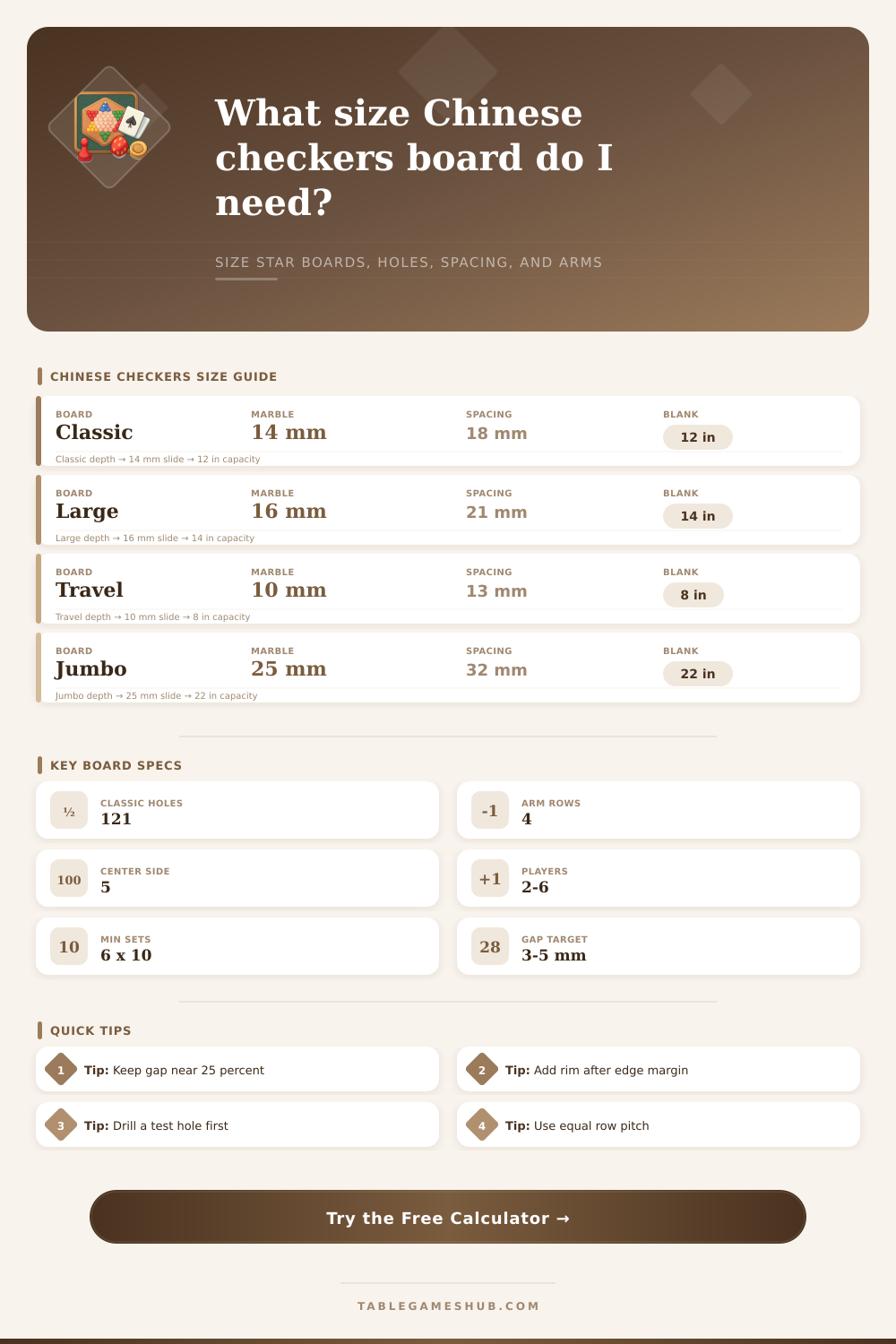
| Board Preset | Marble Diameter | Center Spacing | Typical Blank |
|---|---|---|---|
| Classic 121-hole board | 14 mm or 9/16 in | 18 mm or 11/16 in | 11 to 12 in round or hex |
| Large table board | 16 mm or 5/8 in | 21 mm or 13/16 in | 13 to 14 in round or hex |
| Travel board | 10 mm or 3/8 in | 13 mm or 1/2 in | 7 to 8 in compact blank |
| Jumbo board | 25 mm or 1 in | 32 mm or 1 1/4 in | 20 to 22 in large blank |
| Geometry Item | Classic Value | Formula Used | Why It Matters |
|---|---|---|---|
| Total holes | 121 | center hex plus 6 arms | Confirms the drilled pocket count |
| Center hex | 61 holes | 3n(n-1)+1 with n=5 | Sets the middle playing field |
| Home triangle | 10 holes | r(r+1)/2 with r=4 | Matches one color of marbles |
| Row pitch | 0.866 x spacing | triangular lattice height | Controls point-to-point board length |
| Marble Size | Suggested Gap | Suggested Hole | Center Spacing |
|---|---|---|---|
| 10 mm travel marble | 3 mm | 11 to 12 mm | 13 mm |
| 12 mm compact marble | 3 to 4 mm | 13 to 14 mm | 15 to 16 mm |
| 14 mm classic marble | 4 mm | 15 to 16 mm | 18 mm |
| 16 mm large marble | 5 mm | 17 to 18 mm | 21 mm |
| 25 mm jumbo marble | 7 mm | 27 to 29 mm | 32 mm |
| Arm Rows | Holes Per Arm | Six-Arm Total | Common Use |
|---|---|---|---|
| 3 rows | 6 holes | 36 home holes | Small teaching or display board |
| 4 rows | 10 holes | 60 home holes | Standard Chinese checkers layout |
| 5 rows | 15 holes | 90 home holes | Oversized custom star board |
| 6 rows | 21 holes | 126 home holes | Large custom marble display |
| Blank Shape | Dimension to Cut | Margin Behavior | Best Fit |
|---|---|---|---|
| Round blank | Use point-to-point diameter | Even rim all around | Traditional wooden boards |
| Hexagonal blank | Use point-to-point plus rim | Good flat sides for storage | Routed or CNC boards |
| Square blank | Use point-to-point as side length | Extra corner material remains | Simple workshop layout |
| Star silhouette | Use field spans and arm angles | Least extra material | Decorative wall boards |
Tip 1: Test the marble before drilling all holes
Drill one pocket in scrap with the chosen bit, oversize, and depth. The marble should sit securely while still being easy to lift out.
Tip 2: Treat spacing as a center-to-center lattice
Draw or CNC the holes from the center points first. Add the hole radius, edge margin, and rim only after the star field is laid out.
When you are building a Chinese checkers board, you have to make a plan for the dimensions of the board prior to you begins drilling the holes. The Chinese checkers board is a six-point star with a hexagon in the center. The measurements that you make for the board will have an impact upon the way in which the marbles can move upon the board.
Many people feel that the layout of the board is fixed, but the distance between the holes, the size of the marbles, and the amount of wood that are created around the marbles will change the experience of the game. Each of these variables has to be considered prior to you begin to cut the wood that will become the Chinese checkers board; if you make the incorrect choices in regard to these variables, you will find that the game is difficult to play with the marbles. The diameter of the marbles that you will use for the game is the first measurement that you will have to consider.
How to plan and measure a Chinese checkers board
The larger the marbles, the wider that you will have to space the holes, and the deeper that you will have to drill the boards for the marbles to fully sit within the holes. Additionally, the use of larger marbles will force the Chinese checkers board to be of a larger size than if the marbles were smaller in diameter. Smaller marbles will permit the board to have a smaller size, but those smaller marbles may be more difficult to move if the spaces between the holes are too small for the marbles to move upon the board.
Furthermore, the clearance around each of the marbles within each hole is important; if the clearance isnt correct, then the marbles may either not proper sit within the holes or they may continually rattle within the holes. It is with these considerations that you may use a calculator to determine the proper size of the clearance for the marbles. In addition to the diameter of the marbles, you must also consider the spacing between the centers of each of the holes on the board.
The spacing between the centers of the holes has to allow for the diameter of the marbles and yet also provide enough space for the marbles to be moved. If there is too much space between the centers of the holes, then the board will be too large; if there is too little space between the holes, the marbles will be difficult to move. The number of rows in each of the arms of the star will also impact the size of the board.
For instance, each player is typically provided with ten marbles on the board, which indicates that there should be four row in each of the arms of the star. The size of the center hexagon that is present in the middle of the board can be measured in the number of rows that are represented in each of the sides of the center hexagon. The number of rows within the center hexagon will impact the number of holes that are present in the center portion of the board.
For instance, if there are five rows in each of the sides of the hexagon, there will be 121 holes in the center of the board. Increasing the size of the hexagon will increase the length of the game, and decreasing the size of the hexagon will make the game more rapidly to play. A calculator performs these calculations automatically if you enter the number of rows in the center hexagon and the number of rows in each of the arms of the star into the calculator.
The dimension of the board also includes the amount of wood that should remain along the edge of the board, referred to as an edge margin. The edge margin will provide protection to the holes from cracking, as well as will contribute to the structural integrity of the Chinese checkers board. Additionally, the rim of the board will help to prevent the marbles from rolling off of the board.
Each of these measurements will contribute to the size of the entire board that must be cut from the blank piece of wood. The thickness of the wood will impact the depth of the holes in the board. The marbles should be deep into the holes to ensure that they do not easily roll off of the board, but the players fingers should be able to grip the marbles enough to allow for the marbles to be gripped.
The depth of the holes should be less than half of the diameter of the marbles, and the depth of the holes should be less than the thickness of the wood; otherwise, the drill bit will drill through the back of the Chinese checkers board. Before beginning to drill the wood for the Chinese checkers board, you should of drilled a trial hole into a piece of scrap wood of the same thickness as the wood that will be used for the Chinese checkers board. Many people will make mistakes when creating a Chinese checkers board.
Most commonly, individuals will ignore the geometry of the Chinese checkers board. The distance between the rows of holes is not the same as the distance between the holes in the horizontal measurements. As a result, the height of the board will be of a different dimension than the width of the board.
If individuals ignore this fact, their Chinese checkers board will appear incorrect, or the marbles will roll off of the board. A calculator will automatically calculate the dimensions of the board that are required to avoid these mistake. Finally, the shape of the wood blank that you will use to create the Chinese checkers board will impact the appearance of the board and the manner in which it can be stored.
If the wood blank is round, the margins around the edges of the board will be even. If the blank is hexagonal in the shape of the board, it will follow the symmetry of the six-pointed star. A square blank of wood is easy to cut from sheet goods, but will leave extra amounts of wood in the corners of the board.
Finally, if the shape of the blank of wood is in the shape of a six-pointed star, it will use the least amount of wood, but will require more precision in cutting the wood. Each of these different shapes has a minimum dimension that is required for the size of the board; the calculator represents these dimensions. It is important that you calculate all of the measurements for a Chinese checkers board prior to beginning to drill the holes.
For instance, if you calculate all of the dimensions of the board prior to drilling the holes, you will avoid making mistakes in creating the board. If your Chinese checkers board is too small, it is possible that the marbles will become become excessively in the positions in which they are required to be positioned. Likewise, if the board is too large, it may be awkward to utilize the Chinese checkers board.
Furthermore, the star-shaped geometry of the board is difficult to alter once you have cut the holes into the wood; thus, it is critical that the numbers is correct prior to beginning to cut the Chinese checkers board. When you appropriately calculate all of the measurements, the resulting Chinese checkers board will be balanced, the marbles will sit appropriately in the holes in the board, and there will be enough open space in the center of the board for the marbles to be played with.