Ultimate Frisbee Field Dimensions Calculator
Size a regulation ultimate field, compare USAU and WFDF layouts, and estimate cones, yard-line marks, runoff footprint, and stripe area.
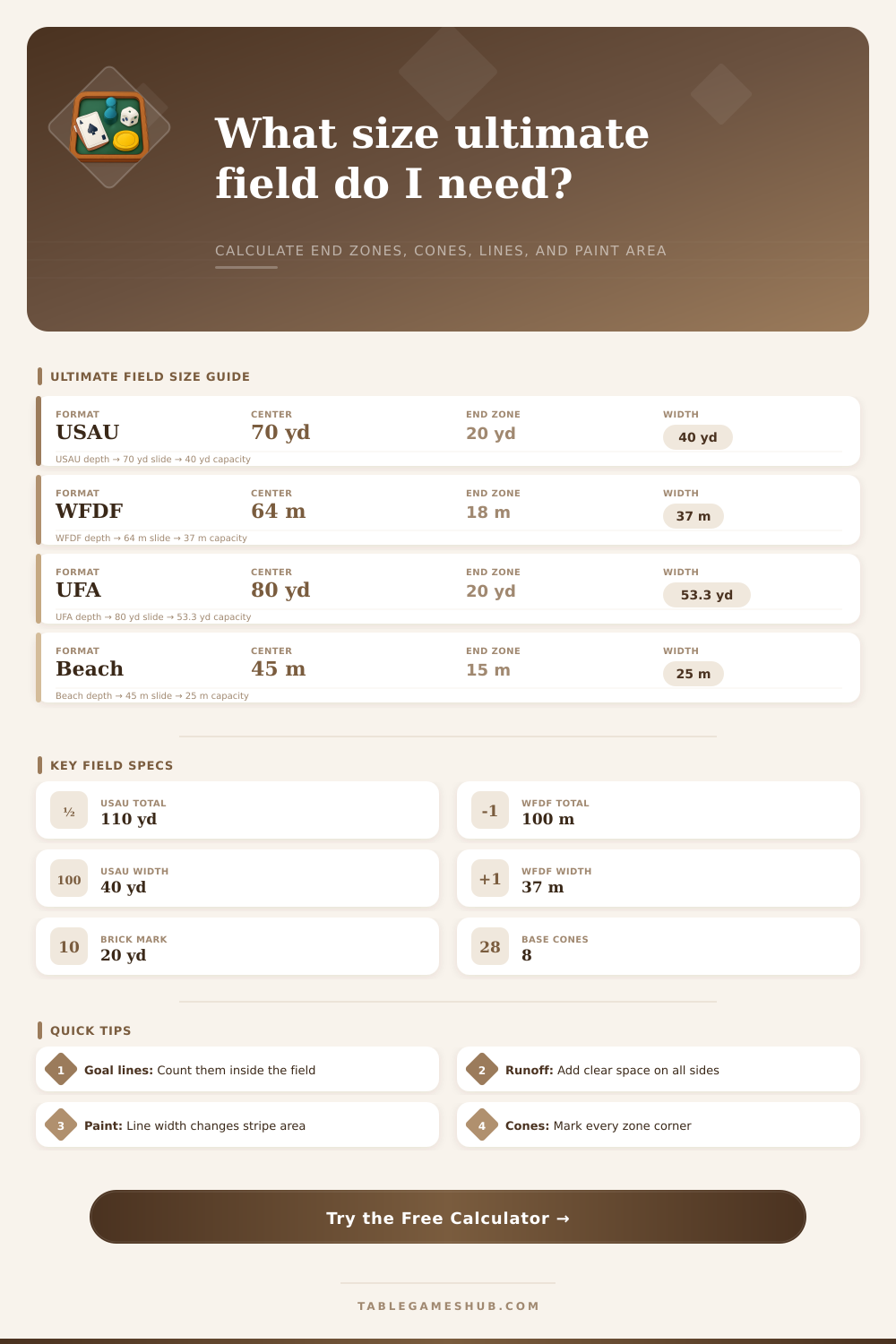
| Format | Central zone | End zones | Total field | Width |
|---|---|---|---|---|
| USA Ultimate regulation | 70 yd | 20 yd each | 110 yd | 40 yd |
| WFDF championship grass | 64 m | 18 m each | 100 m | 37 m |
| UFA football overlay | 80 yd | 20 yd each | 120 yd | 53.3 yd |
| Beach or indoor 5-on-5 | 45 m | 15 m each | 75 m | 25 m |
| Marking item | What it locates | Base quantity | Calculator adjustment |
|---|---|---|---|
| Corner cones | Four outside field corners | 4 | Multiplies by field count |
| Goal-line cones | End-zone front corners on both sidelines | 4 | Included in the base 8 regulation markers |
| Sideline cones | Optional visibility markers along long lines | Spacing based | Uses the sideline cone spacing input |
| Yard-line guides | Interior guide stripes across the central zone | Spacing based | Excludes both official goal lines |
| Brick marks | Two centered crossed marks in the central zone | 2 marks | Adds crossed line length to stripe area |
| Line width | USAU stripe area | WFDF stripe area | Best use |
|---|---|---|---|
| 2 in or 5 cm | About 89 sq ft | About 8 sq m | Temporary tape or light spray |
| 3 in or 8 cm | About 133 sq ft | About 12 sq m | Club field with clear sidelines |
| 4 in or 10 cm | About 178 sq ft | About 16 sq m | Common painted grass layout |
| 5 in or 13 cm | About 222 sq ft | About 20 sq m | High-visibility tournament lines |
| Setup | Field count | Shared line impact | When to use |
|---|---|---|---|
| Single field | 1 | No shared sideline credit | League night or practice |
| Side-by-side pair | 2 | One long sideline can be shared | Small tournament pod |
| Three-field row | 3 | Two shared sideline pairs | Park or school complex |
| Four-field block | 4 | Up to three shared sideline pairs | Event layout with common walkways |
When considering the dimensions of an ultimate field, there is several different factors to consider. The dimensions of the playing area will have a direct impact upon the quality of the game that is played on that field. For instance, if the dimensions of the playing area are too small for the number of player that are to participate in the game, the players will become fatigued more quick during the game.
The length of the central playing area is one of the most important dimension of the field. For adult games, seventy yards are the most common length for the central playing area. Seventy yards of length allow for the handlers to reset the disc after they field a passed disc, as well as allows for the cutters to reach their maximum speed during the game.
Ultimate Frisbee Field Dimensions
If the length of the central playing area is shortened, the offense may begin to feel like the defense is jamming them. In contrast, if the length of the playing area is lengthened, the defense will begin to have an advantage in that the disc will have to travel a longer distance to reach the end zone. The end zones are the area at each end of the field.
The depth of the end zones will impact the field in that it will impact how much room the receiver has to run after the thrower throws the disc. Twenty yards is a standard depth for each end zone. Twenty yards of depth provides a realistic target for the thrower to aim for.
If the end zones are too small in dimensions, it will be more difficult for the offense to score on each play. In contrast, if the end zones are too large, the field will become more stretched out over the course of each game. The width of the field is another dimension that can impact the game in different way.
Forty yards is the most common width for each field. Forty yards of width allow for the offense to spread out, and it prevents the players from becoming limited to the same cutting lane along the field. If the field is made narrower than forty yards, the disc will remain in the middle of the field.
In contrast, if the field is made wider than forty yards, the offense will have more option during the game. The dimension of the runoff space for the field is the area of the field that is beyond the marked rectangle for the ultimate field. Runoff space is created to prevent the players from running into other object within the field, such as tents or spectators.
Five yards of space on each side of the field is the most common dimension for runoff space. If the field is to be hardened, such as with pavement, the field will require more runoff space. Additionally, if the ultimate field is to be used for a tournament, more runoff space may be required.
Without runoff space, the game may become unsafe for the players if they encounter any boundaries or object. Other factors to consider include the width of the lines on the field and the distance between the cone that will mark the boundaries of the ultimate field. Field lines that are four inches in width are common and visible from distances, but require more paint than lines that are thinner in width.
Additionally, if the organizers space the cones closer together, new players will be able to more easily read the boundaries of the field. However, if the cones are to be closer together, more cones will be required to mark the boundaries of the playing field. Many organizations will use different measurements for their field.
The organization that is hosting the game of ultimate frisbee can choose the dimensions according to the rules. For example, USA Ultimate use fields that are seventy yards in length, forty yards in width, and twenty yard end zones. In contrast, WFDF uses the metric system in place of yards for their field measurements.
Additionally, professional leagues may use different width for the fields different than ultimate frisbee clubs in relation to football fields. A field dimension calculator can be used to determine the dimensions of each of these organizations field and the material that is required to construct such fields. If two fields are to be placed next to each other on the same plot of land, the shared sidelines can save cones and paint for the organization.
The sideline that is shared between fields will be the boundary of both field at the same time. A field dimension calculator can take into account the shared sidelines between fields to ensure that the material calculations are not performed twice for the shared sideline of the fields. Using a field dimension calculator will allow for the host of the field to view the outcomes of their decision for constructing the ultimate field.
For instance, the calculator can help the host to determine if adding more runoff space will make the field too large for the grass that is available for ultimate frisbee. Additionally, using the calculator will allow the team to determine how changing the width of the lines will change the amount of paint that will be required for painting the field. Thus, using the calculator will help the host to make decisions regarding the dimensions of the field prior to physicaly constructing the field.