🎲 Domino Spacing Calculator
Calculate stable domino gaps, fall angle, turn strain, surface transfer, and run footprint from actual tile height, thickness, spacing, and curve radius.
| Measure | Result | Formula | Why it matters |
|---|
Long straight lines
Use 28% to 36% of height as the first spacing target, then lower the gap when floors are uneven or tiles vary in thickness.
Curves and circles
Keep turns broad enough that the angular step stays under about 14 degrees between domino faces.
Branch triggers
Reduce the local gap near split points by 10% to 20% so the falling tile reaches both paths cleanly.
Soft surfaces
Carpet, rubber, and thick mats absorb energy, so the same domino often needs a noticeably smaller gap.
| Domino type | Typical height | Typical thickness | Starting gap | Best use |
|---|---|---|---|---|
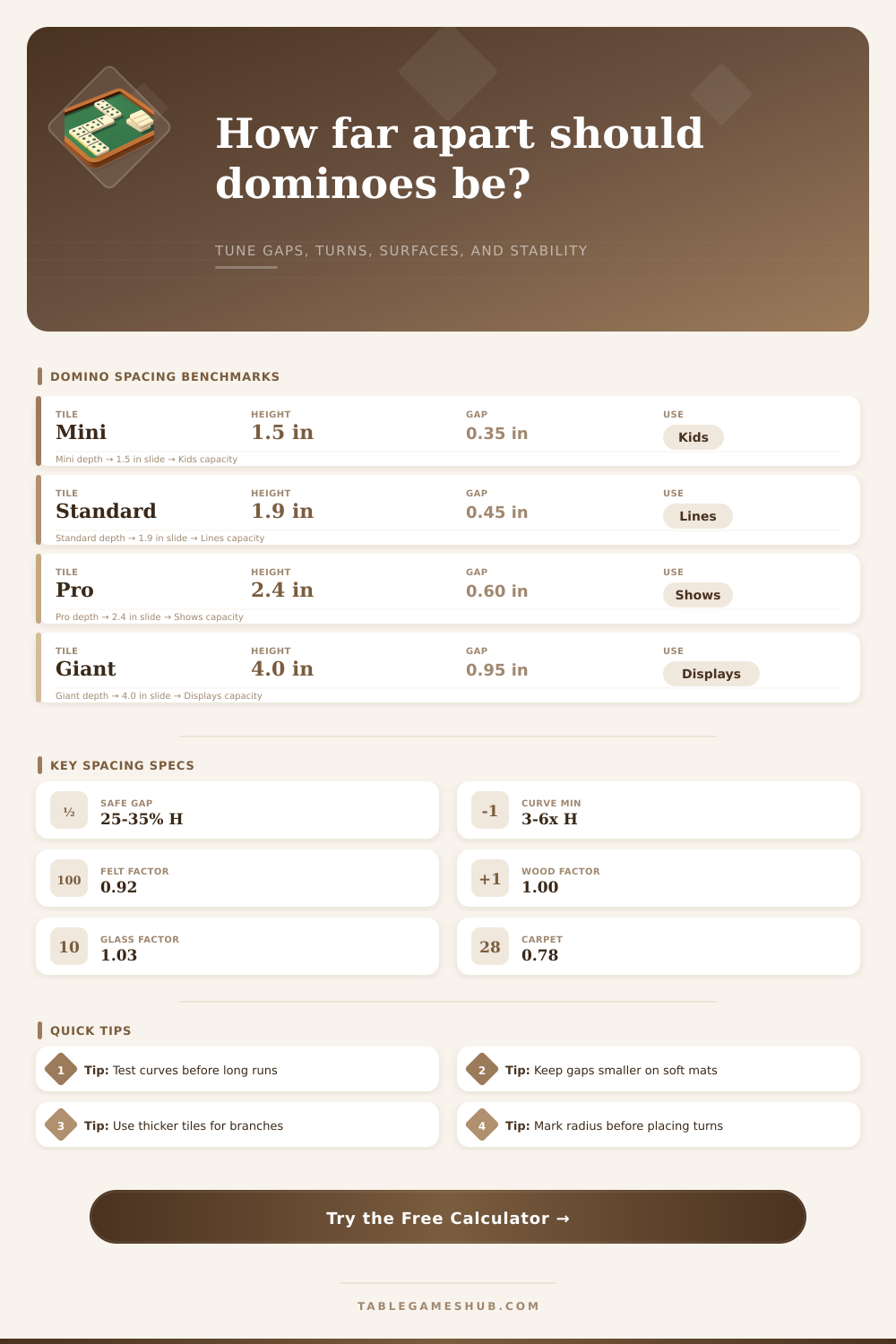
| Mini classroom tile | 1.4 to 1.6 in | 0.20 to 0.24 in | 0.30 to 0.42 in | Small table patterns |
| Standard game domino | 1.8 to 2.0 in | 0.28 to 0.34 in | 0.40 to 0.55 in | Practice lines |
| Builder domino | 2.2 to 2.5 in | 0.28 to 0.40 in | 0.52 to 0.72 in | Show layouts |
| Giant display tile | 3.5 to 5.0 in | 0.50 to 0.90 in | 0.85 to 1.40 in | Floor demonstrations |
| Surface | Factor | Spacing effect | Placement note |
|---|---|---|---|
| Glass display surface | 1.03 | Slightly longer gap | Check glare and fingerprints before filming |
| Smooth wood table | 1.00 | Baseline gap | Good balance of grip and slide |
| Paper template | 0.94 | Shorter gap | Tape the paper flat at the corners |
| Felt game table | 0.92 | Shorter gap | Use heavier tiles if felt is plush |
| Tile or laminate floor | 0.88 | Shorter gap | Grout lines can interrupt long runs |
| Low carpet | 0.78 | Much shorter gap | Expect more rocking and energy loss |
| Curve style | Radius target | Angular step | Recommended adjustment |
|---|---|---|---|
| Gentle show arc | 6x height or more | Under 8 degrees | Use normal gap |
| Table corner curve | 4x to 6x height | 8 to 12 degrees | Reduce gap about 5% |
| Tight turn | 3x to 4x height | 12 to 16 degrees | Reduce gap 10% to 15% |
| Spiral center | Under 3x height | Over 16 degrees | Use very short gaps or widen radius |
| Score band | Gap condition | Turn condition | Practical result |
|---|---|---|---|
| 85 to 100 | Inside safe gap | Wide radius | Good for long continuous runs |
| 70 to 84 | Near limit | Moderate radius | Fine for short tested sections |
| 55 to 69 | Over target | Tight radius | Use smaller gaps near turns |
| Under 55 | Too wide | High strain | Re-space before connecting to the main run |
Test the tightest turn first
Set a 12 to 20 domino sample on the smallest curve in the layout. If the sample slows or misses, reduce the whole curve gap before building the longer run.
Mark a centerline before placing
A light centerline keeps pitch and radius consistent. For branch points, mark both paths so the trigger tile reaches the next dominoes at matching angles.
The reasons that domino runs fails is due to the fact that the gap between the dominoes does not match the height, the thickness, the surface, or an path of the dominoes. However, if the individual sets up the gap, the height, the thickness, the surface, and the path of the dominoes and aligns them with each other correct, then the domino run will continue in a state of momentum. If the gap between the domino run is not correct, however, the domino run will either stall in a turn in the path of the dominoes, or the dominoes will knock on each other sideways, leading to the failure of the domino run.
The gap between the dominoes is the distance that the falling domino must travel to knock over the next domino in the line. The distance that the domino must travel is dependent upon both the height of the domino and the thickness of the domino. Specifically, the thicker the domino, the short the gap that exists between the domino and the next domino in the line.
Why domino runs fail and how to fix them
Likewise, the thinner the domino, the longer the gap between the domino and the next domino. The individual can make these calculations within the calculator to save from having to guess at the distance that the domino run will travel. In addition to the thickness and height of the domino, the surface upon which the domino are placed can also have an effect upon the distance between the dominoes.
For instance, wood is a reliable surface for dominoes due to the flat nature of the wood and the grip that the dominoes will have upon the wooden surface. In contrast, surfaces like felt and carpet will absorb some of the energy of the falling dominoes. Thus, the gap between the dominoes on a carpet will not necessarily be the same as on a wooden table.
Surfaces like glass and laminate will allow for the dominoes to fall long distances due to the reduction of drag that these surfaces will exhibit for the falling domino. In addition to the surfaces upon which the domino are placed, the path of the falling domino run can also have an effect upon the distance between the dominoes. For instance, if the individual comprizeds the path that the domino are to follow of only straight paths, then the gap between the domino may be more readily accomplished than if the path includes some turns.
When the path of the domino turn, the effective distance that each domino will travel can be reduced, especially if the radius of the turn is too small relative to the height of the domino. If the turn of the domino is too large relative to the height of the domino, the falling domino may not make contact with the next falling domino in the line. Thus, the calculator also considers the radius of any turns in the path of the domino run.
Another consideration in the design of a domino run is the use of branches in the path of the domino run. When a domino hit a branch, the falling domino must make contact with two domino paths at the same time. Thus, the falling domino must make contact with both branches before it will lose its momentum.
To account for this, the calculator also includes an input to account for the stress that is placed upon the falling dominoes at a branching point. Another variable in the design of a successful domino run is the concept of the stability reserve. A stability reserve is the gap between the maximum gap that can exist between the domino run and the actual gap that the individual that is constructing the run creates.
If the individual is creating a short run of dominoes, for example, a small stability reserve is all that is needed. However, if the individual is creating a long run of dominoes, or if the thickness of the domino vary along the path of the run, or if the floor is not even, then a larger stability reserve should be used to provide for the additional variables. Thus, an individual reserve selector is included in the calculator to provide the individual with the ability to select the size of stability reserve that they would like to use as part of their plan for constructing a domino run.
As noted above, the distance between the domino run may need to change based off the surfaces upon which the run will occur, the shape of those surfaces, and any turns that may be incorporated into the layout of the dominoes. Thus, the calculator can be used to test different types of layouts, including those that incorporate different types of surfaces and different shapes for the path of the falling domino. Each of the different layout options can be easily selected in the calculator, and the calculator will provide recommendations for each of the different layouts.
Many individuals who attempt to construct a domino run make an error by using a percentage of the height of the domino as the gap between the domino run. While this parameter may work for those who construct their domino runs upon wooden tables, the same percentage may fail for other surfaces. For example, if the percentage of the height is 30%, the same percentage may work for wooden tables, but will fail on carpet surfaces.
Furthermore, 30% of the height of the domino may work for a domino run with few turns, but will be insufficient for a tight spiral of falling domino run. Thus, the individual should of review each of the parameters of the calculator prior to constructing the domino run. The reference tables included in this article allow the individual to review the various parameters of the calculator, such as the different sizes of domino that can be utilized, and the different types of surfaces for which the domino run will be constructed.
These tables will allow the individual to decide if adjustments should be made to the gap between the domino run prior to the beginning of the construction of the actual domino run. The tool will output two different figure. The first of these figures is the gap between the domino run.
The second of these figures is the stability score for the domino run. The stability score will help to ensure that the gap between the domino run is relatively safe from failure. High scores indicate the likelihood that the gap, radius, and the type of surface will work together well to allow for the successful construction of the domino run.
Low scores for the stability score indicate that one of these elements may cause the failure of the domino run. The final test that can be performed to ensure the success of the constructed domino run is to actually construct a short section of the domino run that includes some turns and branch points for the domino to follow. By constructing this short section of the domino run, any issues can be easily detected.
If any issues are recognized, the gap between the domino can be adjusted in these problematic areas of the constructed plan. Thus, the remainder of the domino run can remain the same as the calculated distance between the domino, but the gaps in the problematic areas can be more closely matched to the size of the domino and the expected momentum that each of the domino will exhibit.