Slingshot Band Power Calculator
Plan a controlled target setup by estimating elastic stretch, draw force, stored band energy, transfer loss, and a conservative recreational energy cap.
Band and Draw Inputs
Quick Presets
Current Spec Grid
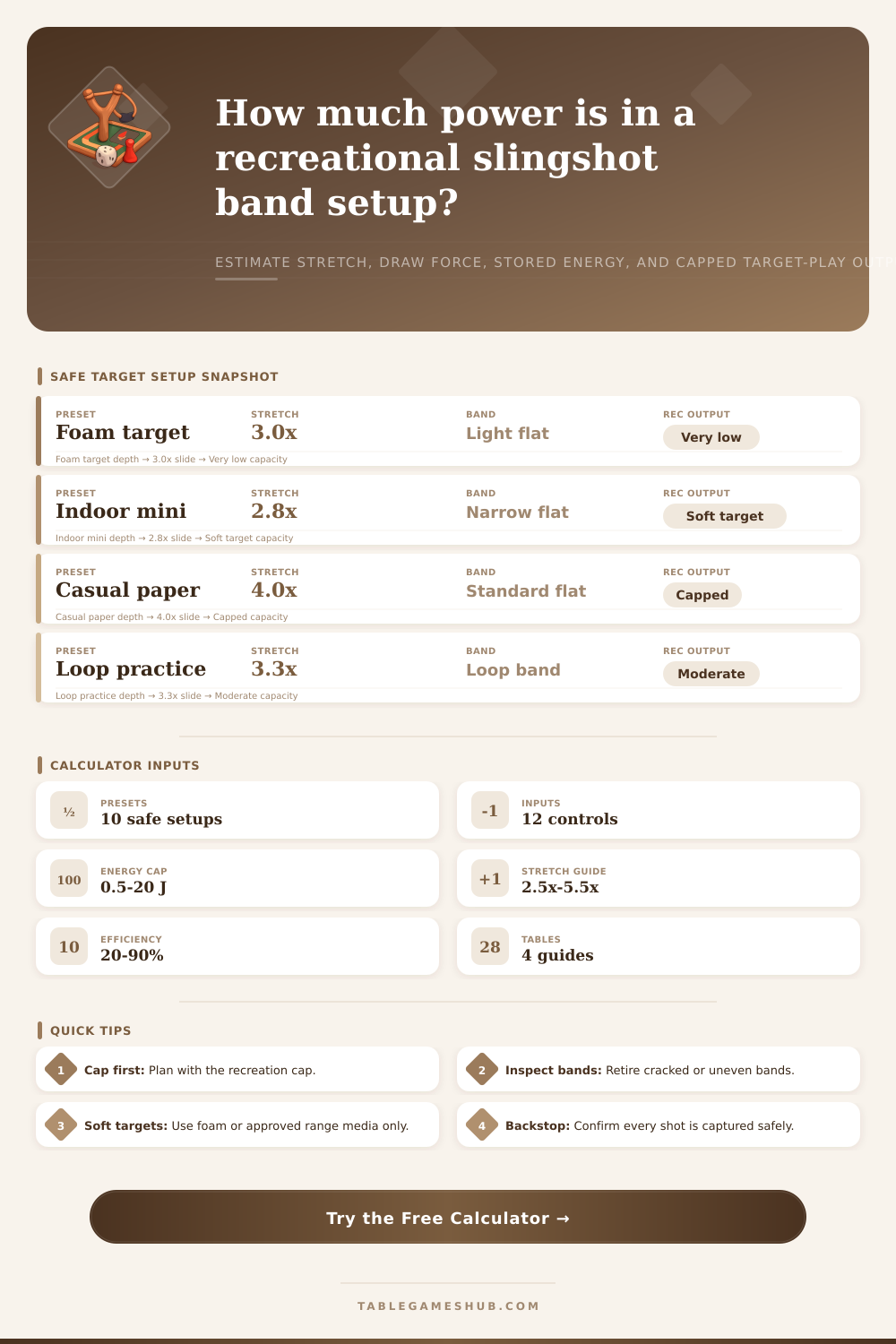
Preset Comparison Table
| Preset | Stretch target | Band geometry | Recreation intent |
|---|---|---|---|
| Foam Target | About 3.0x | 12 mm x 0.45 mm | Very low energy for soft target feedback |
| Indoor Mini | About 2.8x | 8 mm x 0.45 mm | Short lane with foam media only |
| Youth Supervised | About 2.9x | 10 mm x 0.45 mm | Easy draw with adult setup control |
| Casual Paper | About 4.0x | 18 mm x 0.60 mm | General target lane with capped output |
| Loop Practice | About 3.3x | 9 mm x 0.70 mm model | Moderate loop-band feel with a buffer |
Stretch Ratio Guide
| Stretch ratio | Planning meaning | Status label | Practical check |
|---|---|---|---|
| Under 2.5x | Low elastic loading | Gentle setup | May feel slow, but is easier to control |
| 2.5x to 4.5x | Common recreational range | Balanced target setup | Compare width and draw force here first |
| 4.5x to 5.5x | High stretch planning range | High stretch check | Inspect bands often and confirm maker limits |
| Over 5.5x | Very high stretch | Reduce stretch | Lengthen the relaxed band or shorten draw |
Recreational Energy Guide
| Safe rec energy | Use context | Projectile guidance | Backstop reminder |
|---|---|---|---|
| 0.5 to 2 J | Soft indoor target drills | Foam or very light target media | Close distance with eye protection |
| 2 to 5 J | General recreational target play | Soft or approved range projectile | Use a backstop that captures misses |
| 5 to 10 J | Outdoor controlled target lane | Range-suitable projectile only | Keep a clear lane and confirm local rules |
| Over selected cap | Calculator displays the capped value | Reduce band size or draw | Use the capped value for planning |
Formula Reference Table
| Item | Calculator formula | What it means | Limit to remember |
|---|---|---|---|
| Stretch ratio | Draw length divided by relaxed active length | How far the elastic is stretched | Compare against maker guidance |
| Peak draw force | Stress response multiplied by effective band area | Estimated force at full draw | Approximate, not a scale reading |
| Stored energy | Average force multiplied by extension | Energy held in stretched bands | Changes with temperature and band age |
| Safe rec energy | Smaller of transfer energy and cap, then reduced by margin | Conservative target-play output | Use only for recreation planning |
A slingshot band power calculator take specific measurements of your slingshot and translates those measurements into a mathematical calculation of the energy and force that the slingshot will create. By plugging in measurements of the width, thickness, length of the band when it is relaxed, and the draw length of your slingshot, you can determine how much energy and how much force is create by your slingshot. Furthermore, you can use the slingshot band power calculator to understand how the dimension of the band will impact the performance of the slingshot.
The stretch ratio of your slingshot bands is calculate by dividing your draw length by the length of your relaxed active bands. The stretch ratio measures how much the slingshot is stretching the bands in comparison to it’s non-stretched length. If you have a stretch ratio of 4x, for instance, your bands are being stretched to four times than their normal length.
How a Slingshot Band Power Calculator Works
A lower stretch ratio mean that the bands are being stretched less than bands with a high stretch ratio. Consequently, bands will last longer with a lower stretch ratio, but they will store less energy. Bands with a high stretch ratio store more energy, but the elastic is at a higher risk of crack.
By using a slingshot band power calculator, you can see how changing the length of your bands will change the stretch ratio. Two different measurement that are associated with slingshot bands are the force created by the bands and the energy created by the bands. The peak force of the bands is the maximum pull that the bands will exert on the slingshot when you release the bands, but the energy created by the bands is the total work that the bands can do.
Different bands will have the same measurement of peak force, but they may have different amounts of store energy due to the force curves of those bands. The slingshot band power calculator takes into account the force curve of the bands by using a curve factor that change according to the type of bands that you use in your slingshot. The value of energy that is shown in the calculator is the amount of energy that is available for your target practice.
Another factor to consider is the efficiency of the slingshot bands. Not all of the energy that is store by the bands will be transferred to the projectile that you launch from the slingshot. Some energy will be lost to the friction between the bands and the slingshot pouch, and some of that energy will be lost to the slingshot frame.
These losses can be accounted for in the calculator by adjusting the efficiency of the bands. When launching bands for recreational use, the efficiency will most commonly be in the high sixties. Using an efficiency that is lower than the value indicated for recreational use will result in a more conservative estimate of the energy of the bands.
The safe recreational energy value that the calculator provides include this efficiency factor and is the energy value that you should of use when calculating the power of your slingshot. The mass of the projectile that you use in your slingshot will impact the speed at which the projectile travels after being launch. If you use a projectile that has a higher mass than others, the speed of the projectile will be less than if you used a lighter projectile.
The capped speed that is provided in the calculator is the speed at which your projectile will travel based off both the mass that you choose for your projectile and the safe energy value of your slingshot bands. This value can help to indicate if you should change the mass of the projectile that you use in your slingshot. The width and thickness of the bands also impact the force that is create by the bands.
Increasing the width of the bands will increase the area of the bands, which will gradually increase the force that the bands create. Increasing the thickness of the bands will also increase the force of the bands, but the effect is more aggressively than increasing the width of the bands. If you would like to make a small change to the energy of your bands, you can adjust the width of the bands.
However, if you would like to make a large change to the energy of your bands, you should adjust the thickness of the bands. Both of these variable can be tested in the band power calculator prior to cutting or purchasing new bands for your slingshot. Finally, another variable to consider is the effect that the real world can have on your slingshot bands.
For instance, the temperature at which you use your slingshot can alter the stiffness of the latex of the bands. Furthermore, the elastic properties of the bands can wear with repeated use. It is recommended that you check your bands for small nicks in the bands, as well as spots on the bands that are shiny due to friction against the slingshot.
These are indicator that your bands are wearing out, and you should replace them. Thus, while a slingshot band power calculator can help to provide you with a good idea of the energy of your bands, you must also consider how the bands feel to your slingshot in order to determine whether or not it is time to replace the bands.