🎯 Bocce Court Dimensions Calculator
Plan bocce court length, width, foul lines, center line, backboards, sideboards, and pallino zone scaling.
| Layout | Inside Length | Inside Width | Best Fit |
|---|---|---|---|
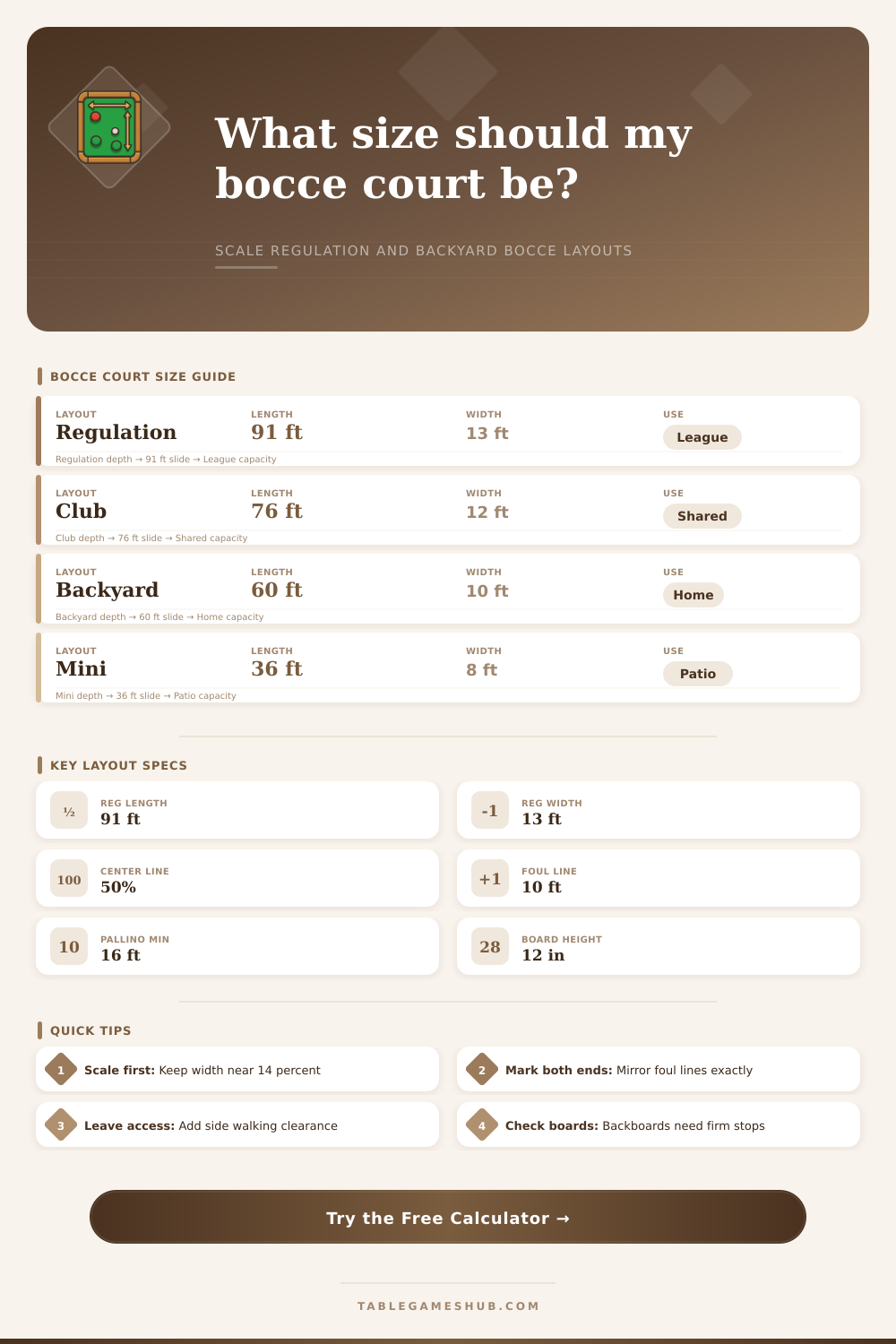
| Regulation court | 91 ft | 13 ft | League and tournament play |
| Club court | 70 to 86 ft | 12 to 13 ft | Community courts |
| Backyard court | 50 to 60 ft | 10 to 12 ft | Home play with full throws |
| Compact court | 30 to 44 ft | 6 to 9 ft | Patio and narrow yards |
| Line | Regulation Position | Scaled Position | Purpose |
|---|---|---|---|
| Foul line | About 10 ft from end | Keep 10 to 16 percent | Throwing boundary |
| Center line | 45.5 ft on 91 ft court | Half of court length | Divides court ends |
| Pallino start | About 16 ft from end | Use 18 to 28 percent | Minimum landing depth |
| Far buffer | About 10 ft before end | Use 10 to 18 percent | Prevents dead landings |
| Board | Common Height | Dimension Role | Calculator Use |
|---|---|---|---|
| Backboard | 12 to 18 in | Stops end shots | Shown in height summary |
| Sideboard | 6 to 12 in | Contains side rolls | Shown in height summary |
| Board thickness | 2 to 4 in | Adds outer footprint | Expands length and width |
| Access clearance | 2 to 4 ft | Walking and approach | Expands total footprint |
| Court Length | Suggested Width | Foul Line | Pallino Zone |
|---|---|---|---|
| 91 ft | 13 ft | 10 ft from each end | 16 to 81 ft |
| 60 ft | 10 to 12 ft | 8 to 10 ft from each end | 12 to 50 ft |
| 44 ft | 8 to 9 ft | 6 to 8 ft from each end | 9 to 36 ft |
| 30 ft | 6 to 7 ft | 4 to 6 ft from each end | 6 to 24 ft |
Tip 1: Scale lines with the court
On short backyard courts, keep the center line at half length and reduce foul and pallino marks proportionally instead of copying every full-size distance.
Tip 2: Size the footprint outside the boards
The playable rectangle is measured inside the boards, but the build footprint also needs board thickness plus walking clearance at both sides and ends.
The dimensions of an bocce court are important to consider because the dimensions of the bocce court will determine the way in which the game is played. The dimensions of a regulation bocce court are 91 feet in length and 13 feet in width. In many case, however, individuals dont have the space to construct a court of such dimensions.
For this reason, many build bocce courts that are more smaller in size than those regulation courts. These smaller courts will alter the way that the game is played with the court; the way in which the balls are to be thrown and the use of the backboards will change. The width of the bocce court is also an important dimension; the width must be wide enough to avoid having the balls of the competing players to collide with one another.
Bocce Court Size and Layout
The calculator included within this article will assist in determining the dimensions of your bocce court based off the length and width of the space in which the court is to be built. The calculator ensure that the foul lines are mirrored from each end of the bocce court. Additionally, the calculator will show the total footprint that is required for the bocce court; such a calculation accounts for the thickness of the boards and the area required for players to walking around the bocce court.
Walking room is required for individuals to be able to move around the court without stepping on the playing surface of the bocce court. Foul lines are an important part of the bocce court design. Foul lines should be positioned between 10% and 16% of the total length of the bocce court from each backboard.
The pallino zone is another element of the bocce court layout. The pallino zone should begin between 16% and 28% of the length of the bocce court from the throwing end. These percentages ensure that the target ball is not too close to the player who is to be throw the balls.
If these percentages are not used in the construction of a bocce court that is smaller than the regulation size, the target zone will be too close to the player and the game strategy will fail. Another factor to consider in the building of a bocce court is the height of the backboards. Sideboards should be constructed to be approximately 8 inches in height; heights of 8 inches will allow the balls to remain within the bocce court yet will not interfere with the viewing of the games of the opponent players.
Backboards should be constructed to be 12 inches in height; 12 inch heights will ensure that the balls does not roll away from the bocce court. The thickness of the bocce court will impact the total footprint that is required for the bocce court. Thus, the thickness of the boards should be accounted for in the calculation of the total dimensions of the bocce court.
Another dimension that will impact the game of bocce is the length of the bocce court. A length of 50 feet is one of the most common lengths of bocce courts that are constructed in backyards. A length of 50 feet will allow the target ball to reach the end of the court at a relatively fast rate.
A length of 36 feet for bocce courts is even more shorter in size. A length of 36 feet will reward players for the accuracy of there throws rather than the power that they utilize in throwing the balls. The length of the bocce court can be tested using the calculator that is provided.
Reference tables will help players to understand how line positions change with different lengths of bocce courts. Another element that is required of a bocce court is a center line. The center line will divide the court into two equal halves.
The center line will prevent arguments between opponents regarding whether the balls crossed into the opponents half of the court. In addition to the center line it is also important to provide walking clearance outside of the sideboards. The lack of walking clearance may result in the players and spectators stepping on the playing surface of the bocce court; stepping on the playing surface will damage the ground and affect the game of bocce.
Bocce courts are often built on the ground; the type of ground upon which a bocce court is built can impact the way in which bocce is played on that court. If the bocce court is built on sloped ground the balls will roll at different speeds on that court; the balls will roll faster on the courts that slope downhill and the balls will roll slower on the courts that slope uphill. Builders that intend to utilize sloped ground may either build extra lengths of the court at the low end of the court or they may build a crown in the middle of the bocce court; the crown will allow water to drain away from the bocce court.
These adjustments to the bocce court will ensure that the balls rolls in the desired manner on that court. Additionally, care must also be taken in the planning of the dimensions for the foul lines and the pallino zone; these dimensions must be accounted for to ensure that the players understands the strategy of the game.