6-Sided Dice Probability Calculator
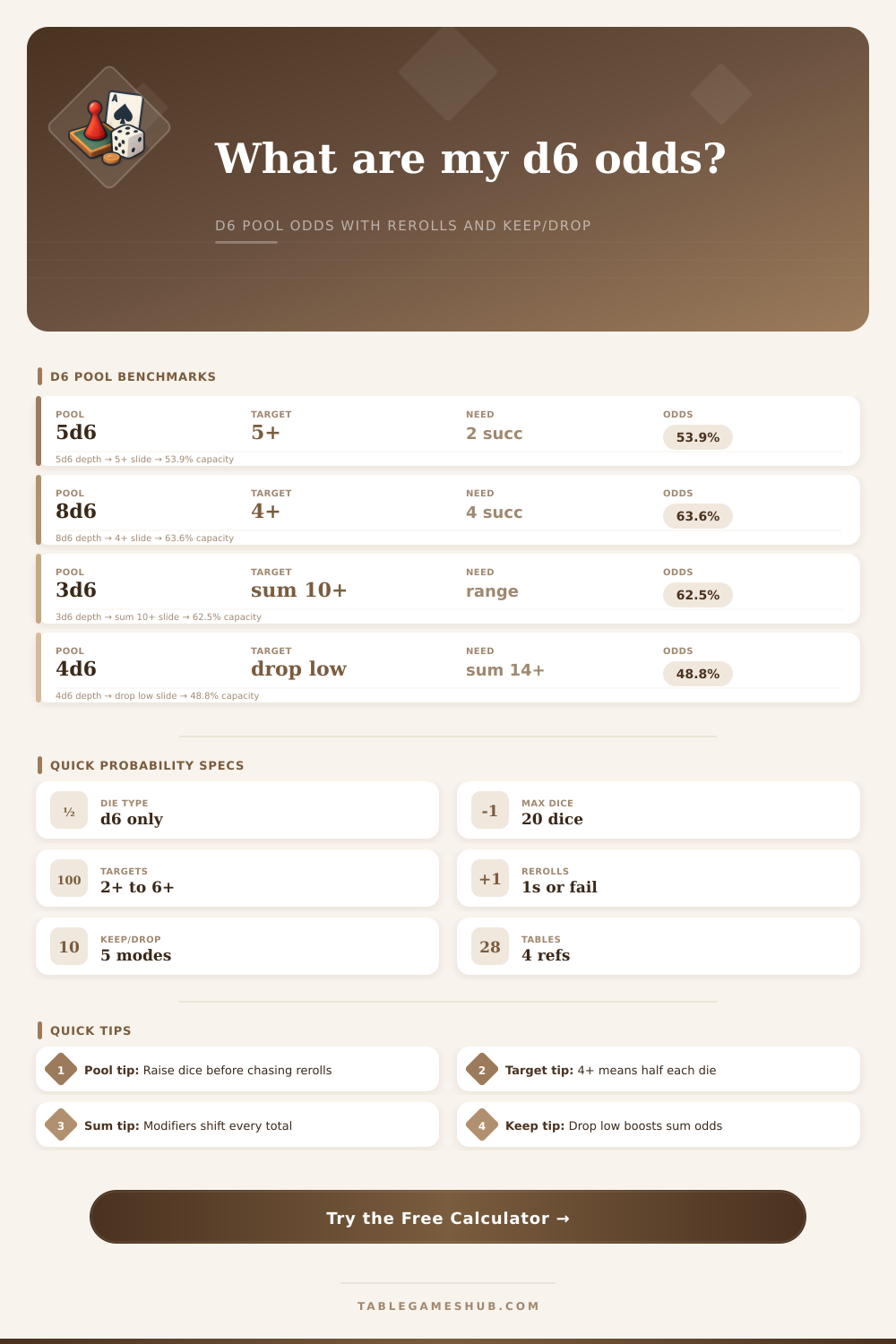
Calculate d6 pool success odds, target-number checks, sum ranges, rerolls, flat modifiers, and advantage-like keep or drop dice in one focused tool.
| D6 Target | Winning Faces | Base Per-Die Odds | With Reroll 1s | Common Use |
|---|---|---|---|---|
| 2+ | 2, 3, 4, 5, 6 | 83.33% | 97.22% | Very easy success gate |
| 3+ | 3, 4, 5, 6 | 66.67% | 77.78% | Strong attack or skill check |
| 4+ | 4, 5, 6 | 50.00% | 58.33% | Even d6 success test |
| 5+ | 5, 6 | 33.33% | 38.89% | Hard pool threshold |
| 6+ | 6 only | 16.67% | 19.44% | Critical or rare success |
| Pool Size | 4+ Expected Hits | 5+ Expected Hits | 6+ Expected Hits | Useful Read |
|---|---|---|---|---|
| 3d6 | 1.50 | 1.00 | 0.50 | Small check, swingy outcome |
| 5d6 | 2.50 | 1.67 | 0.83 | Common compact dice pool |
| 8d6 | 4.00 | 2.67 | 1.33 | Reliable mid-size pool |
| 12d6 | 6.00 | 4.00 | 2.00 | Large attack or effect pool |
| Keep/Drop Mode | Dice Used | Best For | Sum Effect | Success Effect |
|---|---|---|---|---|
| Keep all | All rolled dice | Standard pools | Baseline average | Baseline hit count |
| Drop lowest | All but low die | Advantage-like sum checks | Raises total | May remove a failure |
| Drop highest | All but high die | Disadvantage-like checks | Lowers total | May remove a success |
| Keep highest | One best die | Single-die advantage | Strong high-end bias | Counts best die only |
| Keep lowest | One worst die | Single-die penalty | Strong low-end bias | Counts worst die only |
| Rule Modifier | Calculator Input | Applies To | Exact Handling | Example Use |
|---|---|---|---|---|
| Flat total bonus | Modifier | Sum modes | Shifts every total | 2d6 plus 2 needs 9+ |
| Auto success | Bonus successes | Success modes | Shifts hit count | Skill rank adds one hit |
| Reroll 1s | Reroll rule | Face distribution | Once-only d6 reroll | Elite attack dice |
| Reroll failures | Reroll rule | Target failures | Uses target number | Blessed or focus effect |
When you use dice to determine the outcome of an event, you are utilizing the mathematical concept of probability to attempt to achieve a specific result from that event. Yet, many people struggles to understand the mathematics behind dice rolls. For example, a person may believe that using a certain number of dice will provides the player with a high chance of success with there roll.
Yet, a player’s intuition in this situation is often incorrect because human intution does not accurately calculate the probability of certain events occur. Probability are the study of the likelihood of an event occurring. Understanding this concept is essential for understanding the mathematics behind the act of rolling dice.
How Dice, Target Numbers, and Rules Change Your Chances
For a single die, the probability of any number coming up is linear. Yet, for a large pool of dice, the results tend to cluster around an average value. Adding one die to a small pool of dice will have a significant impact on that average rolls result.
Yet, adding one die to a large pool will have a much smaller impact on that average result. This is a law of diminishing returns. The law of diminishing returns states that as a group of players increases, the benefit of adding one more player to that group decrease.
The target number for a roll determine the probability of each die in the pool rolling a success. For instance, changing the target from a four plus to a five plus will reduce the chance of success of each die in the pool. Changing the target number is a significant change for the game because this change will affect each die in the pool at the same time.
Many players dont properly understand the impact that the target number will have on the game. Yet, it is this number that often has the greatest impact on the game roll compared to the number of dice in the pool. The other factor in determining the probability of success in a game is the use of modifiers.
There are several different type of modifiers. One type is the bonus success modifier. A bonus success modifier adds one guaranteed success to the total number of successes for the roll.
This type of modifier remove the uncertainty of the dice roll as a bonus success cannot fail. A flat modifier is a bonus that is mathematically added to the total sum of the dice. A flat modifier will shift the probability curve of the dice pool but will not guarantee a specific result from that pool.
A bonus success is a different mathematical tool than a flat modifier because a bonus success will eliminate the volatility of the dice pool, while a flat modifier will only change the likelihood of the different outcomes of that dice pool. Rerolls are a type of modifier that allow a player to roll a die a second time. By rerolling a die, the player changes the probability of a successful outcome of that die.
Rerolls allow a player to replace a failed roll of a die with a new roll of that die. However, the reroll will not guarantee success for the player if the target number for that die is too high. Furthermore, there is a mathematical ceiling to the reroll that will limit a player to the probability of only the second roll of the die.
Keep and drop rules are modifiers that require a player to keep certain dice within a pool and to drop other dice within that pool. One of the most common rule of this type is the rule that asks for a player to drop the lowest die within a pool. By dropping the lowest die within a pool, you reduce the probability of rolling a catastrophic failure for that die pool.
Furthermore, by dropping the lowest die within a pool, the player increases the probability of the sum of the dice in that pool being a high number. Reference tables can be used to determine the expected number of hits for a pool of dice of a certain type. Using these reference tables, it is possible for a game designer or game master to compare the expected outcomes of different pools of dice.
Should the success rate within a game session be determined to be too high with a given pool, those reference tables can show the designer how to change the size of the dice pool or the target number for that dice pool. Changing either of these factors will allow for a change in the difficulty of the game. The goal of using dice within a game is to create tension within the players.
For players to feel tension when rolling the dice, the outcome of that roll should be neither impossible for the players to roll nor certain. If the outcome of a roll of the dice is impossible for the players, tension will result in frustration for the players. However, if a player feels that a certain outcome of the dice roll is certain, the players will begin to feel boredom towards the game.
Thus, by testing different combination of dice, target numbers, and other rules, it is possible for a game master to determine the level of tension that they wish to provide to the players. By testing different combinations of game elements, a game master can manage the experience of the game based off math rather than through intuition.