Nim Strategy Calculator
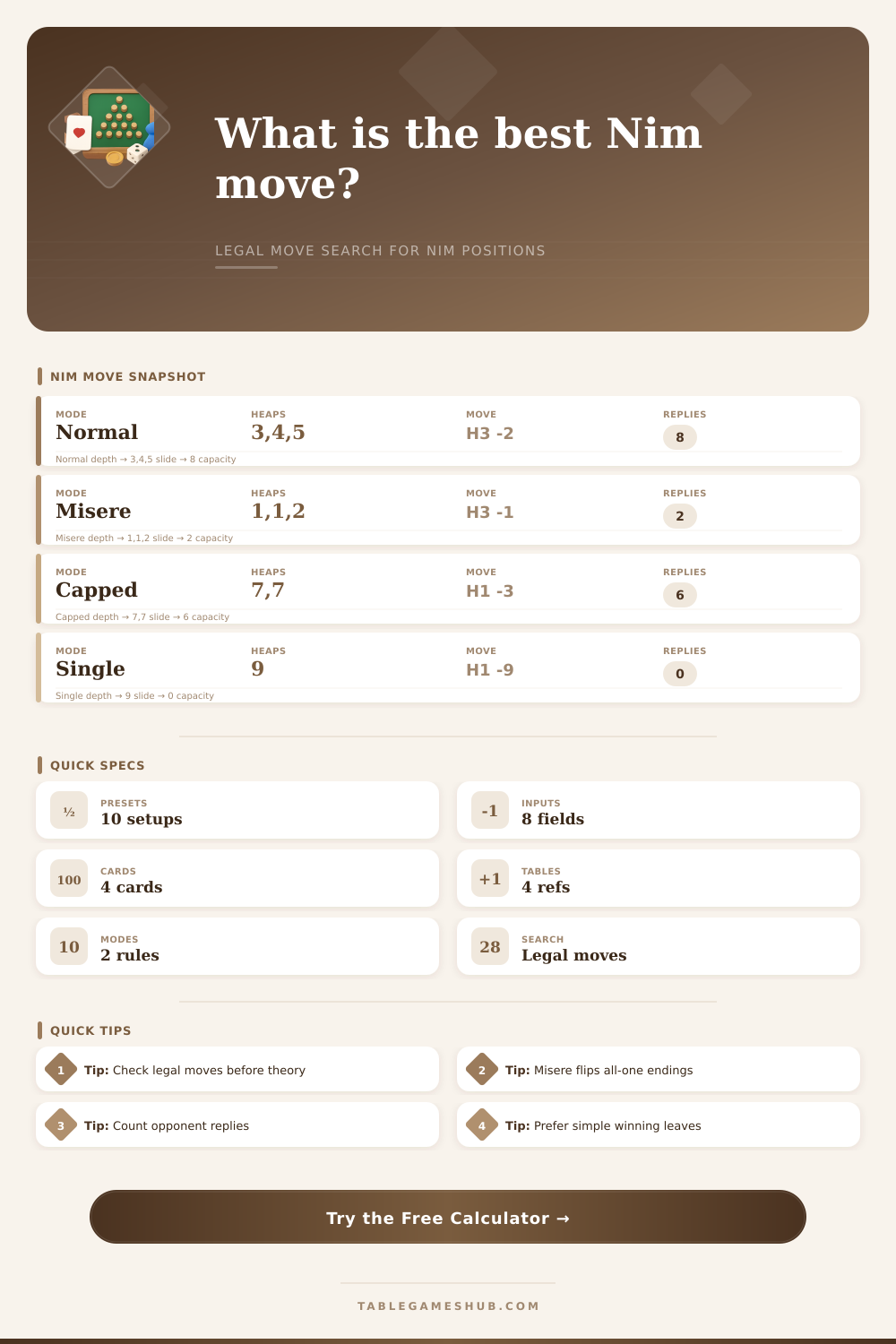
Search legal Nim moves, compare normal and misere play, choose a target heap, remove count, next position, and likely opponent reply count.
| Rank | Move | Next Position | Result | Opponent Replies |
|---|---|---|---|---|
| Run the calculator to compare legal moves. | ||||
| Reply | Position After Reply | Your Status | Reply Type |
|---|---|---|---|
| Choose a move to see likely replies. | |||
| Pattern | Normal Play | Misere Play | Calculator Check |
|---|---|---|---|
| Nim sum 0 | Player to move is usually behind | Same unless all heaps are 1 | Searches every legal move |
| Nim sum nonzero | At least one zeroing move exists | Same before the all-one ending | Finds target heap and remove count |
| All heaps 1 | Odd count wins for player to move | Even count wins for player to move | Uses parity instead of plain XOR |
| Capped remove | May block the classic zeroing move | May change the endgame trap | Ranks only legal counts |
| Preset | Mode | Heaps | Focus |
|---|---|---|---|
| Classic 3, 4, 5 | Normal | 3, 4, 5 | Zeroing move search |
| Misere 1, 1, 2 | Misere | 1, 1, 2 | Leave odd all-one count |
| Capped 7, 7 | Normal | 7, 7 | Limit-aware legal counts |
| Misere Trap 1, 1, 1, 5 | Misere | 1, 1, 1, 5 | Endgame conversion |
Nim is a game that is played with pile of objects. Nim is also a game that rely upon mathematical logic in order to win the game. To play Nim, players must remove any number of object from a single pile during their turn.
The game continues until the final object have been removed from the final pile. The rules for winning the game may differ based off the rules that the player have chosen to use to play the game. In Normal play, the player who removes the last object from the game is the winner.
How to Win at Nim Using Nim Sum and Parity
In Misere play, however, the player who remove the last object is the loser of the game. In order to win the game of Nim, players must utilize the mathematical concept of the Nim sum. The Nim sum isnt the simple addition of the number of objects in the piles.
Instead, the Nim sum is the result of performing a bitwise operation (an XOR operation) upon the number of objects in each of the pile. If the calculated Nim sum is 0, the player whose turn it is to remove objects is in a losing position. If the calculated Nim sum are not 0, the player whose turn it is to remove objects is in a winning position.
A winning player can always find a move that will ensure that the calculated Nim sum will become 0, and a winning player can always force the opponent into a losing position by ensuring that the Nim sum is 0. A player who finds it difficult to calculate the Nim sum in their heads may wish to utilize a strategy tool. Such a tool allow a player to enter the number of objects in each of the game piles.
Based upon the number of objects in each pile, the strategy tool can calculate the Nim sum for that player. Furthermore, the strategy tool can also indicate which of the piles that the player should target to remove objects, as well as how many objects should be removed from that targeted pile in order to ensure that the Nim sum is 0. Using such a strategy tool can make the mental math involve in calculating the Nim sum easier for that player.
The strategy to win the game is the same throughout the bulk of the game. At the end of the game, however, the strategy may change. In the endgame, it is common for each of the remaining piles to contain only one object.
In this instance, the player can utilize the logic of parity instead of the logic of the Nim sum. In games that are played in Misere mode, for instance, the player should ensure that an odd number of remaining piles with only one object remain for the opponent. If the player dont utilize the logic of parity during the endgame of the game, the player may end up losing the game overall, even if they successfully used the logic of the Nim sum throughout the remainder of the game.
In some versions of the game of Nim, the rules include a limit to the number of objects that can be removed from a given pile. The classic strategy of the game may not always be able to be utilize within these versions of Nim. The strategy tool includes a feature that account for these limits on the number of objects that can be removed from a given pile.
Thus, the strategy tool will not suggest a move that would remove a number of objects from a pile that would violate those limits on the number of objects that can be removed. Instead, the strategy tool will find the best move within the game that complies with the rules of that version of Nim. A player may also win the game of Nim by ensuring that their opponent has as few move as possible to respond to their most recent move.
If a player finds two different move that will result in the Nim sum becoming 0, they should select the move that will leave their opponent with the fewest number of legal moves. By limiting the legal moves that their opponent has, the opponent will be less likely to make a move that will return the Nim sum to 0. Thus, the player is maintain their winning position.
To win the game of Nim, a player must stop thinking of the game in terms of the objects in the piles, and to think of the piles in terms of the mathematical logic of the game. If the piles has a Nim sum that is not 0, the position is a winning position for the current player. If the Nim sum is 0, the position is a losing position for the current player.
The goal is to always move the game from a winning position to a losing position for the opponent. If the player understands the logic of the Nim sum and the logic of parity, they can move from playing the game of Nim at random to playing the game in a calculated way.