🔢 Killer Sudoku Cage Calculator
Find no-repeat digit combinations by cage size, target sum, digit range, and required or excluded digits.
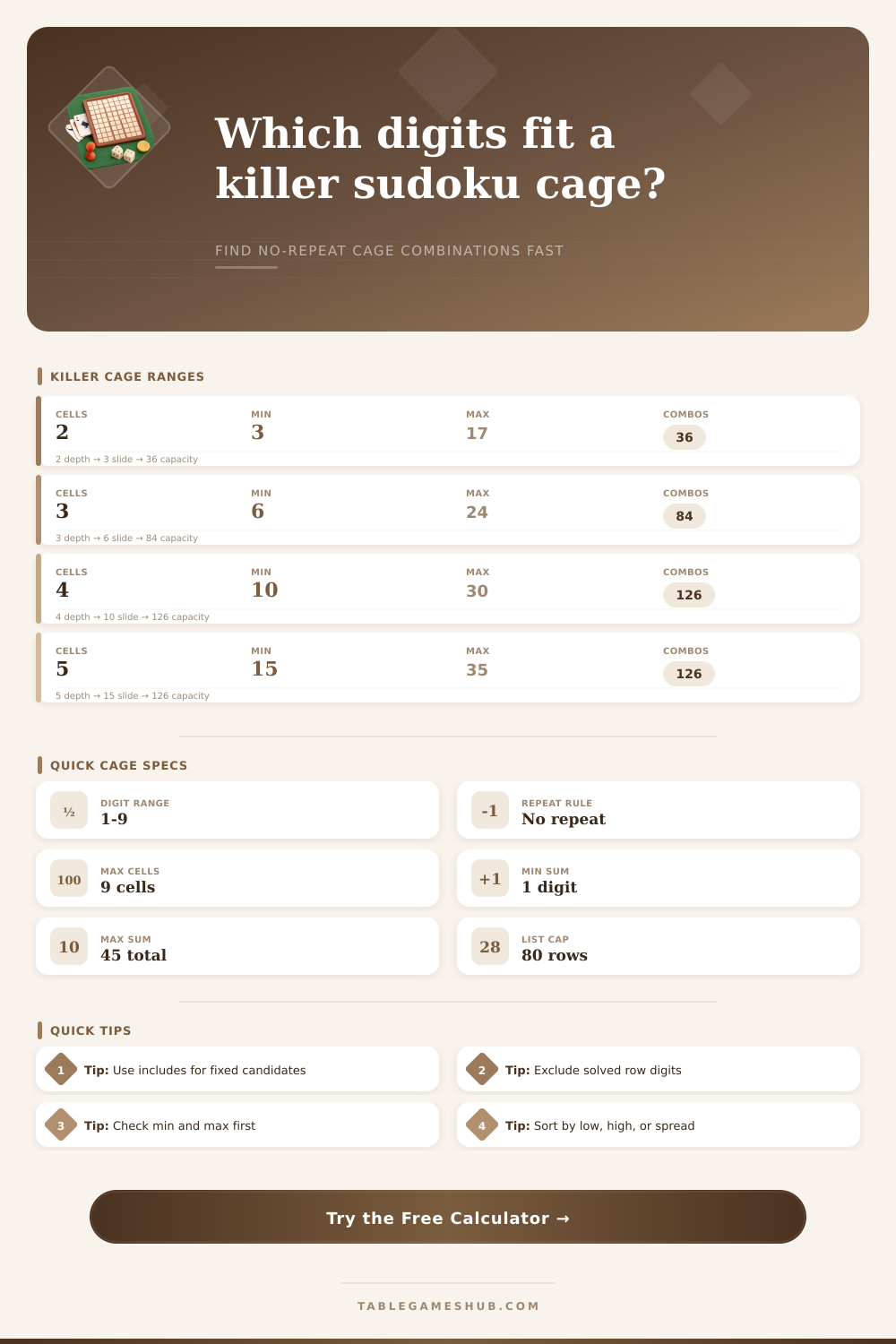
| Cage Size | Minimum Sum | Maximum Sum | Total Sets |
|---|---|---|---|
| 1 cell | 1 | 9 | 9 |
| 2 cells | 3 | 17 | 36 |
| 3 cells | 6 | 24 | 84 |
| 4 cells | 10 | 30 | 126 |
| 5 cells | 15 | 35 | 126 |
| Common Cage | Combinations | Forced Pattern | Solver Read |
|---|---|---|---|
| 2 cells, sum 3 | 1+2 | Only low pair | Immediate set |
| 2 cells, sum 17 | 8+9 | Only high pair | Immediate set |
| 3 cells, sum 6 | 1+2+3 | Only low trio | Strong clue |
| 3 cells, sum 24 | 7+8+9 | Only high trio | Strong clue |
| Filter Type | Input Example | What It Does | Best Use |
|---|---|---|---|
| Include | 2,7 | Requires both | Known candidates |
| Exclude | 1,5,9 | Removes digits | House cleanup |
| Range | 3 through 8 | Limits pool | Pencil marks |
| Parity | Mostly odd | Tests odd/even | Pattern scan |
| Target Check | Meaning | Next Step | Example |
|---|---|---|---|
| Below min | Too small | Increase sum | 4 cells, 9 |
| Above max | Too large | Lower sum | 2 cells, 18 |
| Zero combos | Filters conflict | Review digits | Include 9, sum 6 |
| One combo | Forced set | Place carefully | 3 cells, 24 |
Tip 1: Check the range before solving
If the target is below the smallest possible sum or above the largest possible sum, the current cage size or candidate range is wrong.
Tip 2: Use includes and excludes together
Add known cage candidates as includes, then exclude solved row, column, or box digits to reveal the remaining legal sets.
Killer Sudoku is a logic puzzle that requires the player to solve each of the cages according to a specific sum for each cage, as well as according to the rule that the digits in each of the cells in a cage cannot repeat. Each of the cages must contain a group of cells whose digits adds up to the target sum for that cage, and each of the digits within a cage must follow the normal rules of Sudoku (each digit in a row, column, and box within the puzzle must be used only once). Many people often experience mental fatigue when attempting to calculate all of the possible combination of digits within each of the cages.
This type of fatigue can occur due to the large number of possible combinations for any given cage. One way to combat this fatigue is to use a combination calculator to determine all of the possible combinations of digits within any given cage in the puzzle. The combination calculator can be helpful for Sudoku puzzles in that it eliminate the need for the player to perform these calculations in there head.
Solve Killer Sudoku with a Combination Calculator
A combination calculator is a tool that allows the player to input the number of cells within a cage, as well as the target sum for that cage. The calculator will then output all of the possible combinations of digits that can total the target sum for that cage and contain only a number of digits that correspond to the number of cells within that cage. Some cages will contain many possible combinations for their digits, and these are referred to as flexible cages.
Other cages will contain only a single possible combination of digits that will total the target sum for the cage. These types of cages are referred to as rigid cages, and the combination of digits that is the only possible combination within that rigid cage is referred to as a forced set. These types of forced sets can be very useful in that they allows for the certain placement of a set of digits within the Sudoku puzzle.
One method for solving Killer Sudoku is to use the process of elimination to reduce the number of possible combinations for each of the cages. This process of elimination can be performed in part due to the discoveries of digits that are revealed through the rules of standard Sudoku. For instance, if any of the digits within a cage are known to be a certain digit, the player can subtract that digit from the target sum for the cage, and the remaining cells will have to contain the new target sum for the remaining cells.
Furthermore, the player can further eliminate these combinations by using the calculator to remove any digits that is already use within the row, column, or box that the cage occupies; this will prevent any illegal combinations for those Sudoku cells. An understanding of the minimum and maximum possible sums for each of the cages within a Killer Sudoku puzzle are essential skill for successfully solving the puzzle. An understanding of these possible sums can help to identify any errors in the logic of the player.
For instance, any four-cell cage will have a minimum possible sum of 10; the digits 1, 2, 3, and 4 are the four smallest digits within the Sudoku puzzle, and their sum is 10. Therefore, if any player discovers a four-cell cage that has a target sum of 9, they will know that that target sum is impossible for that four-cell cage. Knowing that this target sum is impossible will help the Sudoku player to find mistakes in there work on the puzzle.
Parity is another concept that can be used to solve Killer Sudoku puzzles. Parity is a term used to describe whether a number is odd or even. Any cage that requires a total number of digits that is odd will contain an odd number of digits within the cage that are odd themselves.
Furthermore, each of the cages within Killer Sudoku are not isolated from the rest of the puzzle. Each of the digits within any combination must still obey the rules of Sudoku; they cant be used more than once within the row, column, or box that contains those cells. Finally, a player can achieve certainty within Killer Sudoku by discovering all of the forced sets within the puzzle, and through the use of the process of elimination to remove each of the incorrect digit combinations from each of the cages.
Its important to use the calculator to avoid errors based off math mistakes. A person should of checked there work more carefuly.