Star Wars Legion Dice Calculator
Estimate attack dice output through surge conversion, aim rerolls, cover, Armor and Impact, defense dice, block surges, expected hits, and expected wounds.
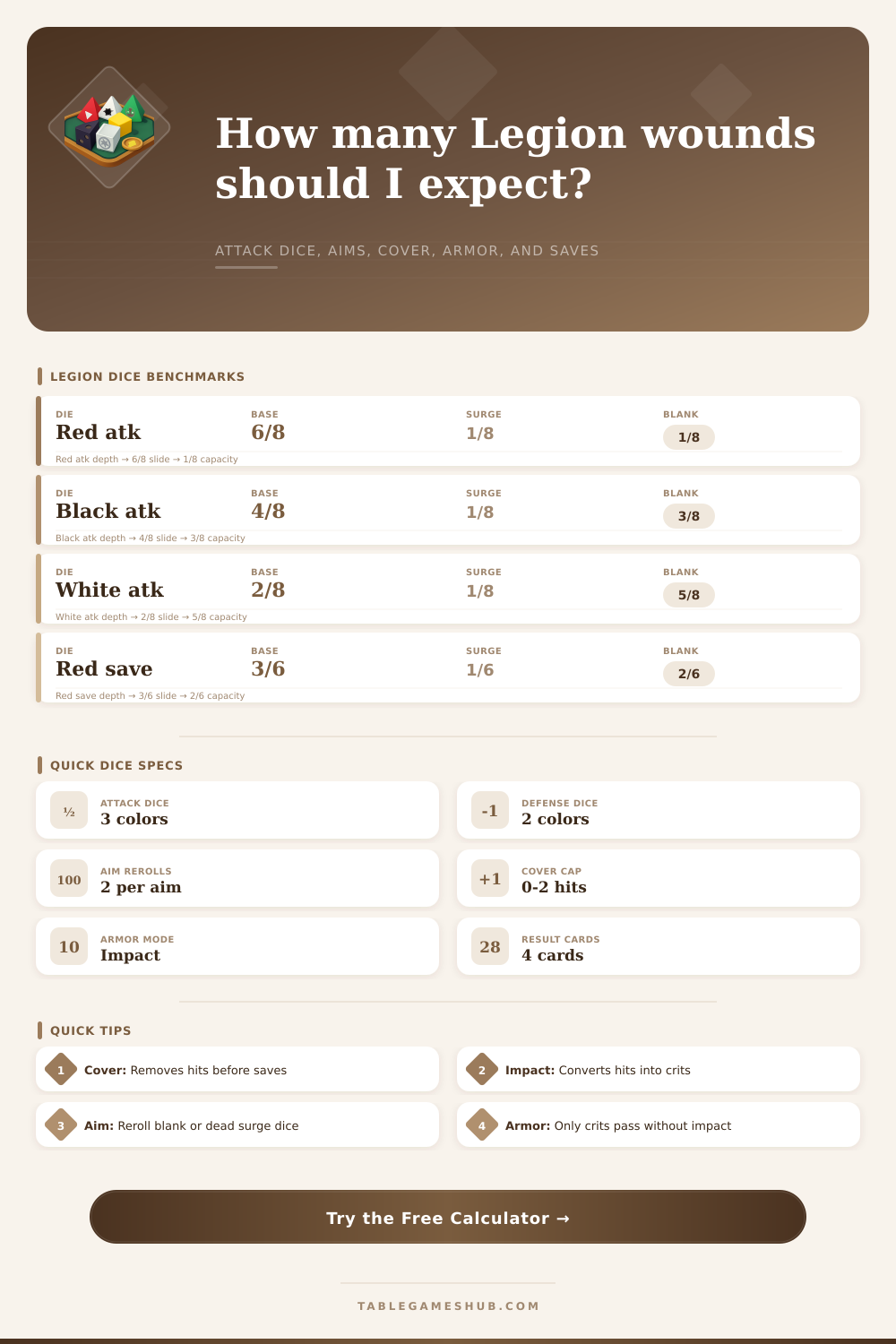
| Attack Die | Hit Faces | Crit Faces | Surge Faces | Blank Faces |
|---|---|---|---|---|
| Red attack d8 | 5 of 8 | 1 of 8 | 1 of 8 | 1 of 8 |
| Black attack d8 | 3 of 8 | 1 of 8 | 1 of 8 | 3 of 8 |
| White attack d8 | 1 of 8 | 1 of 8 | 1 of 8 | 5 of 8 |
| Surge to crit | Same hit faces | Add surge face | Converted | Unchanged |
| Modifier Step | What Changes | Ignored Results | Best Input Use | Calculator Output |
|---|---|---|---|---|
| Aim token | Reroll up to 2 dice | Kept hits and crits | Set aims from action or token sharing | Expected reroll gain |
| Light cover | Cancels 1 hit | Critical results | Choose cover value 1 | Hits after cover |
| Heavy cover | Cancels 2 hits | Critical results | Choose cover value 2 | Hits after cover |
| Impact vs Armor | Converts hits to crits | Excess normal hits | Set Armor active and Impact value | Crits after Impact |
| Defense Die | Block Faces | Surge Faces | Blank Faces | Block With Surge |
|---|---|---|---|---|
| Red defense d6 | 3 of 6 | 1 of 6 | 2 of 6 | 4 of 6 |
| White defense d6 | 1 of 6 | 1 of 6 | 4 of 6 | 2 of 6 |
| No defense dice | 0 of 6 | 0 of 6 | All wounds | 0% |
| Surge to block | Add surge face | Converted | Unchanged | Plus 16.7% |
| Common Pool | Dice Mix | Typical Surge | Typical Defense | Useful Check |
|---|---|---|---|---|
| Line infantry plus heavy | Red and black dice | None or hit | Red or white saves | Cover tax on normal hits |
| Large white dice pool | Many white dice | Hit or crit matters | Usually infantry saves | Aim value from blank dice |
| Anti-armor shot | Red or black dice | Crit is strong | Armor active | Impact converts enough hits |
| Heavy cover target | Any attack pool | Crit bypass helps | Normal saves after cover | Whether aims beat cover |
Star Wars Legion is a tabletop game that determine the outcome of its battle with the use of dice and rules. The combat in this game are especialy complex due to the various ways in which players account for modifiers and dice rolls to determine if the attack from one player lands on the opponent model. The variable for each attack include attack pools, aim tokens, cover, armor, and defense dice.
If a person is not knowledgeable of these variables, then the player will have to rely on luck to determine the outcome of the attacks their units make against the opponent’s model. The attack pool for each unit include three different color of dice. Red dice are reliable in that they will hit the target models on the battlefield.
How Dice and Rules Decide Attacks in Star Wars Legion
White dice are unreliable because they will not result in a hit with the target as often as the other color, but they will also hit the target with critical hit. Black dice are also used in attack pools for each model. However, black dice are less effective at clearing heavy cover due to the fact that they do not roll critical hits as often than the other colors of dice.
Thus, the color of the dice in an attack pool can determine the effectiveness of the attack of a model. Aim token can be used to reroll two dice from an attack pool. The player should use the aim tokens on specific color of dice within the attack pool.
For instance, the aim tokens can be used to reroll the blank or non-critical hit dice within an attack pool. By using aim tokens wise, a player can ensure that they’re attack is optimized. By optimizing the attacks for their models, the model will remain effective throughout the game.
Cover is a rule in Star Wars Legion that indicate the degree of difficulty in attacking a model. Cover can remove normal hits from an attack pool before the target rolls defense dice. Light and heavy cover can remove the normal hits from an attack pool prior to the defense dice being rolled.
Thus, models that rely upon normal hits will be unable to damage the target with cover. However, critical hits will ignore the effect of cover. Armor is a rule for models that indicate that normal hits will not damage the model with armor.
Only critical hits can damage models with armor. Thus, in order to damage models with armor with normal hits, the impact keyword must be used for those models. The impact keyword allow models to convert normal hits to critical hits.
Therefore, if there are insufficient impact keywords for models to convert normal hits to critical hits, normal hits will not damage models with armor. The player uses defense dice to block the damage that is made by the opposing model. Red defense dice will block hits from the opponent’s attack pools frequently.
White defense dice will not block the attacks as often. Additionally, surge can be used to block abilities from the opponent’s models to increase the blocks that is made by a player’s models. The relationship between the attack pool and the defense dice determine how many wound the target model will take.
For players to succeed in the game, it is more important for them to understand the mathematical distribution of the outcomes of the game than it is for them to be able to accurately roll the dice for their attack pools. Although the rolls of the dice for each model are random, the distribution of the outcomes is a mathematical calculation that provide the players with an average expected outcome for each roll of the dice. For instance, if the math for an attack indicates that the outcome will cause two wounds to be taken by the model but the model has five wounds, the attack will not remove that model from the game.
If players understand the mathematical probability of outcomes of the attacks, players can continue to plan the attacks of their models accordingly. By using data to understand the interaction of the variables of aim tokens, cover, and armor, players can make decisions during the game based off calculated probabilities of the outcomes rather than luck.