Hula Hoop Calorie Calculator
Estimate hula hoop workout calories from body weight, duration, hoop weight, cadence, waist or arm style, interval ratio, skill level, and adjusted MET.
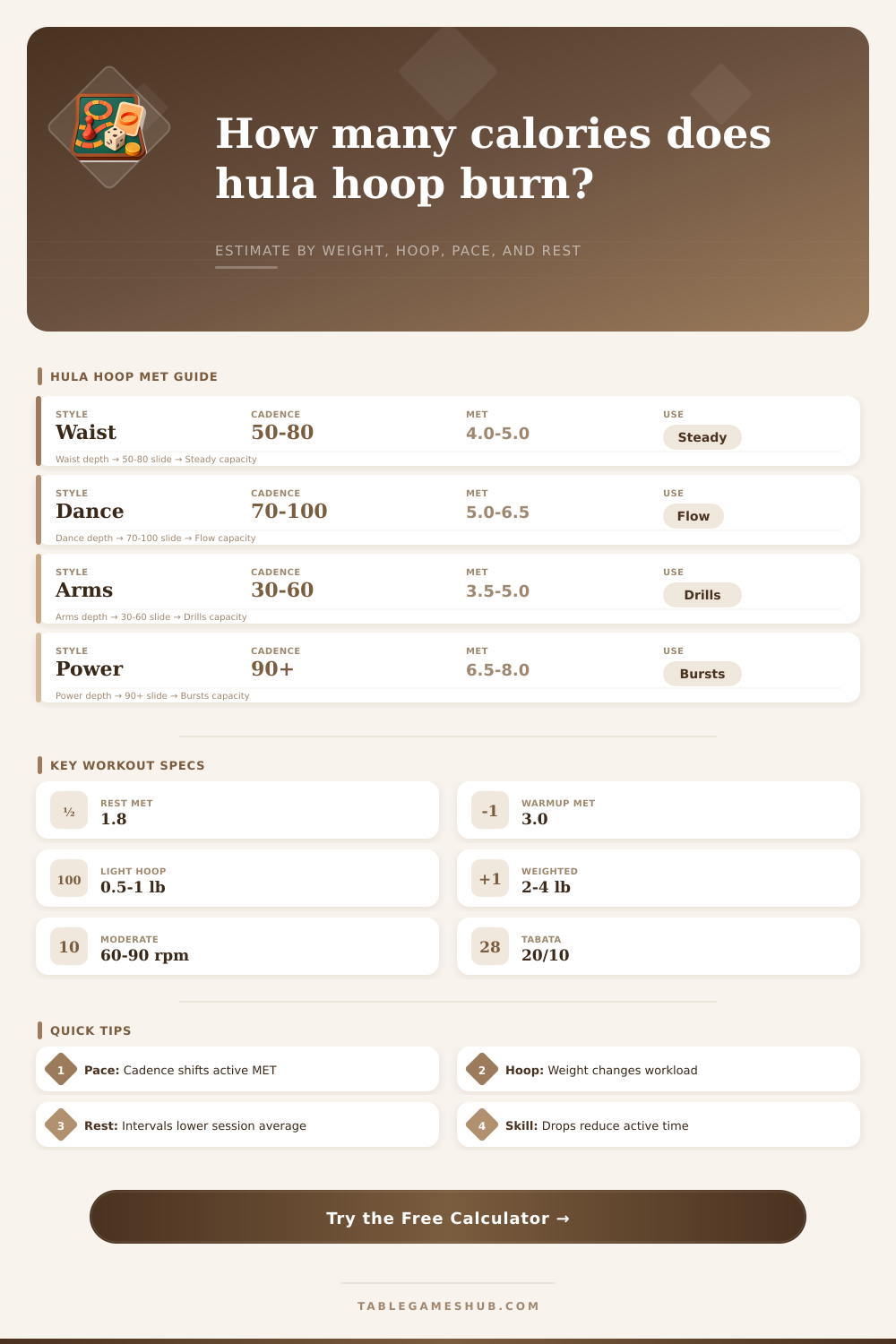
| Hooping Effort | Typical Cadence | Reference MET Range | Calculator Use |
|---|---|---|---|
| Easy skill practice | 40-60 rpm | 3.5-4.0 MET | Learning blocks, frequent drops, relaxed waist spins |
| Light waist hooping | 50-75 rpm | 4.0-4.8 MET | Steady rhythm with a light or moderate hoop |
| Moderate hoop cardio | 60-90 rpm | 5.0-6.0 MET | Default estimate for continuous waist hooping |
| Dance flow hooping | 70-100 rpm | 5.5-6.8 MET | Steps, turns, arm transitions, and traveling patterns |
| Power or weighted bursts | 85+ rpm | 6.5-8.0 MET | Short higher-output intervals with solid continuity |
| Hoop Weight | Adjustment | Typical Feel | Calculator Note |
|---|---|---|---|
| 0.5-1.0 lb or 0.2-0.45 kg | 0.97x | Light dance or fitness hoop | Often easier to spin quickly but lower load per revolution |
| 1.1-2.0 lb or 0.5-0.9 kg | 1.00x | Common moderate training hoop | Default workload band for the calculator |
| 2.1-3.0 lb or 1.0-1.35 kg | 1.05x | Weighted workout hoop | Raises estimated active MET if cadence stays controlled |
| 3.1-4.0 lb or 1.4-1.8 kg | 1.09x | Heavy weighted hoop | Use lower cadence if the spin is slower or reset-heavy |
| 4.1+ lb or 1.9+ kg | 1.12x | Very heavy specialty hoop | Best paired with honest rest and skill inputs |
| Input Choice | Factor Range | What It Represents | When To Use |
|---|---|---|---|
| Basic waist hooping | 1.00x | Steady forward/back or side-to-side pulse | Most general hula hoop calorie estimates |
| Walking waist hooping | 1.06x | Additional steps while maintaining the spin | Cardio sets with travel around the room |
| Dance flow | 1.12x | Turns, footwork, level changes, and transitions | Choreographed or freestyle hoop sessions |
| Arm isolation drills | 0.88-0.95x | Smaller muscles and often lower whole-body movement | Arm-heavy practice or mixed technique blocks |
| Beginner drop rate | 0.82x | More pauses, pickups, and spin restarts | Early practice where active spinning is intermittent |
| Advanced continuity | 1.04-1.07x | Fewer drops and smoother transitions | Longer sets that stay consistently active |
| Session Format | Work:Rest | Active Share | Best Calculator Match |
|---|---|---|---|
| Continuous spin set | 60:0 | 100% | Steady cardio or long endurance preset |
| Technique practice | 30:30 | 50% | Beginner practice or arm isolation drills |
| General intervals | 45:15 | 75% | Interval block with moderate to vigorous MET |
| Dance combinations | 90:30 | 75% | Dance flow with planned resets |
| Tabata bursts | 20:10 | 67% | Short power hooping intervals |
| Example Session | Inputs | Estimated Active Time | What To Watch |
|---|---|---|---|
| 15-minute beginner practice | 45 rpm, 3.5-4.0 MET, frequent resets | 6-10 active min | Skill factor and rest time drive the estimate |
| 30-minute steady waist cardio | 70 rpm, 5.0 MET, moderate hoop | 24-30 active min | Continuous spinning raises average MET |
| Weighted hoop intervals | 75 rpm, 2-3 lb hoop, 45:15 split | 75% of main block | Hoop mass only helps if cadence stays repeatable |
| Dance flow routine | 85 rpm, mixed waist and arms, 90:30 split | 70-80% of block | Arm share lowers or raises the blended estimate |
A hula hoop can be use as a tool for cardiovascular exercise. Furthermore, a hula hoop can be used to engage the core muscle of the body. While many people remembers the activity of hula hooping from their childhood years, adults can use a weighted form of the exercise as a fitness tool due to the resistance provided to the individual who attempt to use the weighted hula hoop.
The additional resistance require the engagement of the oblique and transverse abdominis muscles in order to maintain the momentum of the hula hoop. Thus, the use of a weighted hula hoop increase the metabolic cost of performing the exercise. The intensity of hula hoop exercises can vary depending on a variety of variables.
How to Exercise with a Hula Hoop
For instance, the weight of the hula hoop can change the muscles that must be active in perform the exercise, and the cadence at which an individual performs the exercise can change the cardiovascular intensity of the session. An individual can perform the exercise at a slow cadence or at a high cadence; high cadence exercise are required to reach aerobic benefits for the cardiovascular system. Thus, an increase in cadence increase the cardiovascular effort required of the individual during the session.
In addition to the cadence at which an individual performs the exercise, the total amount of time that an individual spend in performing the exercise and the amount of time that they are active can change the intensity of the session. An individual may make the mistake of considering the total length of their session to be the amount of time during which their body is active. However, an individual spend some of the session performing actions like picking up the hula hoop that fell to the ground.
Thus, if an individual counts the time spent picking up the hula hoop as active time, the individual will overestimate the number of calories burn during that session. Therefore, an individual should account for the time during which the person will pick up the hula hoop so that the estimation of calories burn is accurate. An individual can also change the way in which they perform the exercise to alter the amount of energy that is expend during the session.
For instance, the individual may choose to perform the exercise while standing in one spot, or the individual may choose to walk or dance while performing the exercise. Walking increase the activity of the lower body muscles, as well as the total energy expended. However, if an individual moves the hula hoop from the waist to the arms, the muscles that are active in moving the hoop are reduce in strength and size.
Thus, performing the exercise with the arms require less energy than performing it with the waist. An individual can increase the intensity of exercise using hula hoops by incorporate intervals into the session. Intervals are periods of high intensity performance with the hula hoop followed by a period of rest.
For instance, the individual may perform hula hoop at high intensity for 45 second, followed by a 15-second rest period. Thus, performing intervals of high intensity hula hoop exercise will increase the average intensity of exercise while limiting exhaustion of the individual that is performing the exercise. The calorie calculator contain variables that take into account each of the factor mentioned above to provide an estimation of the number of calories that will be burn during an exercise session with hula hoops.
Furthermore, the calculator indicate the intensity of those cardiovascular exercise sessions. Finally, by utilizing the calorie calculator, an individual can establish a standard for their future sessions with the hula hoop. Thus, by incorporating each of the factors mentioned above, adults can use the hula hoop as an effectiv exercise tool.