Jump Rope Length Calculator
Size a rope from athlete height, shoes, handles, clearance, material stretch, skill style, and adjustment knots.
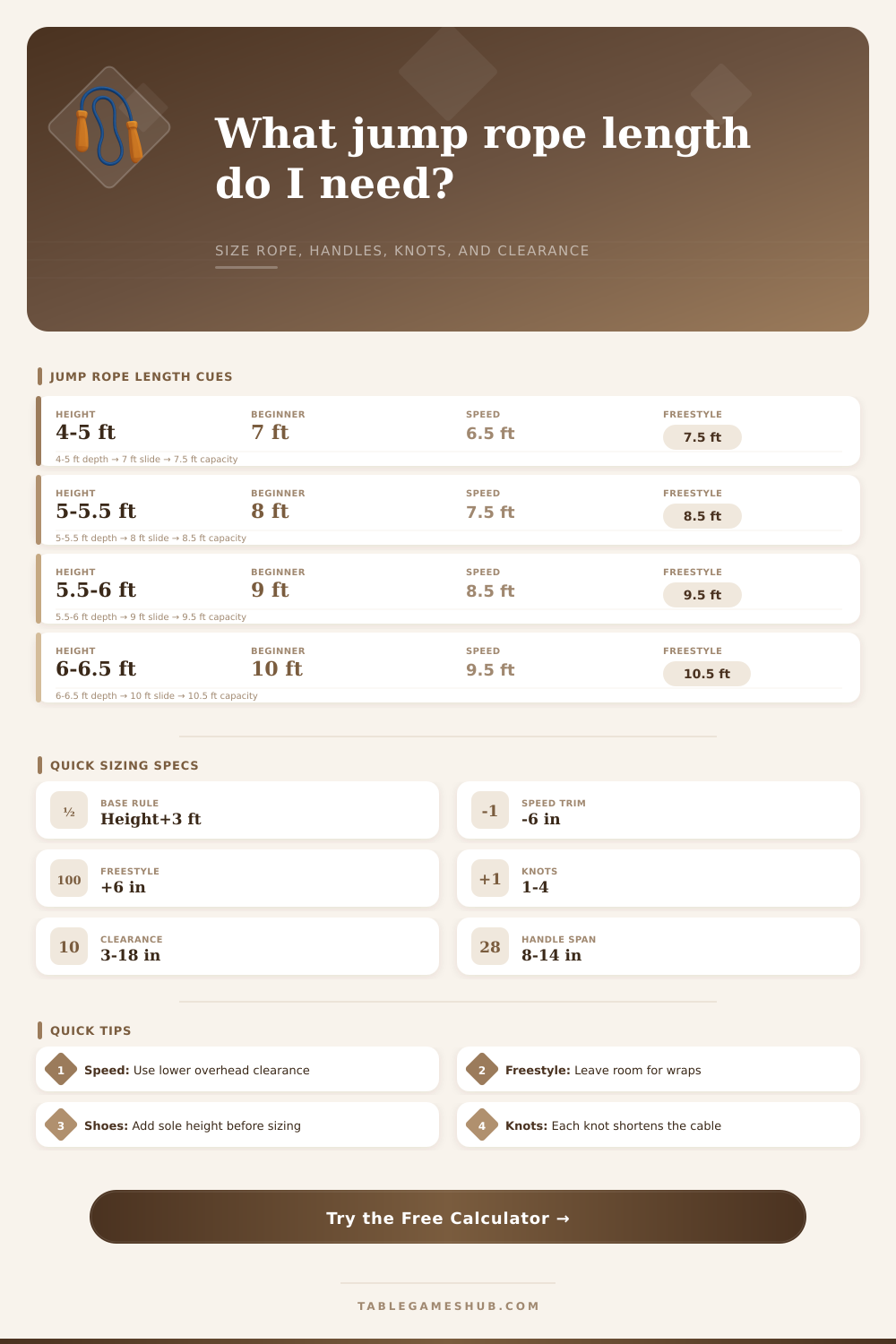
| Athlete Height | Beginner / Fitness | Speed Rope | Freestyle / Tricks |
|---|---|---|---|
| Under 4 ft 10 in | 7 ft rope | 6 ft 6 in rope | 7 ft 6 in rope |
| 4 ft 10 in to 5 ft 3 in | 8 ft rope | 7 ft 6 in rope | 8 ft 6 in rope |
| 5 ft 4 in to 5 ft 10 in | 9 ft rope | 8 ft 6 in rope | 9 ft 6 in rope |
| 5 ft 11 in to 6 ft 5 in | 10 ft rope | 9 ft 6 in rope | 10 ft 6 in rope |
| Over 6 ft 5 in | 11 ft rope | 10 ft 6 in rope | 11 ft 6 in rope |
| Skill Style | Overhead Clearance | Hand Position Cue | Sizing Bias |
|---|---|---|---|
| Beginner rhythm | 8 to 12 in | Hands slightly forward of hips | Longer, forgiving arc |
| Fitness single-unders | 6 to 10 in | Elbows tucked, wrists active | Balanced length |
| Boxing footwork | 5 to 9 in | Hands low and relaxed | Slightly shorter |
| Speed double-unders | 2 to 5 in | Hands close to pockets | Short and precise |
| Freestyle wraps/crosses | 10 to 18 in | Handles travel across body | Extra length for wraps |
| Heavy rope conditioning | 6 to 10 in | Hands steady, shoulders quiet | Do not over-trim |
| Material | Typical Feel | Effective Length Factor | Best Sizing Note |
|---|---|---|---|
| Coated steel speed cable | Fast, low sag | 0 to +0.5 in | Trim cautiously because mistakes show quickly |
| PVC fitness rope | Moderate feedback | +0.5 to +1 in | Works well with balanced clearance |
| Beaded segmented rope | Audible rhythm | +1 to +2 in | Add a little room for segment drag |
| Leather rope | Smooth, heavier swing | +1 to +1.5 in | Allow break-in before final trim |
| Cotton or cloth rope | Soft, higher drag | +1.5 to +3 in | Needs more clearance to avoid foot strikes |
| Thick weighted rope | High feedback | +1 to +2.5 in | Leave retest tail for fatigue changes |
| Component | Common Range | Calculator Effect | Practical Check |
|---|---|---|---|
| Handle length each | 4 to 7 in | Adds to tip-to-tip result | Long handles aid crosses and wraps |
| Handle spread | 8 to 16 in | Raises step-test handle height | Use your normal stance width |
| Adjustment knot | 0.5 to 1.25 in | Shortens active cable | Count both sides if tied evenly |
| Shoe sole height | 0 to 1.5 in | Adds to standing height | Measure the shoes used for training |
| Retest tail | 0.5 to 3 in | Preserved before final cut | Leave more when learning new skills |
Sizing a jump rope correctly is a necessary task for those looking to jump regular. Using the wrong size jump rope can frustrate individuals when jumping and interfere with there movements. Many believe that standing on the middle of the jump rope and pulling the handles up to the armpits will give the correct size for their jump rope.
However, measuring jump rope this way is inaccurate. Pulling up to the armpits can make the jump rope either too long or too short for the individual. If the jump rope is too long, it will sag when jumped on; if the jump rope is too short, it will cause the individual to trip when jump.
How to Measure the Right Length for Your Jump Rope
An individual’s height and their overhead clearance will play a role in the length of jump rope they needs. Overhead clearance is the distance between the individual’s head and the jump rope when it pass over their head when jumping. For those with a greater overhead clearance, the jump rope will have less tension and will move at a slower rate when jumping.
For those with a smaller overhead clearance, the jump rope will hit the individual’s head when jumping. Depending on the type of jumping an individual will be doing, their jump rope length will change. Beginners should use jump ropes that are longer so they have a wider arc when jumping.
Speed jumpers will use jump ropes that is shorter to allow for faster jumps and to make double unders easy to jump. Speed jumpers will also have a smaller overhead clearance since they will keep their jump rope close to their hips when jumping. Instead of getting to the correct jump rope length, it is better for the individual to purchase a jump rope with extra length so they can further test the length of the jump rope for themselves.
Furthermore, the jump rope’s material can impact the length of the jump rope an individual requires. Coated steel jump ropes use a thin material for the jump rope that dont stretch. PVC is a jump rope material in the middle ground for the weight.
For jump ropes out of the two materials, leather and cotton is the heavier of the two materials. For these types of jump ropes, the jump rope will sag, so the length need to be adjusted. Additionally, the materials will stretch over time, so the individual will have to test the length of the jump rope after use for a week.
An individual’s footwear and the handles used for jumping will also impact the length of the jump rope. If an individual uses shoes with thick soles when jumping, this will increase their standing height. This change in standing height will change the arc of the jump rope.
An individual will want to account for the height of their shoes so they do not clip their toes when jumping on the jump rope with high arc. The handles used for jumping will also impact an individual’s jumping. The individual will have to measure the jump rope for the tip-to-tip measurement of the handles and jump rope to allow jumping to be comfortabley with the jump ropes movement while jumping.
Another way to test the length of a jump rope is by using the step test. However, performing the step test correctly will provide the individual with the correct length of jump rope. An individual should stand on the center of the jump rope and pull the handles up to the correct height for their jumping style.
For instance, a jump rope for speed jumping will have the jump rope at the lower rib of an individual when jumping. For fitness jumping, it will be at a more relaxed height. Additionally, if an individual has adjustment knots or collars on their jump rope, the individual will have to account for the length of the jump rope consumed by these adjustments.
Any number of knots will consume some of the length of the jump rope. The individual should account for this when measuring the length of their jump rope. For an individual looking to jump with a jump rope, using the equation to calculate their jump rope length will provide the best starting point for the length of their jump rope.
After purchasing the jump rope, the individual should test the length for a few jump rope jumping session before the individual trims the jump rope to there desired length. When using the proper length for an individual’s jump rope, the jump rope will have a predictable timing for jumping, and it will not interfere with the individual’s jumping movement. Furthermore, using the mathematics to calculate the length of the jump rope will allow the individual to focus on their jumping movement rather than focus on any mistake caused by an incorrectly sized jump rope.