Kite Winder Staircase Calculator
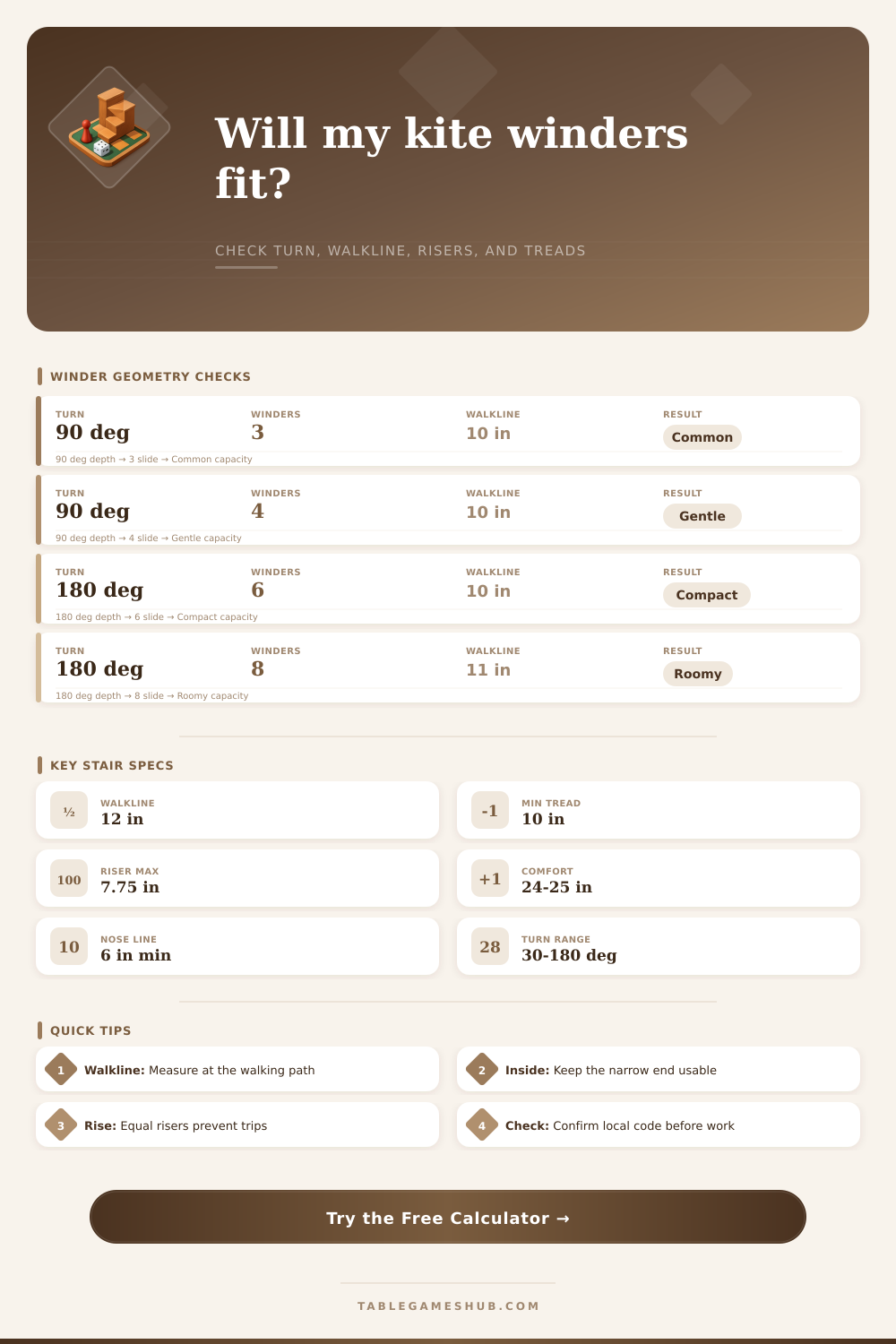
Size kite-shaped winder treads by turn angle, inner radius, walking line, riser count, and code-style comfort checks.
| Turn layout | Typical winder count | Angle per tread | Layout note |
|---|---|---|---|
| Quarter-turn corner | 3 to 4 kite winders | 22.5° to 30° | Common replacement for a square landing in a tight L stair. |
| Half-turn return | 6 to 8 kite winders | 22.5° to 30° | Splits a U-shaped change of direction across several tapered treads. |
| Three-quarter turn | 9 to 12 kite winders | 22.5° to 30° | Usually needs careful centerline and guard coordination. |
| Custom curved turn | Based on angle and radius | 15° to 30° | Lower angle per tread gives smoother foot placement. |
| Check item | Common reference | Calculator method | Why it matters |
|---|---|---|---|
| Walkline tread depth | Often 10 in minimum | Arc length at inner radius plus walkline offset | Represents the path where a person normally steps through the turn. |
| Inside narrow end | Often checked 6 in from narrow side | Arc length at inner radius plus check-line distance | Prevents a tapered tread from becoming a point at the usable edge. |
| Riser height | Often 7.75 in maximum | Total rise divided by whole riser count | Equal risers reduce trip risk across straight and winder treads. |
| Comfort formula | 2R + T near 24 to 25 in | Two risers plus walkline tread depth | Shows whether the rhythm of the winder feels steep, flat, or balanced. |
| Walkline radius | 90° with 3 winders | 90° with 4 winders | 180° with 6 winders |
|---|---|---|---|
| 12 in radius | 6.3 in per tread | 4.7 in per tread | 6.3 in per tread |
| 18 in radius | 9.4 in per tread | 7.1 in per tread | 9.4 in per tread |
| 24 in radius | 12.6 in per tread | 9.4 in per tread | 12.6 in per tread |
| 30 in radius | 15.7 in per tread | 11.8 in per tread | 15.7 in per tread |
| Stair condition | Likely adjustment | Geometry signal | Planning note |
|---|---|---|---|
| Walkline depth too small | Add winders less often, increase radius, or reduce turn angle | Arc per tread under target depth | A small center radius can make even many winders feel abrupt. |
| Narrow end too small | Increase inner radius or move center away from the corner | Inside check depth under reference | A newel post or framed well can create usable inner radius. |
| Riser too tall | Add one riser to the flight or reduce total rise | Actual riser exceeds reference maximum | Riser count must stay consistent through the whole staircase. |
| Comfort formula high | Reduce tread depth target or riser height combination | 2R + T over the preferred range | High values feel long-strided; low values feel steep. |
When designing a staircase for a small area, there is different option as to how the stairs can turn. One possible option is to install a square landing. Square landing are safe for those using the stairs because they provide a alot of area for the feet.
The downside of using a square landing, however, is that it require a great deal of floor space within the small area in which the stairs are to be construct. Thus, a square landing may not be the best option for a staircase in a small room. Another option is to use kite-winders.
Safe Stair Options for Small Rooms
Kite winders allow for the stairs to turn while an individual is climbing them, which is helpful in small areas. The potential downside of using kite winders is, however, that they can be dangerous if they isnt construct with precise measurement. The primary danger of using kite winders is the taper of the kite winders.
If the treads of the kite winders are too narrow at the inner turn of the staircase, the treads may not provide a place for the individuals foot to land when walk down that portion of the flight of stairs. Instead, the individuals foot may land on the edge of the wood of the staircase. In order to avoid this danger, it is important for the designer to understand the concept of the walkline.
The walkline is the path that an individual take while walking down the stairs. The walkline is often one foot from the narrow side of the stairs. The depth of the treads at the walkline should be of the same depth as the other treads of the stairs.
Otherwise, an individual’s stride will break at those turns and the individual may stumble when walking down the stairs. The number of kite winders that people use will also change the feeling of the staircase. For instance, using three kite winders to turn ninety degrees will result in each of the three sets of stairs having a sharper angle then four kite winders that turns the same ninety degrees.
Thus, an individual must consider the total vertical space of the staircase in relation to the comfort of using the stairs with different number of kite winders. The inner radius of the staircase is also important to consider when using kite winders. The inner radius is the distance from the center of the turn of the stairs to the narrowest part of the treads.
If the inner radius is zero, then the treads will meet at a sharp point. Such a sharp point may cause an individuals ankle to twist when walking down those stairs. Often, people will use a small radius to avoid a sharp point on the stair.
Adding this small radius will create a flat area on the tread of the kite winders. This flat area will even prevent the tread from being a small sliver of wood. This type of tread will create a safer environment for those using the staircase.
Another important measurement for the construction of the stairs is the riser height. For a normal staircase, the human body creates a rhythm stepping down the stairs. The human body will anticipate and expect the riser height to be the same along the entire flight of the staircase.
If the riser height for the kite winders is not the same as the rest of the stairs, the person may trip over the riser height. Thus, every riser throughout the staircase must be the same to avoid any accident. Building professional use a formula that determines the comfort of a staircase.
This formula uses the measurement of two risers and one tread. The staircase is measured according to the natural stride of a human being. Using the formula, if the calculation is outside of a specific range, the staircase will either be too steep or too shallow to be comfortable for the user.
Using a calculator will help determine if the rhythm of the stairs is comfortable to the user before construction begins the walkline of the kite winders. Another common idea is to look at the floor to determine the layout of the kite winders. This, however, can lead to mistake.
It is very easy to find the perfect width for the stairs, but the arc length changes according to the distance from the center of the turn in the staircase. The outer edge of the stairs might appear to be wide enough, but the walkline might not be wide enough for safety codes. Therefore, it is important to focus on the arc depth of the stairs instead of the straight line measurement.
By calculating the walkline and the inner check line of the staircase, the geometry will be ensured to be correct for the construction of the kite winders. Building the staircase with kite winders requires many calculation of inches and angles. The number of risers might have to be change according to the calculations.
However, by focusing on the walkline of the staircase and ensuring that each riser is of the same height, the construction will provide a smoothly staircase for the individual using the staircase.