Delta Kite Calculator
Size the sail triangle, spine, leading edges, spreader, dihedral allowance, and bridle tow point for a single-line delta kite.
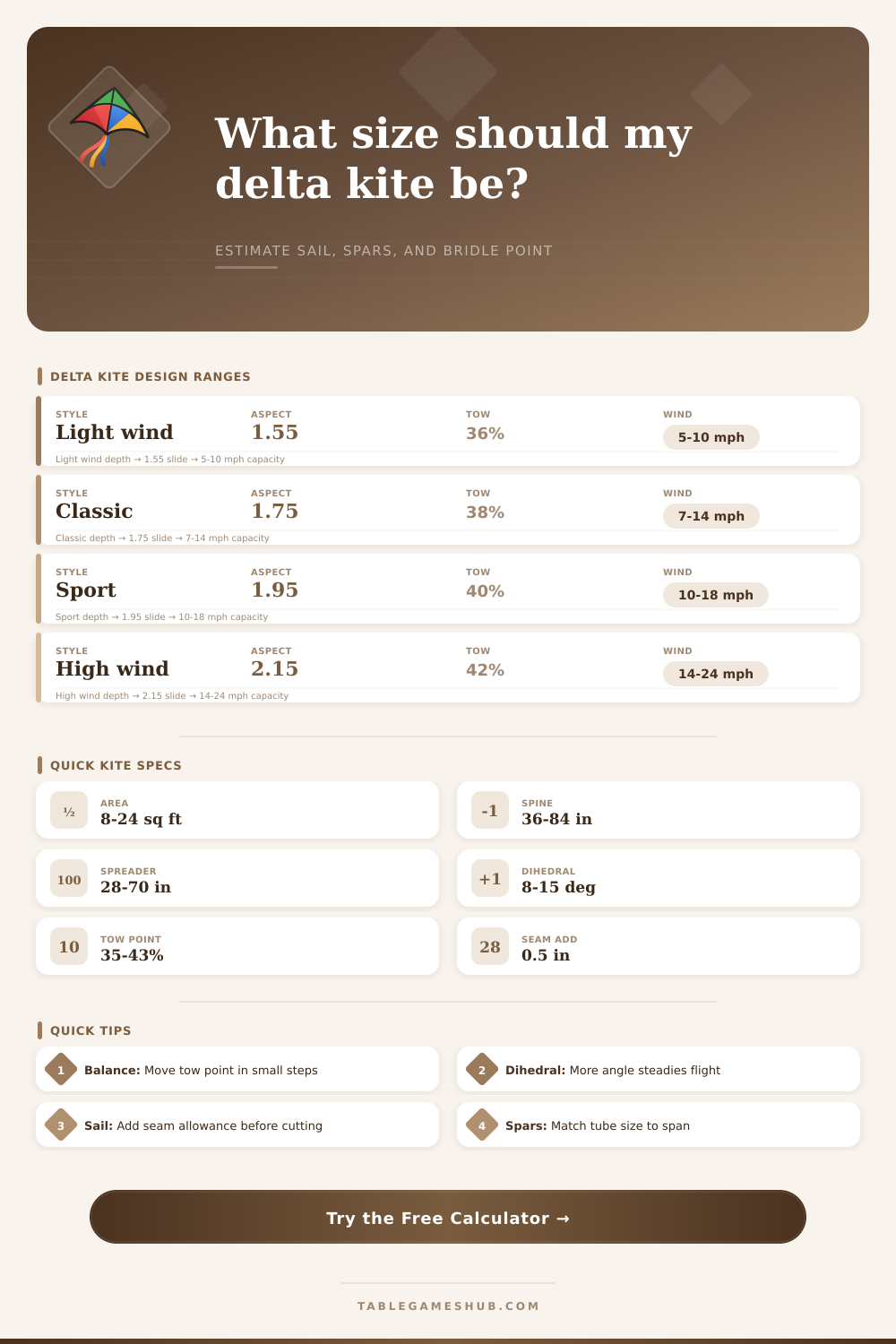
| Design style | Span to height ratio | Typical tow point | Use case |
|---|---|---|---|
| Light-wind delta | 1.45 to 1.65 | 35% to 38% from nose | Low pull, broad sail, calm fields |
| Classic delta | 1.65 to 1.85 | 37% to 40% from nose | General single-line flying |
| Sporty delta | 1.85 to 2.05 | 39% to 42% from nose | Faster tracking and stronger breeze |
| High-wind delta | 2.00 to 2.25 | 41% to 44% from nose | Small sail, higher apparent wind |
| Wingspan class | Sail area guide | Common spine spar | Common spreader spar |
|---|---|---|---|
| 24 to 36 in mini | 1.3 to 3.0 sq ft | 2 to 3 mm carbon | 2 to 3 mm carbon |
| 42 to 60 in small field | 4.5 to 9.5 sq ft | 3 to 5 mm carbon or dowel | 3 to 5 mm carbon |
| 66 to 84 in standard | 12 to 24 sq ft | 5 to 8 mm tube | 5 to 8 mm tube |
| 90 to 120 in display | 28 to 55 sq ft | 8 to 12 mm tube | 8 to 12 mm tube |
| Dihedral per wing | Stability effect | Spreader multiplier | Typical adjustment |
|---|---|---|---|
| 6 degrees | Low roll damping | 1.006 | Good for responsive sport deltas |
| 10 degrees | Moderate stability | 1.015 | Common all-around starting point |
| 14 degrees | Strong stability | 1.031 | Useful for relaxed single-line flight |
| 18 degrees | Very steady | 1.051 | Use when pull and roll need calming |
| Bridle symptom | Likely geometry issue | Field correction | Calculator cue |
|---|---|---|---|
| Overflies and dives | Tow point too far forward | Move tow point back 1% to 2% | Increase tow percentage |
| Hangs back or stalls | Tow point too far aft | Move tow point toward nose | Lower tow percentage |
| Rolls side to side | Dihedral too low or uneven | Raise spreader center or equalize legs | Increase dihedral |
| Wingtip flutter | Leading edge tension low | Shorten sail pocket or stiffen spar | Check leading edge length |
A delta kite require precise geometry to allow it to successfully fly. If a person builds a delta kite with the tow point at an incorrect location, the delta kite will dive into the ground. If a person builds the spreader of a delta kite to be to short, the wings of the kite will not stay open.
The geometry of a delta kite must be correct before cutting the material for the kite; the correct geometry of a delta kite is the only way to ensure that the delta kite will successfully fly. The wingspan and the height of the spine of the kite determines the aspect ratio of the delta kite. A wide wingspan will allow the kite to catch a great deal of the wind and experience a large lifting force.
Delta kite shape and parts
However, a wide delta kite will also be difficult to control when the wind is high. A high aspect ratio will create a leaner kite that travels at a high rate of speeds through the air. You should choose the aspect ratio of a delta kite according to the wind condition in which it will be used; the aspect ratio will dictate how the kite behave in the wind.
The dihedral angle of a delta kite is the V shape that form with the two wings of the kite when looking at the kite from the front. A flat delta kite will tip over when the wind is applied to the side of the kite. Pulling the wings of the kite back from the vertical create a self-righting mechanism for the kite; the more angle created in the front wings of the kite, the more stable the kite will be.
However, if the angle is too great, the kite will not be able to climbing into the air. You must calculate the length of the spreader spar to account for the dihedral angle of the kite. The bridle is the system of strings that allow the kite to connect to the flying line.
The tow point is where the flying line connects to the bridle. If the tow point is too close to the nose of the kite, the kite will overfly and dive into the ground. If the tow point is too far from the nose of the kite, the kite will stall and fall.
The bridle line should be marked in small increment from the nose of the kite to the tail of the kite to allow you to adjust the tow point to the proper distance from the nose. Kite spars are the component of the kite that will maintain the shape of the kite. The spars need to be strong enough to maintain the shape of the kite, but flexible enough to allow the kite to bend with strong gusts of wind.
If a person choose spars that are to thin or to flexible, the spars will fold in strong winds. A table provided with the instructions will allow a person to determine the appropriate diameter of the spars according to the wingspan of the delta kite. You should choose the size of the spars to allow the spar to support the area of sail that the delta kite will create.
The calculated dimensions of the sail is the size that the sail will be once the kite is assembled. A person must add allowance for the hem and seam of the sail; the amount of fabric used to hem the sail and its seams will reduce the size of the sail. If a person cut the nylon to the calculated dimensions of the sail, the final sail will be to small for the design of the kite.
By adding allowance to the cut size of the sail, it will be possible for the final sail to reach the size that is designed for the kite.