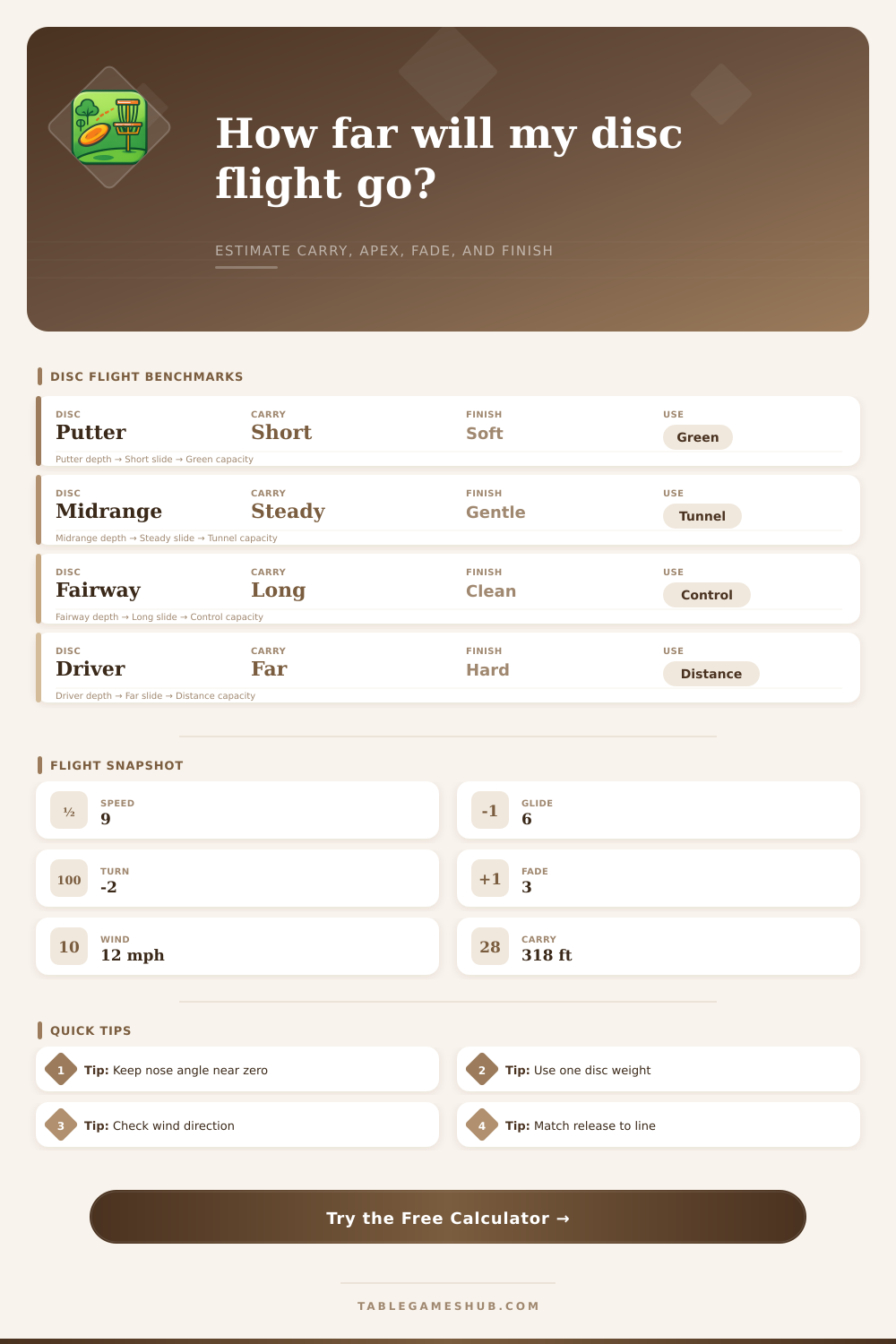
Disc Golf Flight Path Calculator
Map carry, apex, fade, and landing drift from disc specs, release shape, wind, and elevation.
Flight Breakdown
| Disc Family | Speed | Glide | Typical Line |
|---|---|---|---|
| Neutral Putter | 2 | 3 | Short green push |
| Workable Midrange | 5 | 4 | Tunnel and placement |
| Straight Fairway | 7 | 5 | Clean control shots |
| Distance Driver | 12 | 5 | Full-flight bomber |
| Wind Type | Speed Band | Carry Effect | Best Response |
|---|---|---|---|
| Calm | 0-3 | Neutral | Trust nose angle |
| Headwind | 4-10 | Shorter | More stability |
| Tailwind | 4-10 | Longer | Flatter release |
| Crosswind | 4-10 | Side drift | Match disc fade |
| Surface | Roll Factor | Stop Factor | Use Case |
|---|---|---|---|
| Short Grass | Low | High stop | Parked landings |
| Firm Dirt | Medium | Medium stop | Open fairways |
| Packed Fairway | High | Lower stop | Distance gains |
| Soft Woods | Very low | Very high | Minimal skip |
| Release Shape | Ideal Angle | Shot Result | Common Use |
|---|---|---|---|
| Hyzer | Positive | More fade | Safer finish |
| Flat | Near zero | Balanced path | Tunnel control |
| Anhyzer | Negative | Turn carry | Shape left lines |
| Forehand | Firm | Skip finish | Scramble and flex |
Use this disc golf flight path calculator to estimate carry, apex, fade, and landing drift from disc speed, release angle, wind, and slope. Compare shot shapes before you throw.
Disc golf flight path are the result of physics. By analyzing the various factors that influence flight paths, players can more or less accurately predict the flight path of their disc, Factors to analyze include the speed with which the disc is threw, the power with which the player threw the disc, the glide of the disc, the turn of the disc, fade, spin, nose angle, and the effects of wind and slope. While many player use the variables to guess the flight path of their disc, this process often leads to the disc landing in the rough or in trees.
If the physics of the disc are understood, it is possible to determine the carry distance, the apex of the disc, the total finish of the disc, and the side offset of the disc prior to throwing it. The first step in predicting the flight path of a disc is to select the appropriate disc. For instance, a neutral putter require the use of gentle arm speed, around 40 mph, to allow for a straight flight path.
How a Disc Flies in Disc Golf
If the player uses too much arm speed with a neutral putter, the disc will skip if it travels short distance. Distance drivers, on the other hand, require high arm speed, ideally 55 mph or more. If a distance driver has solid spin, the glide of the disc will allow the disc to reach high apex heights.
To ensure the best performance from the disc, the player must ensure that the arm speed that they use is match with the profile of the disc. The release angle of the disc is another variable that can affect the flight path. A slight hyzer angle will allow the disc to fight against a headwind.
An anhyzer angle will allow the disc to create turnover lines that allow the disc to fly around trees in the disc golf course. A high nose angle will reduce the glide of the disc. If the nose angle is too high, the disc will lose distance.
If the player throws the disc flat, this will provide the maximum distance for the disc. Wind is another factor to consider when throwing a disc. If the wind is a headwind, overstable disc should be used.
The overstable discs will prevent the disc from turning too much in the headwind. The headwind will also compress the flight path of the disc, reducing the apex height of the disc. Tailwinds will allow for more turn in the disc.
Fast discs with tailwinds will gain additional carry distance, up to 10% to 15%. Crosswinds will cause the flight path to drift from the intended path of the disc. In strong crosswinds, the disc may finish offline by 20 feet from the intended target.
If the player is to throw the disc uphill, the disc will lose 5% to 8% of its distance for every 10 feet of elevation. This is because gravity will act on the disc when it is descending down the hill. Downhill throws will also gain some distance.
However, discs may skip more on downhill throws if the fairways are packed. The two most important variables for throwing a disc are arm speed and spin rate. High arm speeds will allow for the discs to travel more farther.
Additionally, high spin rates will allow for a wider turn of the disc, which is beneficial for hyzer flip throws. Low spin rates will cause the disc to fade after a short distance from the player. The style in which the player throws the disc will also impact the flight path of the disc.
Forehand throws will create more fade in the disc and make it skip more on the landing area of the disc golf course than backhand throws. The type of grass or landing area that the disc is to travel to will affect the flight path of the disc. If short grass is encountered, the stop factor will be high for the disc.
This will cause the disc to stop quick. The fade of the disc will determine where it will lie in the short grass. For discs landing on packed fairways, the disc can travel an additional 20 to 30 feet.
However, if the disc lands on a packed fairway near the out-of-bounds line, this could be an issue. If the disc lands on a soft wood area, the disc will absorb the momentum of the disc. In this case, the disc will skip minimally when it lands on a soft wood area.
Many disc golf players make mistakes when they are trying to throw their disc. One of the most common mistake is focusing on getting the maximum carry distance from the disc while ignoring the fade of the disc. It is better for a disc to have a shorter carry distance but still fade to the target than for the disc to carry a long distance but fade into an obstacle.
Another mistake is to ignore the nose angle of the disc. If the nose angle of the disc is not pointed down slightly, it will rob the disc of 20 to 30 feet of distance. A final mistake is to not test different weight classes of discs.
The heavier discs will fight better against the wind but will have less glide when thrown. By analyzing each of these factors, players can gain an understanding of the flight path of a disc. With an understanding of the flight path of a disc, players will miss fewer greens and create more opportunities for birdie golf shots.