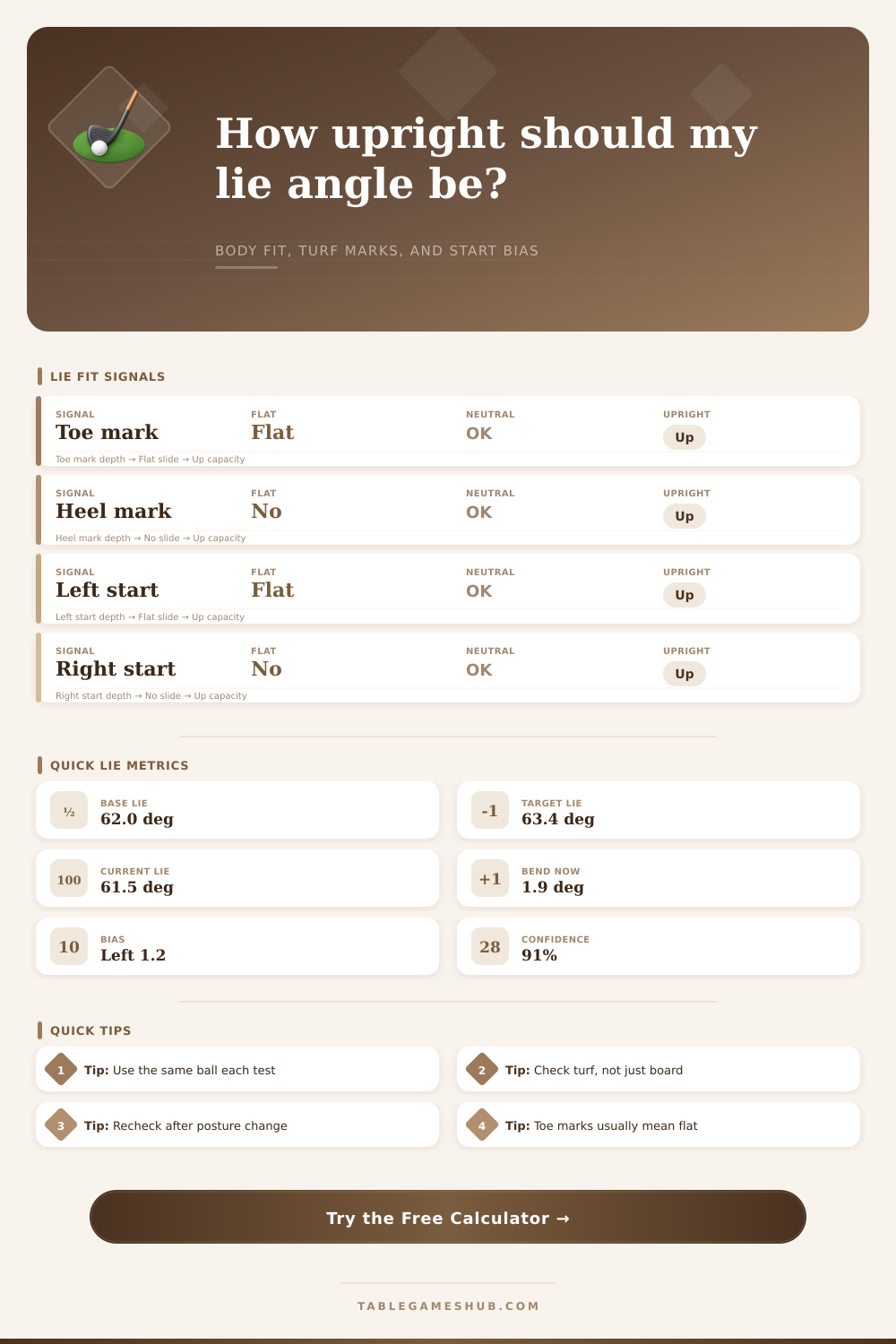
Golf Club Lie Angle Calculator
Blend body fit, board marks, and start line bias into one lie-angle read.
| Club | Base Lie | Role | Look |
|---|---|---|---|
| 3-Wood | 57.0 | Long launch | Low tilt |
| 4-Iron | 60.5 | Long iron | Flat eye |
| 5-Iron | 61.0 | Mid iron | Balanced |
| 6-Iron | 61.5 | Mid iron | Neutral |
| 7-Iron | 62.0 | Anchor club | Standard |
| 8-Iron | 63.0 | Control club | Slender |
| 9-Iron | 63.5 | Short iron | More upright |
| Pitching Wedge | 64.0 | Scoring club | Upright |
| Profile | Height / Wrist | Static Move | Fit Note |
|---|---|---|---|
| Long tall frame | 72 / 35+ | +0.5 to +1.0 | More upright |
| Balanced build | 68-72 / 32-35 | -0.2 to +0.2 | Stay near base |
| Short reach | 66 under / 31- | -0.5 to -1.0 | Flatter build |
| Long reach | 68-74 / 34+ | -0.2 to -0.7 | Watch toe trace |
| Trace | Meaning | Direction | Check |
|---|---|---|---|
| Toe-side | Too flat | Bend up | Heel brush |
| Heel-side | Too upright | Bend flat | Toe brush |
| Centered | Near spec | No move | Recheck lie |
| Thin mark | Setup issue | Review plane | Foot pressure |
| Start Line | Likely Lie | Bend | Follow-Up |
|---|---|---|---|
| Starts left | Too upright | Flatten | Retest board |
| Starts right | Too flat | Upright | Check reach |
| Curves left | Could be upright | Small flat | Watch face |
| Curves right | Could be flat | Small up | Watch plane |
The lie angle is the angle of the clubs sole in respect to the clubs shaft. The lie angle of the club will dictate in what way the clubs sole interact with the ground. If the lie angle are incorrect, the club wont sit flush to the ground.
An incorrect lie angle can cause the toe of the club to dig into the ground, or the incorrect lie angle can cause the heel of the club to lift from the ground. In the case that the toe of the club digs into the ground, the club will cause the ball move to the right. In the case that the heel of the club lifts from the ground, the club will cause the ball to move to the left.
What Is Lie Angle and How to Check It
A persons body geometry will dictate what the proper lie angle for their clubs should be. Clubs will have different lie angles depending upon a persons height, wrist length, and body build. Clubs will also have different lie angle depending upon a persons posture when they swing the club.
A person that has alot of crouch in their swing will flatten the lie angle of the clubs. A person that stands too tall will steepen the lie angle. A person can test the lie angle by observing the marks made by the clubs sole.
If the toe of the club makes contact with the ground as indicated by a lie board or the natural grass, the lie angle of the club is too flat; it should be adjusted to be more upright. If the heel of the club make contact with the ground as indicated by a lie board or the natural grass, the lie angle is too upright; you should adjust it to be flatter. Additionally, a person can test a clubs lie angle by observing the way the ball flies.
If the ball consistantly starts to the left, the lie angle of the clubs is too upright to allow the heel make contact. If the ball starts to the right, the lie angle of the clubs is too flat to allow for the toe to make contact. A common mistake with lie angles is to use artificial hitting mats and not use natural grass to test lie angles.
Artificials mats will compress more different than natural grass, and will show different marks than natural grass. Therefore, a person should always check the clubs sole on grass to ensure that the lie angle is correctly adjusted. Additionally, the persons swing plane can also affect the lie angle of the club.
For instance, a shallow swing plane may hide any heel contact until a person is hitting the ball on firm turf. A person can also calculate the lie angle of the clubs by measuring different aspect of the body. A person can use there height, the distance of their wrist to the floor, their arm span, and the type of posture and swing plane they use when hitting the ball.
For instance, a person that has a steep swing plane will have a different lie angle than a person that has a shallow swing plane. Therefore, by measuring these different aspects of the body, a person can calculate the lie angle to which the clubs should of been adjusted. A persons clubs will have different lie angles depending upon the club.
Clubs with shorter club heads, like the wedges, will have a more upright lie angle than clubs with longer club heads, like 4 iron. Each club will have a lie angle to ensure that the club sits flush with the ground when the club hit the ball. Finally, any uphill lies will make the club feel more upright relative to the ground, and any downhill lies will make the club feel more flat.
Therefore, the lie angle should be tested on level ground when determining the true lie angle of the clubs.