📈 MTG Card Draw Probability Calculator
Measure opening hands, turn odds, and draw-line consistency with quick, exact deck math.
| Input | Value | Result | Note |
|---|
| Chance band | Label | Shape | Read this as |
|---|---|---|---|
| 0-24% | Sparse | Very swingy | Targets are rare and miss-prone |
| 25-49% | Light | Uneven | You will see the card sometimes |
| 50-69% | Steady | Usable | The line shows up often enough |
| 70-84% | Dense | Strong | Core plan is coming together |
| 85-100% | Locked | Very tight | The window is close to certain |
| Copies | 60-card read | 100-card read | Typical role |
|---|---|---|---|
| 1 | Silver bullet | Pinpoint | Only for tutors or unique effects |
| 2 | Light backup | Thin support | Useful when the card is valuable |
| 4 | Main plan | Solid core | Best baseline for a named target |
| 6 | Heavy density | Useful extra | Good when the card is essential |
| 8 | Very dense | High impact | Strong when the deck wants repeats |
| Turn | On-play seen | On-draw seen | What it means |
|---|---|---|---|
| 1 | 7 | 8 | Opening hand plus first draw step |
| 2 | 8 | 9 | Early development window |
| 3 | 9 | 10 | First real setup turn |
| 4 | 10 | 11 | Midgame consistency check |
| 5 | 11 | 12 | Action pieces should matter |
| Tool | Reach | Best for | Caution |
|---|---|---|---|
| Mulligan | Fresh look | Key combo starts | Hand size drops |
| Extra draw | More cards | Any repeat plan | Needs mana and timing |
| Scry/look | Selective | Finding one piece | Counts as partial reach |
| Tutor | Exact hit | Silver bullets | Very narrow scope |
Count the real window
Use the exact turn you care about, because every extra draw step shifts the curve.
Selection is not free
Scry and filter effects help, but they are best treated as partial reach, not automatic hits.
Probability of drawing cards from a deck is a mathematical concept. If a person is working with a sixty-card deck, they can use the mathematics of probability to calculate the likelihood of drawing specific card from that deck. For instance, if there are four copies of a specific card in a sixty-card deck, a player has approximately a forty percent chance of drawing that card in there initial seven-card draw.
If, however, there are six copies of that card in the sixty-card deck, then the player has an increased chance of drawing that specific card due to the increased number of copies of that card in the deck. The mathematics behind these calculations is referred to as hypergeometric math. Hypergeometric math determine the number of ways that a player can draw the specific cards from a deck, given the total size of the deck and the total number of copies of that specific card.
Chance of Drawing Cards from a Deck
Mulligans are a game mechanic that allow a player to reshuffle their hand and draw a new hand. By using a mulligan, a player may have fewer cards in their hand. For instance, if a player draws a hand of six cards, uses a mulligan, and keeps their hand of six cards, they have fewer cards in their hand than if they had kept a hand of seven cards.
This can make it more dificult to play some of the more aggressive strategy in the game. However, having fewer cards in ones hand can increase the chances of drawing the specific combo piece that a player needs to win the game. A player must find a balance between having the right number of cards in their hand to play their strategies yet also having enough cards in their hand to ensure that they can draw the specific cards that they need.
The turn on which a player draws cards also changes the probability that a player will draw any specific card from their deck. For instance, a player that draws cards first in a game will have drawn ten cards by the time they reach turn four. Players that draw second will have drawn eleven cards by turn four.
A player can increase the number of cards that they will have seen by the time they reach turn four by the use of repeatable draw effect. These effects will cause a player to draw extra cards each turn. As a result, a player using such draw effects will have many more cards in their deck by turn four.
Thus, there is an increased chance that they will draw the cards that they need to succeed in the game. Selection tools are cards or abilities that allow a player to select cards within their deck. Scry, for instance, allows a player to look at the top cards of the deck and move them to the bottom of the deck.
Scry, however, isnt the same as drawing a card. Tutors are another type of selection tool that allow a player to search their deck for a specific card. Players consider tutors to be more precise than scry.
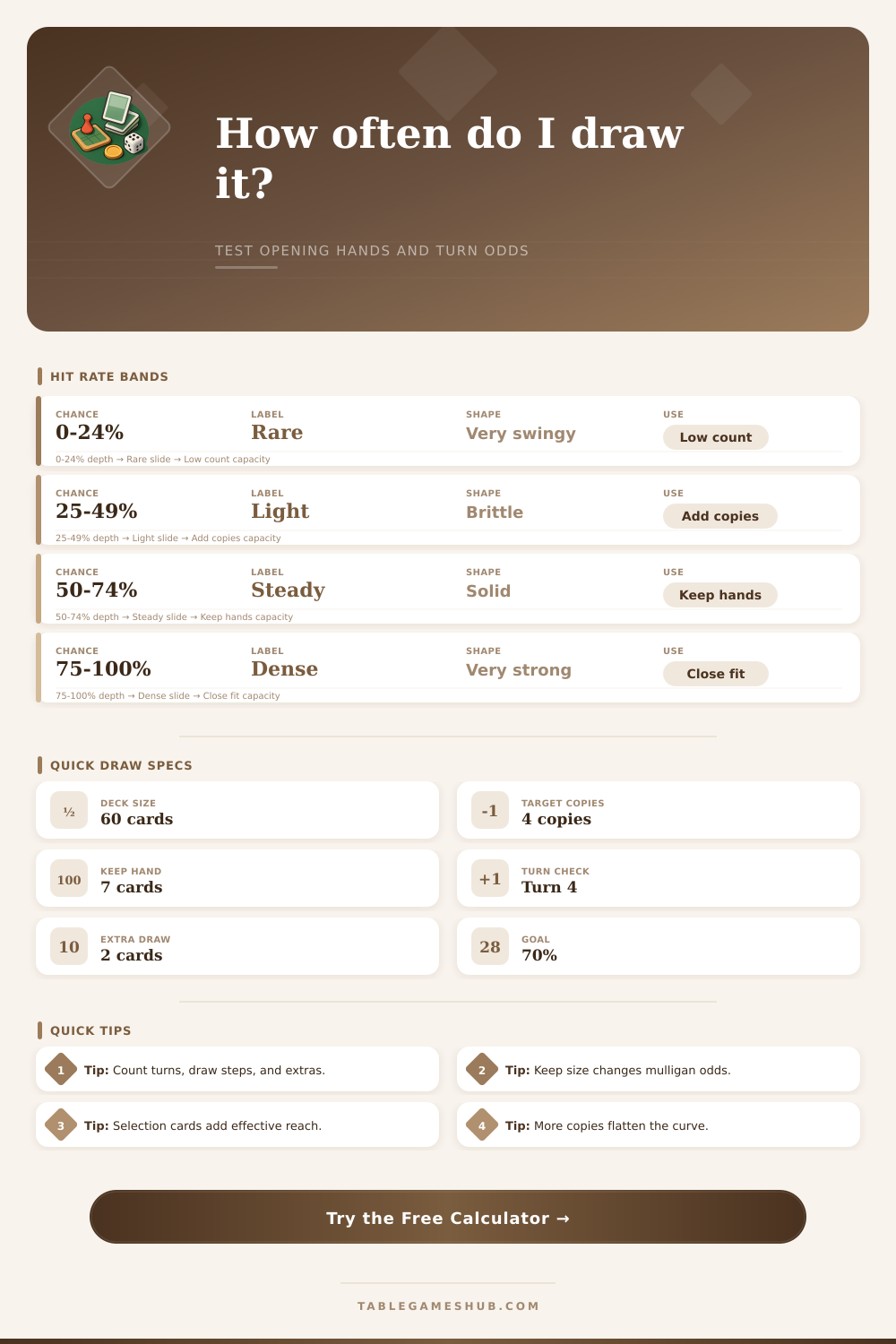
If a player utilizes too many selection tools, however, they may miscalculate the density of the cards within their deck. The number of copies of a card within the deck will determine the density of that card within the deck. If the chance of drawing a player of a specific card is less than 25%, then that card is considered to be sparse, and those cards are often used as one-of cards within a deck.
If the odds of drawing a player of a specific card within their deck is between 25% and 50%, the card is considered to be light. If the chance of drawing a player of a specific card within their deck is between 50% and 70%, the card is considered to be steady. Finally, if the chance of drawing a player of a specific card within their deck is 70% or more, the card within that deck is considered to be dense.
Most players choose to use four copies of each card in their deck as four copies of a specific card will reach the sweet spot for the probability of drawing that specific card. Expected copies is a term used to describe the average number of copies of a specific card that a player will draw within a certain time frame. For instance, a player can calculate that they may expect to draw zero point eight copies of their four-of card by turn three.
If the expected number of copies of a specific card is less than one, then the deck is considered to be thin in that specific card. However, if the expected number of copies of a specific card within a time frame is greater than one, the deck is more reliable in drawing that specific type of card. A player can utilize goal thresholds to determine the number of copies of a specific card that they will include in their deck.
For instance, a player who desires a seventy percent chance of drawing one of their specific spells by turn four within their sixty-card deck will have to include five or six copies of that spell within their deck, depending upon how many draw effects they have within the deck. There are a variety of factors that complicate the raw probabilities of drawing cards from a deck. For instance, a player’s mana curve can factor into drawing too many lands from their deck, which will lead to flooding their lands.
Flooding ones lands prevents players from playing their spells. Other factors include interaction with opponents, which can prevent players from playing the spells that they drew in their opening hand. Finally, sideboarding can also factor into the raw probabilities of drawing specific cards due to the decrease in the total number of cards in the deck.
For instance, sideboarding reduces the total number of cards in a players deck, increasing the chance of drawing specific cards later in the game. Commander, a hundred-card format for Magic: The Gathering, creates more difficult mathematical calculations for players. Since there are so many more cards for players to search through in Commander, more tutors and draw effects is required to locate the specific cards that a player desires to play during the game.