🎳 Bowling Ball Layout Calculator
Calculate pin-to-PAP distance, VAL angle, MB angle & drilling layout for your ideal ball reaction
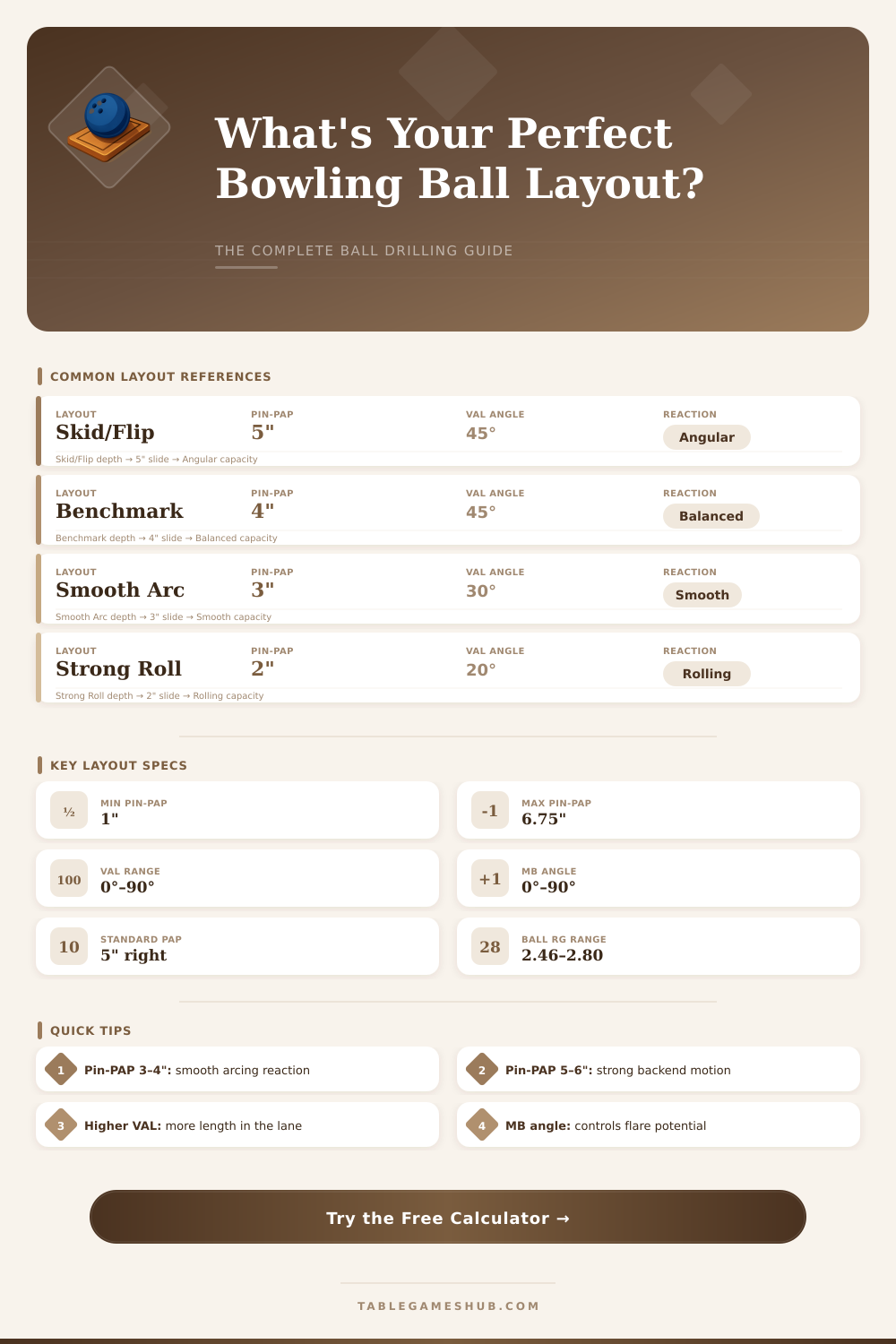
| Reaction Style | Pin-PAP (in) | VAL Angle | MB Angle | Best For |
|---|---|---|---|---|
| Skid / Flip Angular | 5–6.75" | 45–75° | 45–90° | Dry to Medium, Crankers |
| Benchmark / Balanced | 3.5–5" | 40–50° | 40–55° | Medium oil, All styles |
| Smooth Arc | 2.5–4" | 20–40° | 20–45° | Medium–Heavy, Strokers |
| Strong / Early Roll | 1–3" | 0–25° | 0–30° | Heavy oil, High rev rate |
| Max Flare / Control | 6–6.75" | 55–90° | 65–90° | Very dry, Short patterns |
| Low Flare / Straight | 1–2" | 0–15° | 0–20° | Flooded / Sport shot backup |
| Ball Weight | Min RG | Max RG | Max Diff | Max MB Diff |
|---|---|---|---|---|
| 16 lb | 2.430 | 2.800 | 0.085 | 0.025 |
| 15 lb | 2.380 | 2.800 | 0.085 | 0.025 |
| 14 lb | 2.290 | 2.800 | 0.085 | 0.025 |
| 13 lb | 2.200 | 2.800 | 0.085 | 0.025 |
| 12 lb | 2.100 | 2.800 | 0.085 | 0.025 |
| 10 lb or less | 2.000 | 2.800 | 0.085 | 0.025 |
| Player Style | Rev Rate (rpm) | Rec. Pin-PAP | Rec. VAL | Ideal Ball RG |
|---|---|---|---|---|
| Stroker | 180–250 | 3–4.5" | 25–45° | 2.46–2.57 |
| Tweener | 250–350 | 3.5–5" | 35–55° | 2.52–2.63 |
| Cranker | 350–500 | 4.5–6" | 45–75° | 2.57–2.70 |
| Two-Handed | 400–600+ | 5–6.75" | 55–90° | 2.63–2.80 |
| Differential | Flare Rings (Est.) | Track Width | Hook Potential | Coverstock Match |
|---|---|---|---|---|
| 0.000–0.015 | 1–3 rings | Narrow | Very Low | Plastic/Urethane |
| 0.016–0.030 | 3–5 rings | Medium-Narrow | Low–Medium | Urethane/Entry Reactive |
| 0.031–0.050 | 5–7 rings | Medium | Medium | Solid/Pearl Reactive |
| 0.051–0.070 | 7–9 rings | Wide | High | Hybrid/Strong Reactive |
| 0.071–0.085 | 9–12+ rings | Very Wide | Very High | Strong Solid/Hybrid |
The strategy for drilling of rolling ball involve careful arrangement of holes for thumbs and fingers. You do that according to style, hand-size and wanted ball motion. The design of those holes affects, as the ball slips according to the lane and as it stays balanced.
Various designs for bowling exist, and each affects the hook potential and the motion. The corner of holes, the place of the CG and the distance between pin and PAP decides the reaction of the ball on lane.
How to Drill a Bowling Ball
Designs count widely for all players, but apply itself according to various ways. Many factors play role, as axis-rotation and tilt, rev rate, ball-pace and lane conditions. Every player has his release, ball speed or revs.
Hence the rotary axis, PAP and ball path ranges. Most design-systems and drill sheets assume, that the PAP of people is 1 inch up and 5 inches outside with 45-degree axis shift. Driller however can estimate precise PAP, for help fix other key markers and the design pin on the ball.
The Double Angle system for one handers are simple for learn and understand. It bases on two angular and one intermediate length measure. For instance, 45×3.5×55 abbreviated show short pin design for player with average PAP in 5″ x 3/8″ up.
Various systems have different notions, but all describe alike plans. Some favours the Double Angle, others the Storm Pin Buffer. Both ways lead to same result.
The choice depends of player preference and driller.
For asymmetric balls, the mass bias indicator causes different motion according to its place. If you lays it against the track or thumb, or more fore, the move dies. For asymmetric ball you commonly chooses 50 x 4.5 x 40 design.
Drilling of bowling balls require special tools and knowledge. Best exist by means of manufacturer-recommended designs for undoubted skill level. Player can care about permanent form and release before bid sophisticated plans.
With certified pro shop you can estimate PAP and create own design for different oily patterns and lane conditions.