🐉 D&D Monster HP Calculator
Calculate hit points by size, hit dice & Constitution modifier
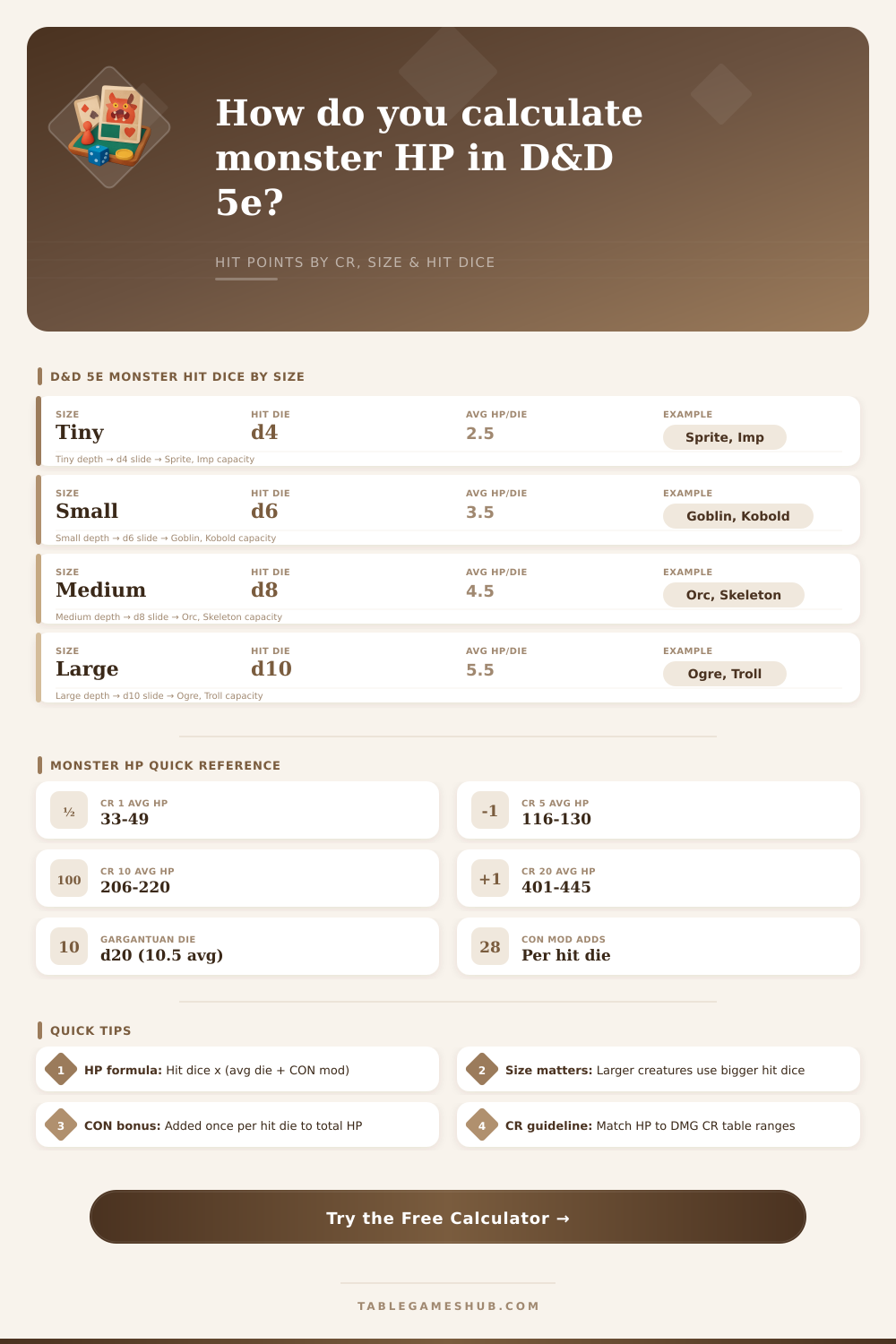
| CR | HP Range | Suggested AC | Proficiency |
|---|---|---|---|
| 1/4 | 36 – 49 | 13 | +2 |
| 1/2 | 36 – 49 | 13 | +2 |
| 1 | 50 – 70 | 13 | +2 |
| 2 | 71 – 85 | 13 | +2 |
| 3 | 86 – 100 | 13 | +2 |
| 5 | 116 – 130 | 15 | +3 |
| 10 | 206 – 220 | 17 | +4 |
| 15 | 296 – 310 | 18 | +5 |
| 20 | 401 – 445 | 19 | +6 |
| 30 | 801 – 850 | 21 | +9 |
| Size | Hit Die | Average per Die | Example Creatures |
|---|---|---|---|
| Tiny | d4 | 2.5 | Sprite, Rat, Imp |
| Small | d6 | 3.5 | Goblin, Kobold, Pixie |
| Medium | d8 | 4.5 | Orc, Skeleton, Bandit |
| Large | d10 | 5.5 | Ogre, Troll, Owlbear |
| Huge | d12 | 6.5 | Giant, Treant, Hydra |
| Gargantuan | d20 | 10.5 | Tarrasque, Dragon Turtle |
Monster hit points in D&D seem complex at first but when you get the hang of it, everything becomes simple. You will notice the HP of monster is written in two ways: as a formula and as average number beside it. For instance, if you see 2d8, that means 9 hit points if you use the average.
Or if it says 4d8+10, you can roll the dice if you want, but if that seems tedious, simply use 28 HP and keep the game moving.
How Monster Hit Points Work in D&D
The size of the monster determines what dice you use. Medium creature usually rolls d8s. If you have monster with 5 Hit Dice (HD) and Constitution modifier of +1, that becomes 5d8+5. The Constitution modifier is added to every single die so that you add up more quickly.
Why the number of dice and the total HP? Both depend on the defensive CR, that basically tells you how “tanky” the creature shoulb be.
Rolling the HP for every monster keeps the game fresh. Search the HD rating in the stat block and roll the needed d8s. Enemy with 2 HD means two dice.
Doing that for every creature, they are not identical copies, suddenly one goblin could have only 7 HP while another has 12, what gives a bit of natural unpredictability. Not every DM rolls for every NPC, but those who do notice big difference when enemy surprises the group with unexpected weakness or strength.
For special occasions, maximum HP is excellent choice for boss threats. On the other hand, for “minion” style enemies, it is usefull to use the minimal value, especially when you cast crowd of them against the group in big fight. Those “glass cannons” do strong actions but do not last long.
But here the secret; alter the HP mid fight is entirely reasonable. If the fight lasts too long and becomes boring, you can reduce the health of the enemy. If some fall too quickly and the tension disappears, add extra 20 HP to keep the tension.
That flexibility is exactly what makes tabletop gaming good.
Why not tell the players how many HP stays for the monster? That is more useful. When you disclose the precise number, you are bound to it (you can not alter it).
But if the group knows that 80 HP stays, they have perfect information about the situation. Keeping it secret, you can alter things on the fly. If monster falls painfully quickly, you can add health or fake roll without anyone knowing.
Even creature with few hit points can destroy low level group if it wins the initiative and has high AC, because damage grows quickly at high levels. High AC means that attacks more commonly fail, what naturally prolongs the fight. More HP gives to the monster more chances to act.
Even so, strengthening enemy must not mean only give more health… Mix AC changes, better attack bonuses or boosted damage create more interesting challenges. Tools like Roll20 help to track all those numbers withoutpain during the game.