♟ Chess Accuracy Calculator
Estimate your accuracy %, quality grade, and improvement potential from centipawn loss & move errors
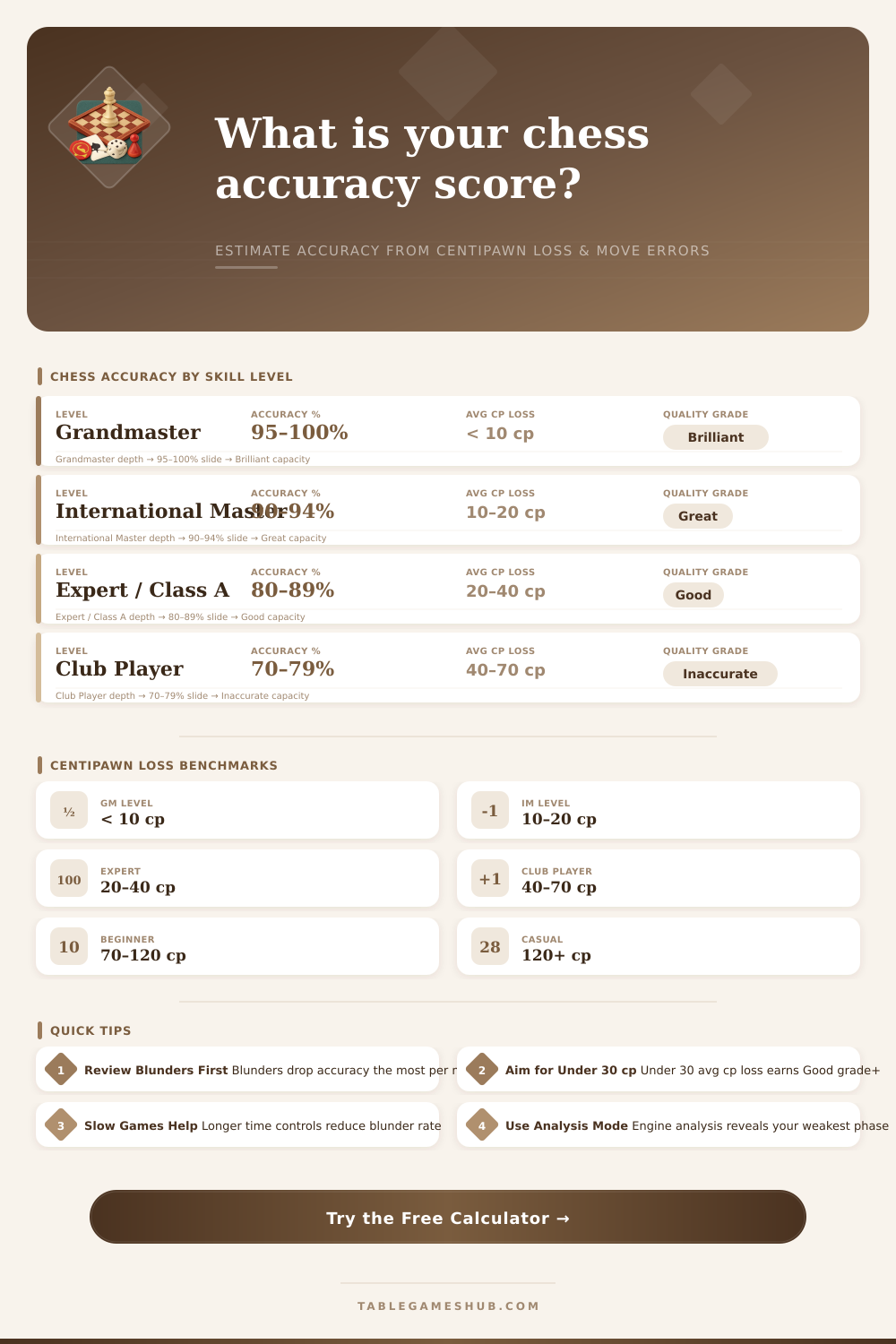
📋 Accuracy & Rating Reference Table
| Player Level | Accuracy % | Avg CP Loss | Quality Grade | Blunders/Game |
|---|---|---|---|---|
| Grandmaster (2500+) | 95–100% | < 10 cp | Brilliant | 0–0.3 |
| International Master (2400+) | 90–94% | 10–20 cp | Great | 0.3–0.7 |
| FIDE Master (2300+) | 85–89% | 20–30 cp | Good | 0.5–1.0 |
| Expert / Class A (2000+) | 80–84% | 30–45 cp | Good | 1–1.5 |
| Club Player (1500–1999) | 70–79% | 45–75 cp | Inaccurate | 1.5–3 |
| Beginner (<1500) | < 70% | 75–150 cp | Poor | 3+ |
📏 Centipawn Loss Benchmarks by Time Control
| Time Control | Expected Avg CP Loss | Expected Accuracy | Notes |
|---|---|---|---|
| Correspondence (days/move) | 5–15 cp | 93–99% | Engine-assisted play common |
| Classical (60+ min) | 15–35 cp | 88–96% | Tournament standard |
| Rapid (15–30 min) | 30–55 cp | 80–90% | Club & online rapid |
| Blitz (3–5 min) | 50–90 cp | 70–82% | Time pressure increases errors |
| Bullet (1–2 min) | 80–150 cp | 55–72% | High blunder rate expected |
Chess accuracy is a measure that shows how closely the moves of a game match the best hints of a chess program. The more the figure is near 100, the more “perfect” is the game according to the engine. Even so, there is a problem, that is not an objective measure Chess.com and Lichess give different results for the same game.
Lichess does not even show a single “playing accuracy” percentage like Chess.com, although it offers other ways to estimate the quality of the moves.
What Chess Accuracy Is and Why It Varies
The accuracy percentage shows how the player followed the best moves. From the viewpoint of a chess engine, “good” moves do not exist. A move only can reduce the chances to win, not increase them.
Every move is compared with what the engine considers best, and those differences ad d up. For instance, if one move leaves the position with damage of 0.06, but the best move would give a benefit of 0.20, the difference is 0.26. Those values are put in a formula that determines the final score.
The length of the game plays a big role here. Short games commonly have higher scores if the player wins, and low if he loses. Also the opening theory helps to raise the accuracy.
A short game of six moves with 100% accuracy probably will give a high score, because the player did only book moves and later the best. If someone plays only according to the book, the accuracy is 100%. But when you start to play “best” moves alone, the accuracy can fall under 100, which is a bit weird.
Even a weak player can do very precise moves in a short and boring game. Think about French or Slav exchange between newcomers, that commonly results in high percentages. On the other hand, a grandmaster could err in a sharp position.
Occasionally a strong player even does “wrong” moves on purpose, to create more problems for a less experienced opponent.
Players with rating under 699 average around 50 percent. Those between 700 and 999 sit around 60 to 70 percent. The group of 1000 to 1499 usually reaches 70 to 80 percent.
Grandmasters usually play with 87 to 90 percent accuracy, but players like Hikaru Nakamura or Magnus Carlsen can go higher. Even so, the accuracy operates only as an average. A player can play perfectly, but lose the queen and lose, despite that he had decent accuracy.
Someone with rating 1600 usually sees 60 to 75 percent. A game with 83 percent accuracy against any rating is already quite good. Ultimately, reaching unusually high accuracy above 90 percent was commonly linkedto cheating.