🎲 Catan Calculator
Dice probability, resource odds & token distribution for Settlers of Catan
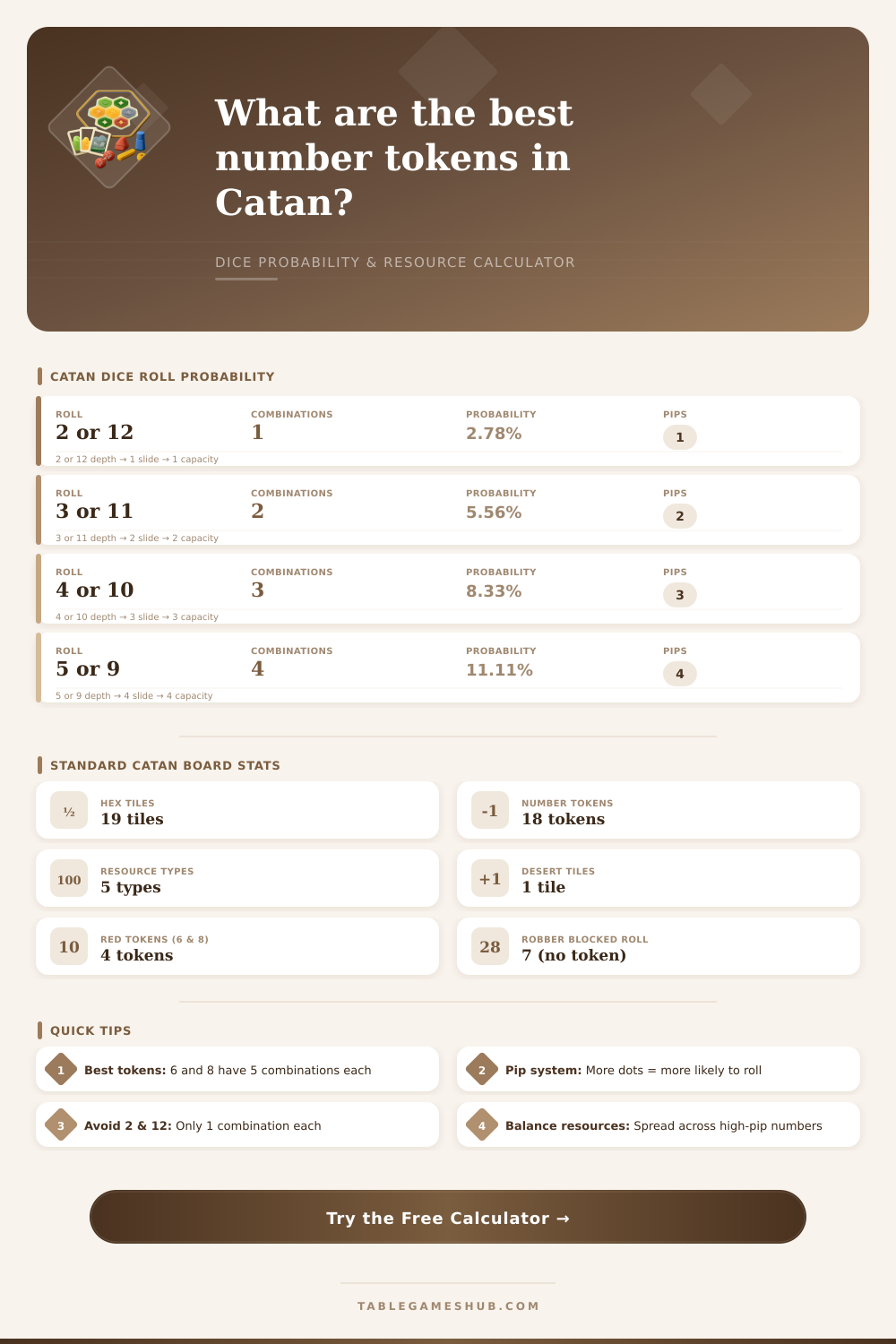
| Roll | Combinations | Probability | Pips | Token Color |
|---|---|---|---|---|
| 2 | 1 | 2.78% | • | Black |
| 3 | 2 | 5.56% | •• | Black |
| 4 | 3 | 8.33% | ••• | Black |
| 5 | 4 | 11.11% | •••• | Black |
| 6 | 5 | 13.89% | ••••• | Red |
| 7 | 6 | 16.67% | — | No Token (Robber) |
| 8 | 5 | 13.89% | ••••• | Red |
| 9 | 4 | 11.11% | •••• | Black |
| 10 | 3 | 8.33% | ••• | Black |
| 11 | 2 | 5.56% | •• | Black |
| 12 | 1 | 2.78% | • | Black |
| Token Number | Copies | Resource Types | Recommended Placement |
|---|---|---|---|
| 6 | 2 | Any (not desert) | Spread across board |
| 8 | 2 | Any (not desert) | Spread across board |
| 5 | 2 | Any | Near 6s and 8s |
| 9 | 2 | Any | Near 6s and 8s |
| 4 | 2 | Any | Mid-board |
| 10 | 2 | Any | Mid-board |
| 3 | 2 | Any | Corners |
| 11 | 2 | Any | Corners |
| 2 | 1 | Any | Outer ring |
| 12 | 1 | Any | Outer ring |
| Resource | Terrain | Cards in Base Game | Tiles on Board |
|---|---|---|---|
| Wood | Forest | 19 | 4 |
| Brick | Hills | 19 | 3 |
| Wheat | Fields | 19 | 4 |
| Sheep | Pasture | 19 | 4 |
| Ore | Mountains | 19 | 3 |
| (Desert) | Desert | 0 | 1 |
Calculators for Catan are very useful tools if you want to plan your next move in Settlers of Catan. The problem is, there are many versions, and each works a bit differently. Some focus on strategies for placing settlements, others analyze the odds of resources, and some help to count the economy of development cards.
Calculators for resource production are probably the most popular. Their mode is simple: you enter the numbers of every hexagon on the board, put zero for the desert, and after you give the data, the program shows which places are most precious. It orders the spots, so you can easily see which position most likely will give you resources when the dice fall.
Useful Catan Calculators
Also exist other versions that focus on the initial odds of the settlements. This utility is genuinely useful at the start of the game, because the first two settlements can entirely alter your strategy. The math behind that counts how close every number is to seven, and later calculates the percetnage from thirty-six.
That makes the comparison between various places very simple.
Some players say that such utilities are too complex. Some could say: “Well, one version only adds up the spots on the number tokens, right? Why use a calculator for basic arithmetic?” But here is the point.
Those little spots are more important than they seem. You maybe smile initially, but after some rounds, you will notice that you look at those spots very strongly to decide where to lay your settlement. And that genuinely helps, because occasionally certain numbers simply do not appear on the cubes during the whole game.
Then those spots suddenly become very important.
Exist also calculators for development cards. One particular program shows the expected and the real cost for buying cards during the pile empty. These probabilities are interesting, even if you are not a big strategist of Catan.
Some even created this utility researching all 143 possible ways to win the game.
On GitHub, you will find several versions of such calculators. There is a choice in JavaScript for the board game itself. Another program addresses the key logic of the game and accepts contributions from anyone that wants to help.
Even a Python-program exists, where you can enter your current stock of resources, sheep, wood, clay and wheat, and it tells you what you can build or exchange.
More than the basic calculators, the gear became even more complex. Exist generators for fair boards and programs for competitions that use ELO-style algorithms to classify players after every match. Some even coded an analyzer to find the best initial positions.
Because development cards are hidden and business happens freely, Catan is difficult to plan, and hence these utilities are so useful for thinking several moves forward.