🧙 MTG Tiebreaker Calculator
Compute Match Win %, Opponent Match Win %, Game Win % & Opponent Game Win % for Swiss tournament standings
| Players | Min Rounds | Recommended | Top Cut | Points to Advance |
|---|---|---|---|---|
| 8 | 3 | 3 | Top 4 | 9 (3-0) |
| 16 | 4 | 4 | Top 8 | 9 (3-0-1) |
| 32 | 5 | 5 | Top 8 | 12 (4-0-1) |
| 64 | 6 | 6 | Top 8 | 15 (5-1) |
| 128 | 7 | 7 | Top 8 | 18 (6-1) |
| 226-409 | 8 | 8 | Top 8 | 21 (7-1) |
| 410-672 | 9 | 9 | Top 8 | 24 (8-1) |
| 1500+ | 15 | 15+ | Top 8 | 36 (12-3) |
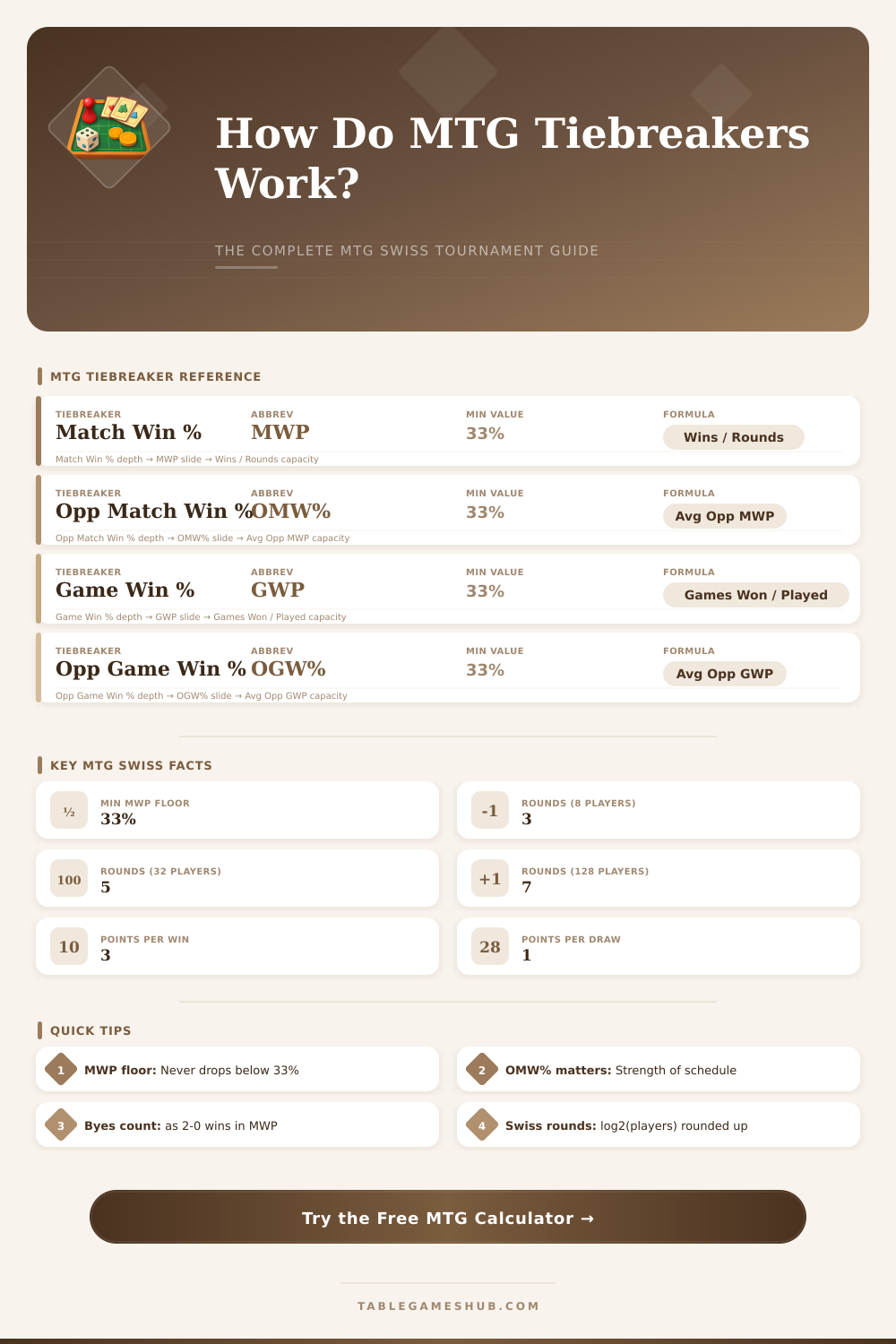
| Tiebreaker | Priority | Floor | Formula | Notes |
|---|---|---|---|---|
| Match Win % (MWP) | Points First | 33% | Wins / Total Matches | Byes count as 2-0 win |
| Opp Match Win % (OMW%) | 1st Tiebreaker | 33% | Avg of opponents' MWP | Each opp floored at 33% |
| Game Win % (GWP) | 2nd Tiebreaker | 33% | Games Won / Games Played | Bye counts as 2 wins, 0 losses |
| Opp Game Win % (OGW%) | 3rd Tiebreaker | 33% | Avg of opponents' GWP | Rare to need this far |
| Record | Match Points | MWP | Typical Standing (5-Round) |
|---|---|---|---|
| 5-0 | 15 | 100% | 1st (uncontested) |
| 4-0-1 | 13 | ~88.9% | Top 2 |
| 4-1 | 12 | 80% | 3rd–8th |
| 3-1-1 | 10 | ~77.8% | 5th–12th |
| 3-2 | 9 | 60% | Bubble (OMW% decides) |
| 2-2-1 | 7 | ~55.6% | Lower half |
| 3-0-0 (4-round) | 9 | 100% | Top 4 lock |
| 2-1-1 (4-round) | 7 | ~77.8% | Bubble for Top 8 |
In tournaments of Magic The Gathering, Tiebreaker rules help to determine higher rank for players that end in upper positions with the same amount of points. The player with the most points receives the upper place after all matches. Even so, ties appear quite often, and in such cases, separate systems sort the results beyond the basic score.
The system for Tiebreaker is made up of three stages. First, one compares the tied players according to the percentage of won matches of their opponents usually called OMW%. Second, if the tie stays, one checks their own percentage of won games, i.e. GW%.
How Tiebreakers Work in Magic The Gathering Tournaments
Third, in case of continued ties, one considers the percentage of won games of the opponents, or OGW%. Like this one reaches right order.
Why does OMW% seem a bit hard? It is basically a measure of opponent strength. For each faced opponent, one took the score of won matches of that opponent and split it by the total number of possbile match points.
Later one averages all those values. When the opponents of some player did well, that player receives bigger OMW%.
Here the reason, that two players, that both beat three matches, end in different ranks. The opponents of one maybe managed to win more in his following games, while those of the other did worse. Who beats more tough opponents, that gets better position, because the Tiebreaker rules reward matches against more competitive rivals.
A minimum limit of 33% applies for the percentages in Tiebreaker rules. The app MTG Companion and the official rules of tournaments follow this limit. Like this, even if an opponent lost every single match, his percentage of won matches will not fall under 33% during the computation.
Such minimum matters a lot in the early phases, wear the values can shift wildly.
Interesting note about byes: if the first victory of some comes from a bye, that does not mean a 0-1-result, that would weigh down the Tiebreaker. It can actually help. Even so, there is another side.
The player, that one would be beating in the first round, could later win in every match, what would raise his OMW% instead.
Matches in the final rounds do not affect the calculations of Tiebreaker rules. Also, during team tournaments, one does not use points from games. Only the whole results of matches matter for Tiebreaker in such cases.
During running of events, tools like MTGevent.com care about all calculations of Tiebreaker rules automatically, together with points and ranking. And here is a funny detail: if each Tiebreaker stays tied, the last secret rule in the Wizards Event Reporter seems to be the entry order of players in the tournament. Entering sooner gives advantage, when everything else matchesperfectly.
Truly weird, that it can depend on that.