🏆 Glicko Rating Calculator
Calculate Glicko-1 and Glicko-2 player ratings, RD values, and expected score changes after competitive matches
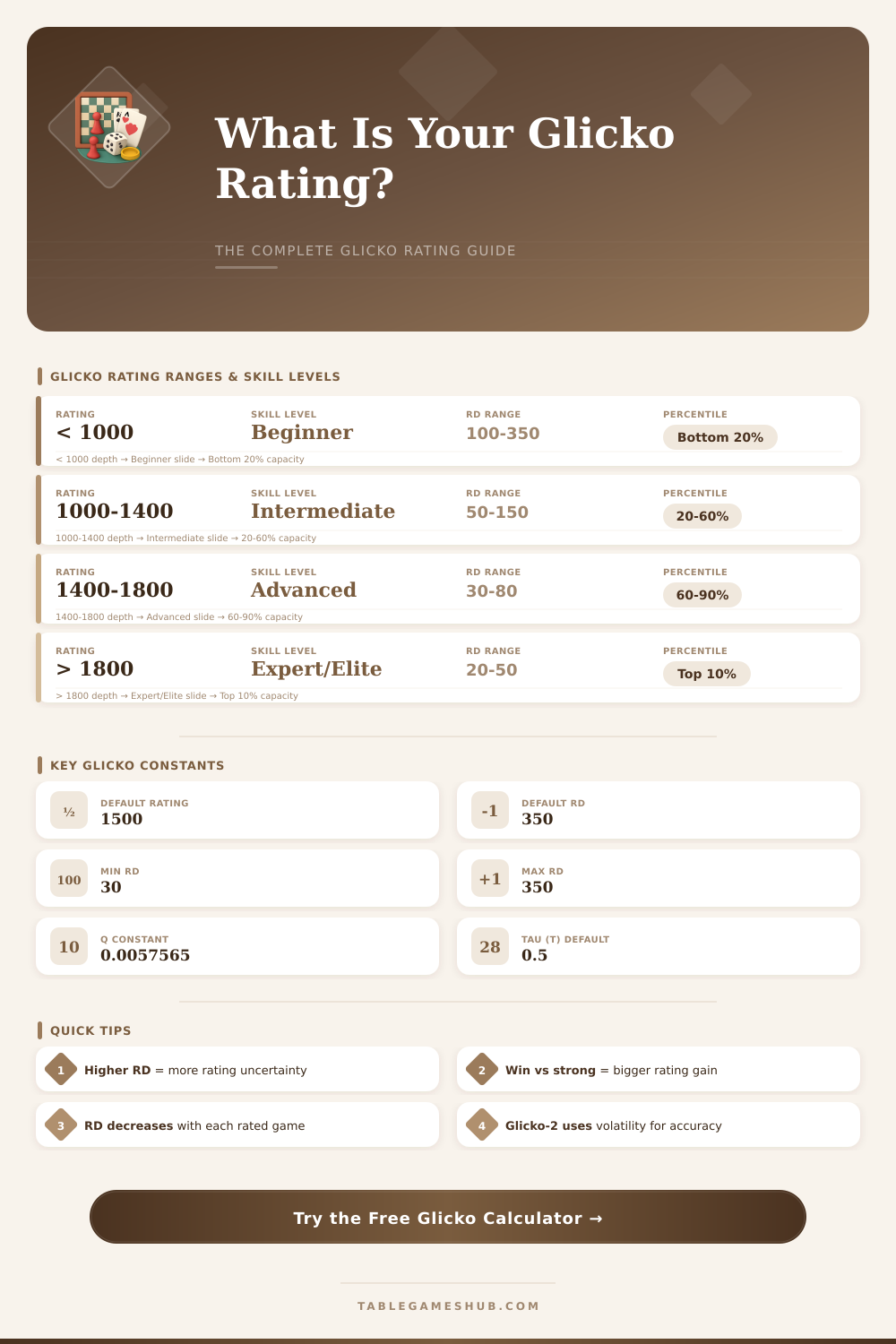
| Rating Range | Skill Level | Typical RD | Expected Win % vs 1500 | Percentile (approx) |
|---|---|---|---|---|
| < 800 | Absolute Beginner | 200–350 | 1–5% | Bottom 5% |
| 800 – 1000 | Beginner | 150–300 | 5–20% | 5–15% |
| 1000 – 1200 | Novice | 100–200 | 20–35% | 15–35% |
| 1200 – 1400 | Intermediate | 60–120 | 35–48% | 35–55% |
| 1400 – 1600 | Above Average | 40–80 | 48–52% | 55–70% |
| 1600 – 1800 | Advanced | 30–60 | 65–80% | 70–85% |
| 1800 – 2000 | Expert | 25–50 | 80–92% | 85–95% |
| > 2000 | Elite / Master | 20–40 | > 92% | Top 5% |
| Rating Difference (r – rₙ) | Expected Score E(s) | Win Probability | Draw Probability (est.) |
|---|---|---|---|
| +400 | 0.909 | ~91% | ~8% |
| +300 | 0.849 | ~85% | ~12% |
| +200 | 0.760 | ~76% | ~18% |
| +100 | 0.640 | ~64% | ~22% |
| 0 (equal) | 0.500 | ~50% | ~25% |
| -100 | 0.360 | ~36% | ~22% |
| -200 | 0.240 | ~24% | ~18% |
| -300 | 0.151 | ~15% | ~12% |
| -400 | 0.091 | ~9% | ~8% |
| Game Context | Typical Rating Range | Recommended RD Start | Recommended c Value | Rating Period |
|---|---|---|---|---|
| Chess (FIDE-like) | 1000 – 2800 | 200 | 34.6 | Monthly |
| Go (Amateur) | 100 – 2000 | 200 | 30 | Monthly |
| Shogi | 500 – 2000 | 200 | 35 | Monthly |
| Online Blitz | 500 – 2500 | 300 | 50 | Weekly |
| Online Rapid | 500 – 2500 | 250 | 40 | Weekly |
| TCG / Card Game | 1200 – 1800 | 200 | 40 | Per Event |
| Esports | 0 – 3000 | 300 | 60 | Per Season |
| Backgammon | 1000 – 2000 | 200 | 30 | Monthly |
| Weeks Inactive | RD Growth (c=34.6) | New RD (was 50) | New RD (was 100) | Max RD Reached At |
|---|---|---|---|---|
| 1 week | +34.6 | ~62 | ~106 | — |
| 4 weeks (1 month) | +69.2 | ~85 | ~122 | — |
| 8 weeks | +97.9 | ~109 | ~141 | — |
| 13 weeks | +124.9 | ~134 | ~161 | — |
| 26 weeks | +176.6 | ~183 | ~205 | — |
| 52 weeks (1 yr) | +249.7 | ~254 | ~270 | ~350 (cap) |
| 100 weeks | — | 350 (cap) | 350 (cap) | ~100 wks |
A low Rating Deviation (RD < 50) means the system is very confident in your rating. A high RD (> 200) means few games have been played and the rating is uncertain. New players always start with RD = 350 (maximum uncertainty).
Glicko-2 adds a volatility parameter (σ) that measures consistency. A player who wins and loses unexpectedly has high volatility. Glicko-2 is more accurate over time but requires tuning the system constant τ (typically 0.3–1.2).
Winning against a player rated 200+ points above you yields far more rating gain than beating a weaker opponent. The Glicko system weights upsets heavily — use this to your advantage in tournaments.
Shorter rating periods (1–2 weeks) keep ratings more responsive. Longer periods (monthly) add stability. The c constant controls how fast RD grows during inactivity — higher c = faster uncertainty growth.
Mark Glickman designed the Glicko Rating system to estimate skill in 1995, to improve the older Elo method. The original group were made up of chess players but the basic idea works for any match between two players with clear winner and loser. Glicko Rating and its more modern version Glicko-2 measure the skill of a player in direct games.
The main problem that Glicko Rating aimed to settle is that Elo does not consider whether a number truly deserves trust. Assume two players with same rank: one always plays games, while the other did not play for five years. Naturally, the idle player should have bigger risk after one single match, because of the higher doubt in his rating.
How the Glicko rating system works
Glicko Rating tracks that by means of something called rating deviation or RD. High RD shows that the system less trusts the rating. The more games someone plays, the less their RD, because real facts back it.
On the other hand, long pause from games does taht your RD grows over time.
Newcomers usually start with RD close to 350. If you play regularly, your RD probably will sit between 60 and 110. Even so, expert or professional players can drop it too 20 or 40.
The method also cares about who you meet. Beating someone much more strong than you is different than beating a weaker player. When you win, your rating climbs.
Losing, it drops. The amount depends on the ranks of both players and the level of trust in those values.
Glicko-2 grows the idea by adding volatility, a new part that describes the shakiness of a player. High volatility means that you swing much from week to week. Low volatility shows steady style.
Interesting fact: the best way to control this uncertainty is to play more games.
Many competitive websites use Glicko Rating or Glicko-2. Chess.com applies the original Glicko Rating. Lichess chose Glicko-2.
The Free Internet Chess Service stays at Glicko Rating. Outside chess, it works in Pokémon Showdown, in competitive CS:GO, Splatoon and Dota 2. Even OGS, the online platform for Go, passed to Glicko-2.
Some folks even adapted the Glicko Rating system to cycling, seeding runners by treating every run as a match.
A quirk of Glicko Rating is that it does not care about the number of tournaments that you join. More important is how you do in the games that you play. Sometimes that causes rankings that seem odd, but thebasic logic stays firm.