🎳 Bowling Ball Weight Calculator
Find your ideal bowling ball weight based on body weight, age, skill level & grip style
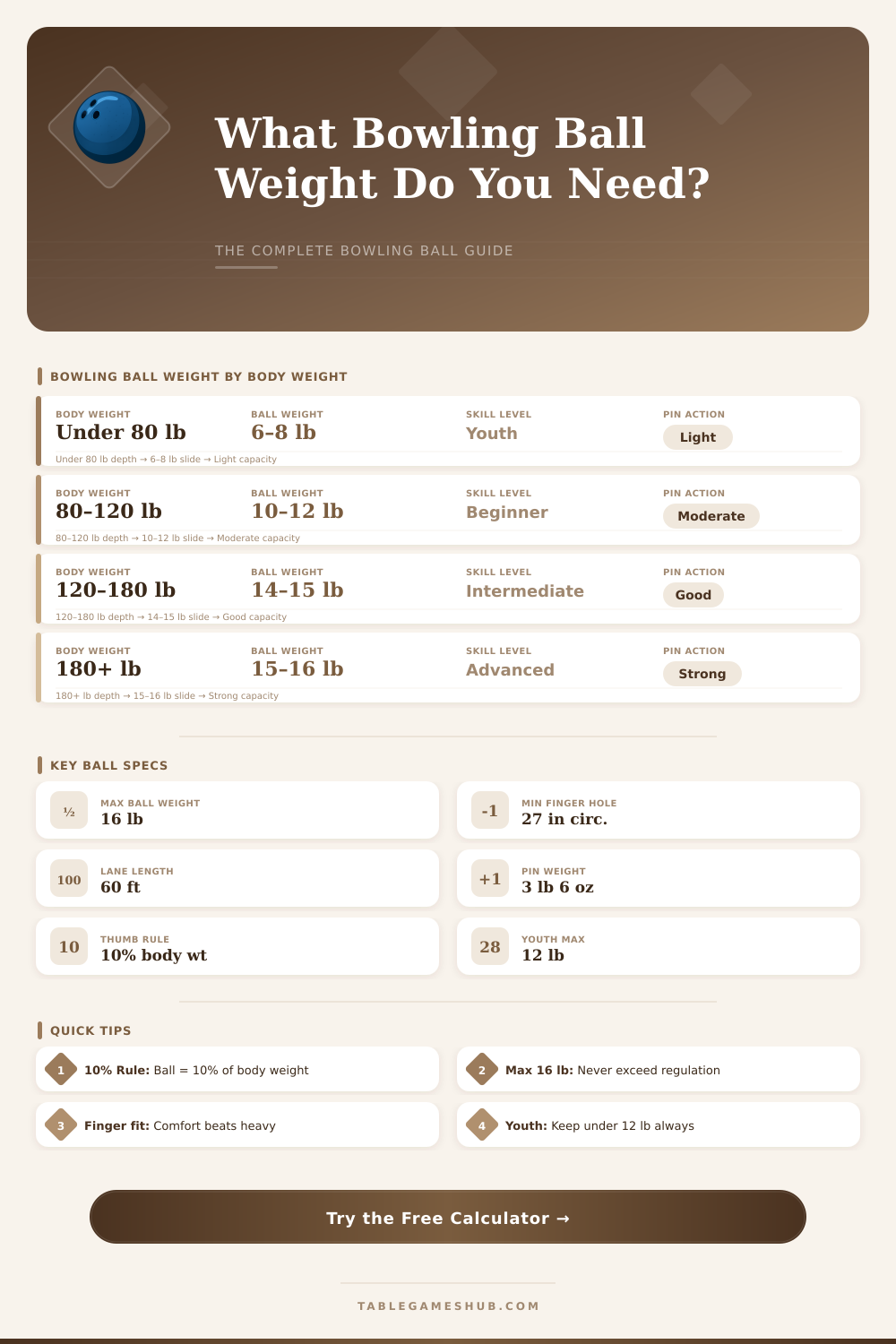
| Body Weight | Recommended Ball | Max Advised | Notes |
|---|---|---|---|
| Under 60 lb (<27 kg) | 6 lb | 6 lb | Very young children only |
| 60–80 lb (27–36 kg) | 6–8 lb | 8 lb | Child bowlers |
| 80–100 lb (36–45 kg) | 8–10 lb | 10 lb | Youth / petite adults |
| 100–120 lb (45–54 kg) | 10–12 lb | 12 lb | Light adults / older youth |
| 120–140 lb (54–64 kg) | 12–13 lb | 14 lb | Average adult female |
| 140–160 lb (64–73 kg) | 13–14 lb | 15 lb | Average adult |
| 160–180 lb (73–82 kg) | 14–15 lb | 15 lb | Above-average adult |
| 180–200 lb (82–91 kg) | 15–16 lb | 16 lb | Heavier adult |
| 200+ lb (91+ kg) | 16 lb | 16 lb | Max regulation weight |
| Ball Type | Hook Potential | Best For | Weight Range |
|---|---|---|---|
| Plastic / Polyester | Very Low | Spare shots, beginners | 6–16 lb |
| Urethane | Low–Medium | Dry lanes, light hook | 10–16 lb |
| Reactive Resin | High | Intermediate–advanced | 12–16 lb |
| Particle / Proactive | Very High | Oily lane conditions | 14–16 lb |
| Asymmetric Core | Highest | Tournament / pro play | 15–16 lb |
| Age Group | Skill Level | Adjustment | Reasoning |
|---|---|---|---|
| Child (Under 10) | Beginner | −2 to −3 lb | Developing arm strength |
| Youth (10–17) | Beginner | −1 to −2 lb | Growing strength |
| Youth (10–17) | Intermediate+ | −0.5 to −1 lb | Moderate adjustment |
| Adult (18–59) | Beginner | −1 lb | Building technique |
| Adult (18–59) | Advanced / Pro | 0 lb | Use full formula weight |
| Senior (60+) | Any | −1 to −2 lb | Reduce joint stress |
| Any | With Injury | −2 to −4 lb | Protect from further injury |
You will find a Bowling Ball with weights that range freely between 6 and 16 pounds, from the most lightweight to the most massive. That range is really useful because it helps many players quickly find the right weight without long research. The maximum allowed weight stays fixed at 16 pounds, which marks the limit for professional tournaments.
On the other hand, the most lightweight Bowling Ball options in stores commonly start at around 6 pounds.
How to Choose the Right Bowling Ball Weight
Age plays a big role when one tries to guess what weight will feel comfortable. Kids usually choose lightweight options, like 6, 8 or 10 pounds. Kids in the age of teenagers commonly choose between 11 and 14 pounds, which gives enough weight without too much trouble.
A simple rule is that the ball weigh around 10% of your body mass, but no more than 16 pounds. Like this, for folk weighing 150 pounds, an 8-pound ball probably will not be ideal.
Skilled bowlers like the heavy balls, between 14 and 16 pounds. Massive balls deliver more push and can create strong hits with the pins. On the other hand, if one chooses too heavy, you risk tiredness, bad launch and possible injuries later.
If too lightweight, you will lack fource and the pins will not fall well. Really, it is nearly perfect balance between force and accuracy.
Interesting fact: many players currently leave the classic 16-pound ball for 14 or 15 pounds. Because of modern technologies in balls, one can reach same results with a bit less mass. Besides that, it reduces the burden on the body over long time.
Before, every foundation took a 16-pound ball, but when the hook in bowling became common, many professionals switched too 15 pounds.
Simple test in reality: keep the ball held before you with a straight arm for some seconds. If the arm does not tremble, that weight works for you. Players with two-hand style have an advantage, because the mass spreads between both arms during the throw.
The speed decides, as a heavy ball must strike (without it), the extra weight does not help a lot.
Here is something that changes everything: balls of 10 or 11 pounds commonly lack a core inside. Even some 12-pound ones do not have the same heavy core as bigger models. That happens because of the key build, which affects how the ball moves on the lane.
For many folks that are serious about bowling, starting at 14 pounds is a good base. Custom drilling fit to your hand can make the ball feel more lightweight and easier in launching than the listed weight.
Do not allow anyone push you to choose a certain weight only because of habit. The main goal is to find what helps you reach good results during awhole game, not only in the first throws.