Yo Yo Test Calculator
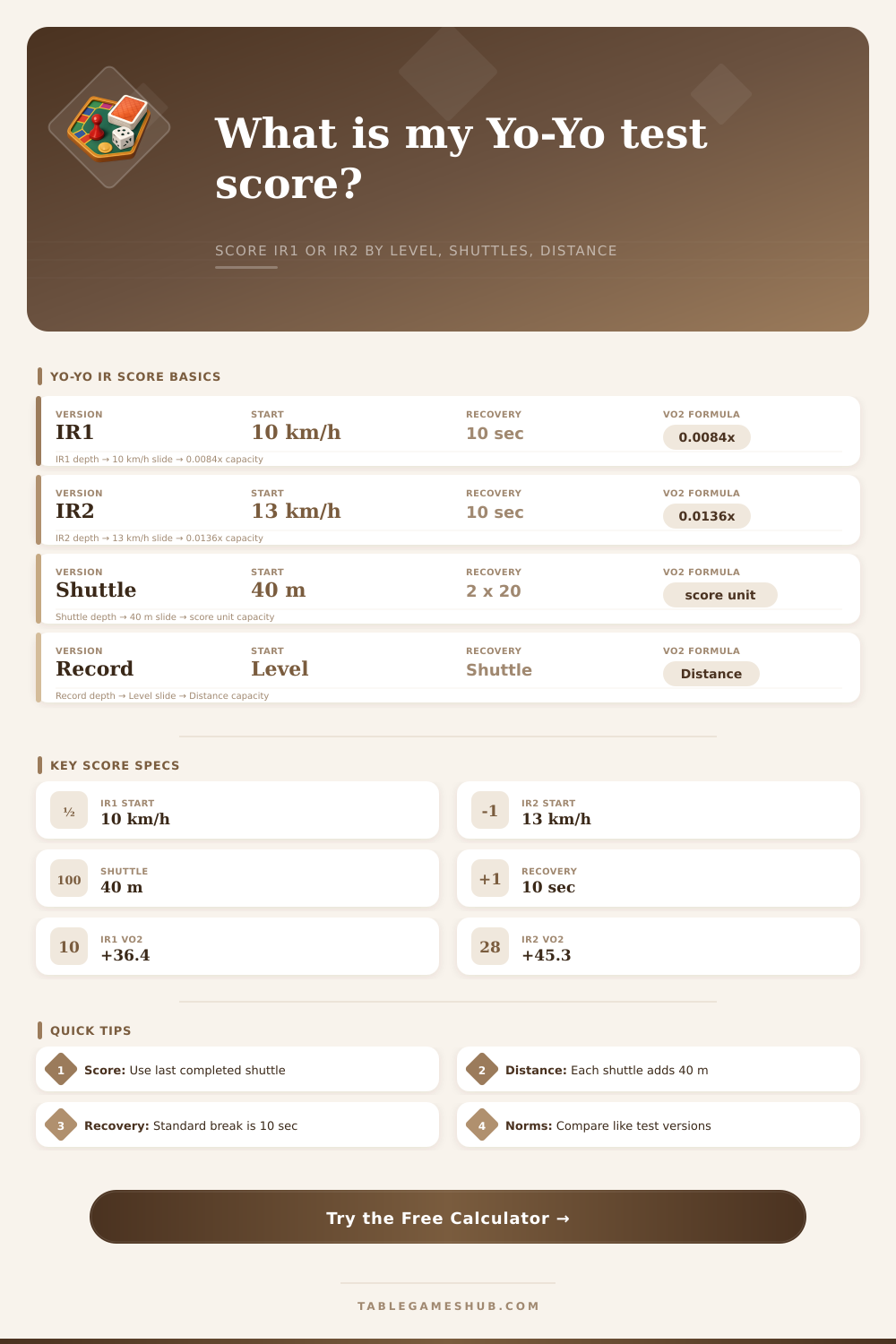
Score Yo-Yo intermittent recovery tests by speed level, shuttle count, cumulative distance, recovery interval, age and sex norm band, VO₂max estimate, and sport group.
| IR1 speed level | Speed | Shuttles at level | Cumulative distance range |
|---|---|---|---|
| 5, 9, 11 | 10.0 to 13.0 km/h | 1, 1, then 2 | 40 to 160 m |
| 12 to 13 | 13.5 to 14.0 km/h | 3 then 4 | 200 to 440 m |
| 14 to 17 | 14.5 to 16.0 km/h | 8 each level | 480 to 1720 m |
| 18 to 21 | 16.5 to 18.0 km/h | 8 each level | 1760 to 3000 m |
| 22 to 23 | 18.5 to 19.0 km/h | 8 each level | 3040 to 3640 m |
| IR2 speed level | Speed | Shuttles at level | Cumulative distance range |
|---|---|---|---|
| 11, 15, 17 | 13.0 to 16.0 km/h | 1, 1, then 2 | 40 to 160 m |
| 18 to 19 | 16.5 to 17.0 km/h | 3 then 4 | 200 to 440 m |
| 20 to 23 | 17.5 to 19.0 km/h | 8 each level | 480 to 1720 m |
| 24 to 26 | 19.5 to 20.5 km/h | 8 each level | 1760 to 2680 m |
| Rating band | Adult male IR1 distance | Adult female IR1 distance | Use note |
|---|---|---|---|
| Elite | Over 2400 m | Over 1600 m | High-performance reference |
| Excellent | 2000 to 2400 m | 1320 to 1600 m | Strong intermittent score |
| Good | 1520 to 1960 m | 1000 to 1280 m | Useful squad benchmark |
| Average | 1040 to 1480 m | 680 to 960 m | General adult reference |
| Below average | 520 to 1000 m | 320 to 640 m | Review test context |
| Poor | Under 520 m | Under 320 m | Use careful comparison |
| Sport group | Monitoring band | Strong target | Notes |
|---|---|---|---|
| Field sport squad | 1200 to 1800 m | 2000 m+ | Soccer, rugby, hockey style demands |
| Court intermittent sport | 900 to 1500 m | 1600 m+ | Basketball, futsal, handball context |
| Match official | 1400 to 2000 m | 2200 m+ | Use federation-specific standards where supplied |
| Academy or school | 600 to 1400 m | 1500 m+ | Compare by age, maturation, and role |
| Return-to-training | Trend based | Prior score | Best compared with the athlete's own baseline |
| General fitness | 600 to 1200 m | 1400 m+ | Use as a repeatable field score |
The Yo-Yo test ask the athlete to run twenty meter out and twenty meters back. The athlete must perform each twenty-meter shuttle in response to an audio signal, and must complete the shuttles before the audio signal end. The Yo-Yo test measure an athlete’s aerobic capacity and there ability to perform intermittent recovery.
Intermittent recovery is the ability of the body to clear waste product from strenuous exercise and to reload oxygen in the body. The Yo-Yo test is a relevant way to test an athlete’s performance in there sports, which often require sprinting and resting periods. One of the most important aspect of the Yo-Yo test is the recovery interval.
The Yo-Yo Test and What It Measures
The length of the recovery interval determine the demands that the test will place upon the athlete. While many people may think of the Yo-Yo test as a test of an athlete’s ability to run a distance, the Yo-Yo test is actualy different in that it measure the recovery periods between each twenty meter shuttle. Furthermore, an athlete can use a calculator to determine the cumulative distance that the athlete ran during the test.
This distance is useful in the professional context in that it is a measure of the total work that the athlete perform during the test. An athlete can choose between two version of the test: the IR1 version or the IR2 version. The IR1 version of the Yo-Yo test begin at a lower rate of speed and increases over time; thus, the IR1 version is suitable for many team sports.
The IR2 version of the test, however, begins at a faster rate of speed and require athletes to perform at higher intensity for longer periods of time. Elite athletes perform the IR2 version to find there absolute performance ceiling in relation to the Yo-Yo test. The choice of which version to use is important, as using the wrong version will result in a score that does not appropriately reflect an athlete’s ability in their specific sport.
The Yo-Yo test can result in a score that include an estimate of an athlete’s VO2max. VO2max is a measurement of the efficiency of an athlete’s heart and lung in transporting oxygen to the athlete’s body. While not as accurate as measuring an athlete’s VO2max in a laboratory, this figure is still of use to an athlete.
For example, an athlete can use their VO2max estimate to determine if their VO2max is increasing over time, indicating that their heart and lungs is becoming more efficient at transporting oxygen to their body. Context is important to the interpretation of an athlete’s Yo-Yo test results. For instance, different sports require different level of fitness.
Thus, an athlete who play soccer may be compared to another athlete who plays rugby, but not in a direct comparison of their test scores. Instead, each athlete should of been compared to other athlete who play the same sport. Furthermore, using benchmarks within each sport allow for a more accurate comparison of athletes’ Yo-Yo test scores, as compared to comparing athletes to an average for all adults.
Finally, errors in the Yo-Yo test can change the accuracy of the test results. For instance, if the twenty meter lane is longer than twenty meters, the results will not accurately reflect an athlete’s true strength. Additionally, if the athlete is performing the test on a slippery or sandy surface, the athlete will expend more energy to perform the same distance as an athlete who is performing on a more even and even surface.
Thus, an elite score for a track event may not translate to an elite score on a muddy pitch, and vice versa. The Yo-Yo test can be used to determine if an athlete who is returning from injury are ready to begin training. The athlete should not begin to train at an elite level right away, but should aim for the athletes previous score on the Yo-Yo test.
By tracking an athlete’s Yo-Yo test score for specific sports, coach can avoid overexerting the athletes. Furthermore, the data gathered from the Yo-Yo test can help coaches to determine if an athlete is game ready. By using the Yo-Yo test to determine an athlete’s fitness level, coaches and athletes can move from guessing at an athlete’s fitness level to knowing that athlete’s fitness level.