🎲 Limbo Height Progression Calculator
Plan a limbo bar schedule from starting height, drop size, round count, player age, turnout, attempt limits, and safety cutoff.
| Measure | Result | Formula | Note |
|---|---|---|---|
| Press calculate to build the progression. | |||
| Round | Bar height | Drop used | Cutoff status | Estimated active players |
|---|---|---|---|---|
| 1 | 40 in | Start | Above cutoff | 12 |
| Age group | Typical start | Suggested drop | Minimum cutoff | Schedule note |
|---|---|---|---|---|
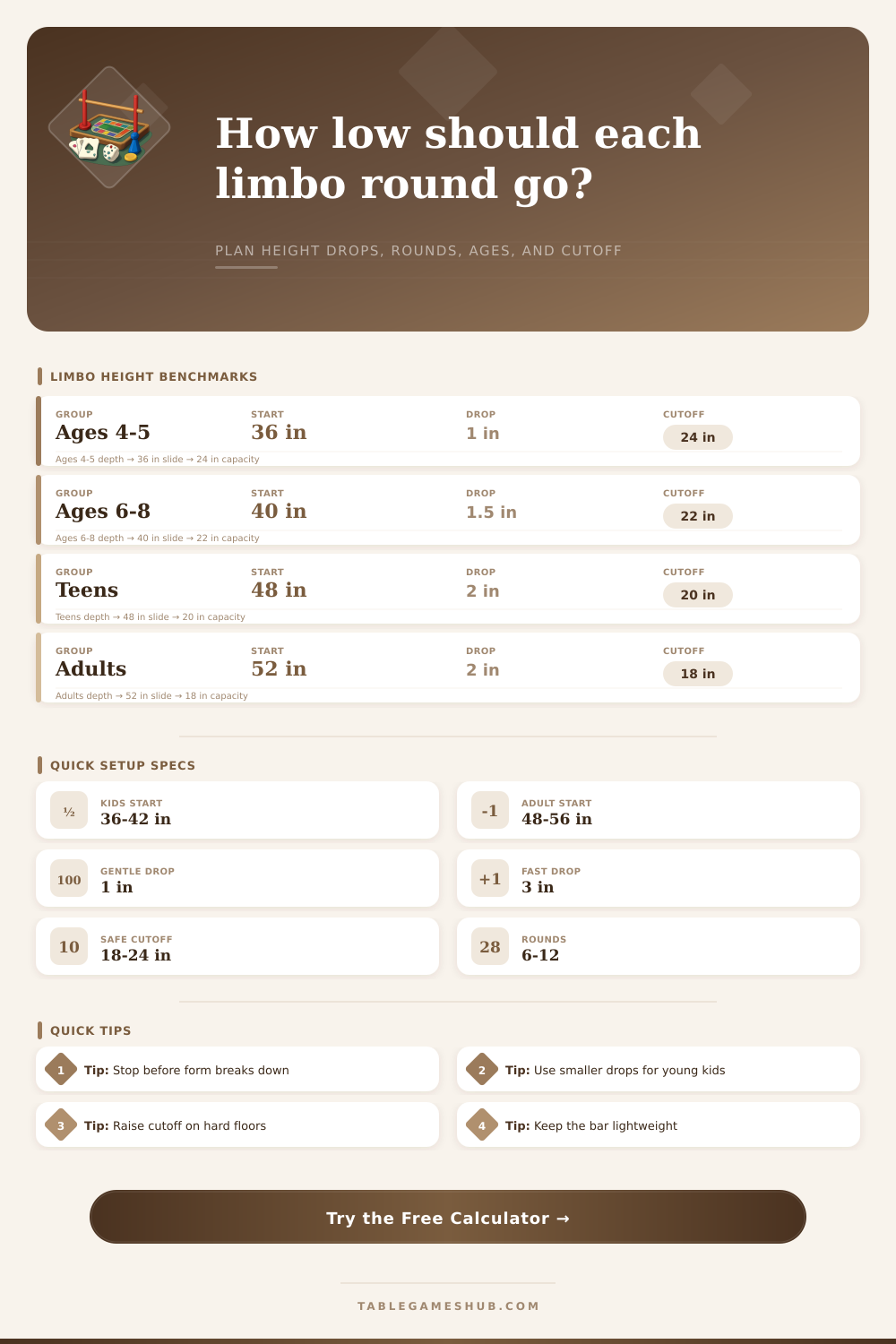
| Ages 4-5 | 34-38 in | 1 in | 24 in | Keep turns playful and stop early. |
| Ages 6-8 | 38-42 in | 1-1.5 in | 22 in | Good for birthday and school games. |
| Ages 9-12 | 42-46 in | 1.5-2 in | 20 in | Use more rounds if the group is mixed. |
| Teens | 46-52 in | 2 in | 18-20 in | Watch speed on slick floors. |
| Adults | 48-56 in | 2 in | 18-22 in | Raise cutoff for office or formal events. |
| Senior friendly | 38-44 in | 1 in | 28-32 in | Prioritize posture and easy passes. |
| Drop style | Drop amount | Best for | Round effect | Risk note |
|---|---|---|---|---|
| Micro | 0.5-1 in | Young kids, mobility play | Longest ladder | Requires patience and clear marking. |
| Gentle | 1-1.5 in | Mixed family games | Balanced ladder | Usually the safest default pace. |
| Standard | 2 in | Teens and adults | Medium ladder | Lower rounds arrive quickly. |
| Fast | 3 in | Large queues | Short ladder | Skip if players look rushed. |
| Challenge | 4 in+ | Fit experienced players | Very short ladder | Use a higher cutoff and soft surface. |
| Condition | Adjustment | Why it matters | Calculator use |
|---|---|---|---|
| Hard floor | Raise cutoff 2-4 in | Falls and knee contact have less cushion. | Enter a higher safety cutoff. |
| Costumes or dresses | Raise cutoff 2 in | Clothing can restrict the backward lean. | Use gentle or standard event type. |
| Large queue | Increase drop 0.5-1 in | Prevents the game from running too long. | Check duration and pass volume. |
| Mixed ages | Use younger cutoff | The lowest safe group should set the floor. | Select mixed ages or edit cutoff. |
| Mobility limits | Raise cutoff 6 in | Good posture matters more than low height. | Use mobility-conscious event type. |
Mark every scheduled height first
Put tape marks on the limbo poles before play starts. The round change is faster and the host avoids guessing uneven bar drops.
Use safety to override the ladder
If players start twisting, grabbing the bar, or rushing the lane, stop at the current height even if planned rounds remain.
Calculate a limbo height progression from starting bar height, round drops, age group, player count, and safety cutoff so each round stays measured and practical.
Limbo is a game where the heights of a bar is lowered in stages, and the goal of the game is for each player to move under the bar without touching the bar or falling to the ground. When hosting Limbo for many people, it can become difficult to manage the game if the height of the bar or the speed at which the bar drop to new heights does not allow for the game to be successful by the players. If you plan the heights of the bar correctly, the game should proceed smoothly for all players.
However, if you plan the heights of the bar incorrectly, the game may become awkward or unsafe for the players. Therefore, it is necesary to plan the heights of the bar in advance so that no one is ever in danger during the game. The starting height for the bar is another factor that must be considered prior to the game beginning.
How to Set the Limbo Bar Height Safely
The starting height will determine the amount of effort that the players must exert to begin the game. If the starting height is too low for the players, the players will need effort too much to begin the game. If the starting height is too high for the players, the game will take too long to becoming interesting to the players.
The starting height for Limbo should be set just above the height of the tallest player in the group who is of the youngest age and has the least flexibility in their joints. Additionally, a calculator can be used to determine this starting height based off the details of the individuals that will play the game. Another factor that should be considered is the size of the drop for the bar.
The size of the drop is the amount that the bar will drop in height between each round of Limbo. The size of the drop for Limbo can have a major impact upon the rate at which the game can be played. For instance, a drop size of one inch is relatively small for the game, yet it takes place over many round of players; a one-inch drop is unlikely to rush the players who are attempting to cross the bar.
However, if the size of the drop is three inches, the game will become faster with more drops of the bar, yet more difficult for the players due to the flexibility of each player’s body. Small drops are best used for events like birthday parties, whereas larger drops are utilized at festivals where many players must move quick through the game. The age of the individuals that will play Limbo can also impact the heights of the bar.
For instance, younger children have less physical ability than adults or teenagers. As a result, younger children need to cross higher bars with smaller drops than teenagers or adults. Additionally, even if all of the other players have high levels of flexibility, it is never a good idea to allow the adults in the group to drop to the same low heights as the young children; the safety cutoff should never be ignored.
The number of players that will join in on the game and the length of time that each player takes to cross the bar will have an impact upon the length of the game. For instance, if there are a dozen players who only take one attempt to cross the bar, the game will be over in a short amount of time. However, if there are many more players, or if each player takes two attempts to cross the bar, the game will take longer to play all of the players.
Calculators are available to help players determine the length of the game with the number of players that will participate. Various tables provide the factors of the game for different age groups of players, as well as for players of different sizes of drops. For instance, the tables indicate that a game with small drops, known as a micro-drop schedule, is appropriate for small groups of players.
The micro drop schedule allows the game to include many rounds of players. Additionally, a fast drop schedule is used for larger groups of players, and the fast drop schedule allows the game to move the line of players quick through the game. These tables are not strict rules for playing Limbo, but they do provide a framework upon which to base the players decisions regarding the game.
The real factors of the game may differ from those suggested by the calculator. For instance, if the ground is hard, the host should set the bar higher to allow for players to not fall too far when they fall in the game. If the grass is not even or if the players will be wearing costumes, the safety cutoff should be raised in order to allow for players to avoid awkward landings or costume-related difficulties.
The calculator can help to determine the heights of the bar, but the host of the game should make the final decision. If players are of awkward stances or beginning to tire, it is up to the host to skip to the next bar drop. It is also important for the host to mark every height for the bar on the poles prior to the game starting.
Marking the heights of the bar on the poles for players will eliminate hesitation of players of what height the bar will drop to. Additionally, marking the heights will prevent debates between the players of the height of the bar. Finally, marking the heights makes it easier to end the game early if the players are not ready for the bar to drop to such a height.
The progression of the bar has a framework upon which to base the game, but the framework is only guidance for the players of the game. Finally, the game is most successful if the framework is invisible to the players, meaning that the players simply follow the framework that has been create; Limbo is most successful if it is planned in advance.