⏱ Match Duration Calculator
Estimate table game match time from clocks, turns, setup, scoring, buffers, table waves, and event rounds.
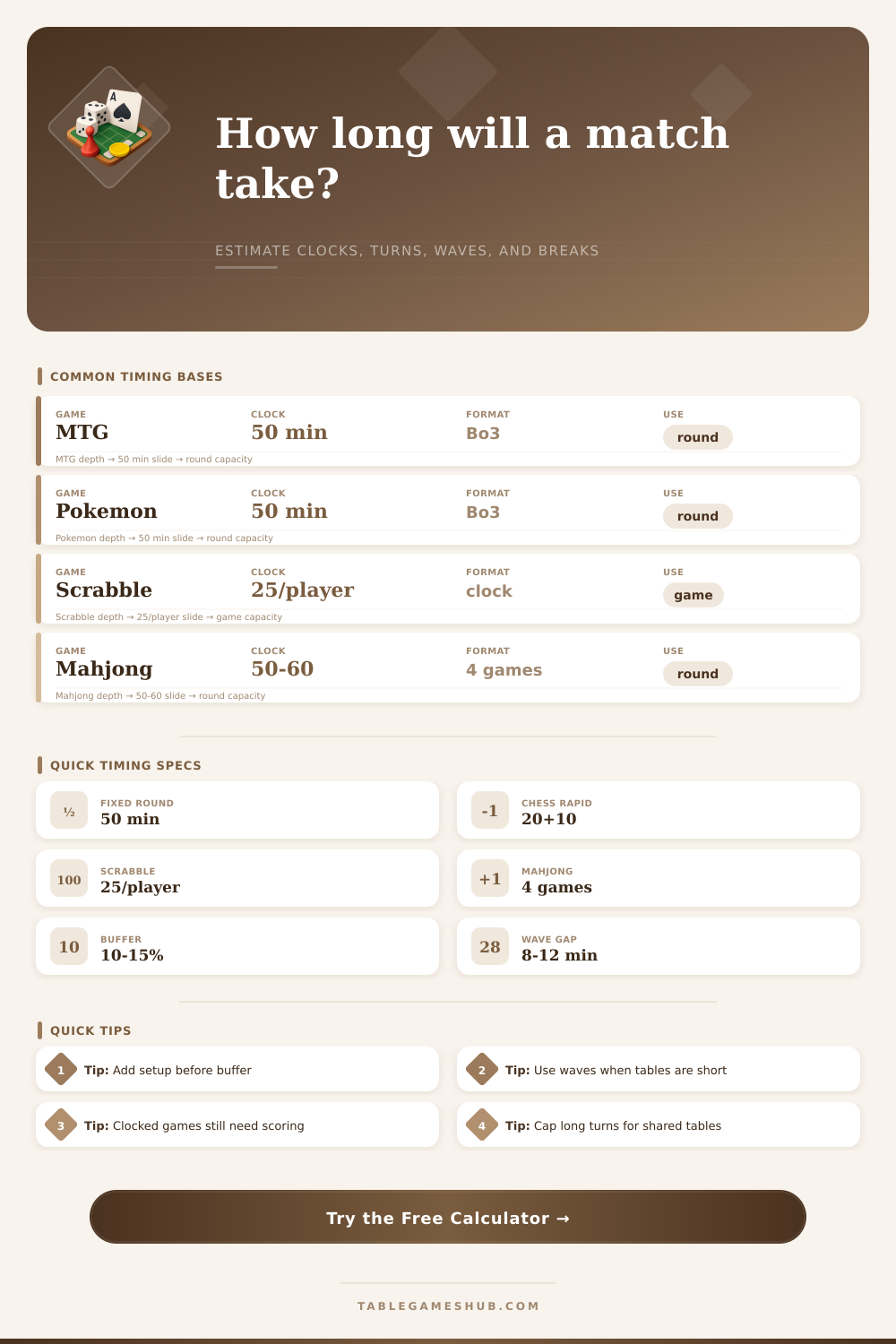
| Game or Format | Reference Timing Basis | Calculator Default | Best Input Model |
|---|---|---|---|
| Magic-style card match | Recommended tournament round clocks commonly use a fixed match window. | 50 minute cap, best of 3 | Fixed round clock |
| Pokemon-style card match | Single-game and best-of-three events commonly use public round clocks. | 50 minute cap, best of 3 | Fixed round clock |
| FIDE rapid or blitz chess | Rated categories are defined by total time per player including increment. | 20 minutes plus 10 seconds | Player clocks |
| NASPA-style Scrabble | Competitive games commonly use individual player clocks. | 25 minutes per player | Player clocks |
| Mahjong tournament round | Rounds often group four games inside one table time block. | 55 minute table round | Fixed round clock |
| Catan tournament table | Turn timers can keep tables inside a target game length. | 90 second turns | Turn-paced estimate |
| Formula Piece | Input Fields | Formula | Why It Matters |
|---|---|---|---|
| Fixed clock | Round cap | core = cap | Matches end by schedule even if game count varies. |
| Player clocks | Players, base clock, increment, turns | core = players x clock + turns x increment | Captures chess, go, Scrabble, and other clocked games. |
| Turn estimate | Players, turns, turn seconds | core = players x turns x seconds / 60 | Useful for board games and RPG encounters without clocks. |
| Hybrid cap | Round cap plus clock or turn estimate | core = min(cap, max(clocked, turns)) | Models a timed event where slow tables are capped. |
| Buffered block | Setup, scoring, breaks, overtime, buffer | match = subtotal x (1 + buffer) | Converts play time into a realistic posted schedule. |
| Scheduling Situation | Table Math | Typical Adjustment | Organizer Check |
|---|---|---|---|
| Enough tables | matches at or below tables | One wave | Post one start time for the round. |
| Short on tables | ceil(matches / tables) | Add waves | Late waves should not block later rounds. |
| Shared components | same tables, boards, mats, or terrain | Add reset minutes | Use setup time for component turnover. |
| Manual scoring | score slips or standings entry | Add reporting time | Do not hide score entry inside the play clock. |
| High rules load | many judge calls or teaching tables | Raise buffer | Use 15 to 20 percent for volatile events. |
| Buffer Level | Use When | Effect on 60 Min Block | Risk Read |
|---|---|---|---|
| 0% | Hard broadcast or closing schedule | 60 min | No recovery margin. |
| 5% | Experienced players, clean score entry | 63 min | Lean but workable. |
| 10% | Normal club event or cafe slot | 66 min | Good default. |
| 15% | Mixed experience or complex components | 69 min | Safer tournament block. |
| 20% | Teaching tables, terrain, or roleplay scenes | 72 min | Best for high variance. |
Put admin outside the play clock
Setup, scoring, table reset, and judge-added time should be entered separately so the posted schedule reflects the room, not only the rules.
Use waves before shortening matches
If tables are the bottleneck, calculate waves first. A second wave is often clearer than forcing every table into an unrealistic time cap.
This is a lesson learned by every organizer, precisely one time. This is typically on a Tuesday when a match extend past its posted conclusion time by half an hour. Players wrap up their current game as you look down at your clipboard. Opponents for the next round wait impatiently. Why’s everyone so late? No one played poorly; it just turned out that they failed to factor in real-world resistance.
Boards take more time to set up than anticipated. Score cards need to be read (not just glanced at). Rules question occur, no matter how clear instructions are. Plug your parameters into the calculator above and it will do the math for you. Let it spare you from wondering if a twenty minute round is hopeful or possible.
Why You Need More Time Than You Think
This brings us to point one. When you start playing with cards, you discover that play time isn’t match time. Fifty minutes sounds like plenty of time to play a card game…until you consider that there’s deck-shuffling involve. Score-keeping require recording. Sometimes players argue over who damaged whom, which makes you need to call judge. All this take some amount of time. This is what bleeds into your schedule (that admin overhead).
Ten minute breaks between round sounds fine to you, right? But then you realize each round take two minutes per table to reset parts and sign off on results. Suddenly, those minutes add up across sixteen table and ruin your schedule.
The reason it works is simple, yet your gut never gets it: the room are the problem, not the clock hanging on the wall. Your choice of timing model is far more important than your choice of game preset. If you’re running a sanctioned event or one that must be consistent, fixed rounds is great. That way, even if a player win their first few matches, they’ll all hit the next one simultaneously as everyone else does.
For Scrabble or other chess-like games, player clocks are perfect because how long it takes each person will determine when the game end, and increment resets add back seconds to prevent sudden death endings from feeling arbitrary. For role-playing encounters or other board games where actions loop predictably without any sort of clock, turn-based estimates can help out. No matter what path you select, the calculator will adjust it’s formula accordingly. It’ll combine setup, scoring, and buffer into a total that’s real-world, not ideal.
Cushion: Buffer percentages is often considered as an afterthought. They’re what makes tournaments run smoothly or cause chaos when delays occur. Five percent is assuming perfect score entry by people who know the game inside out, it’s seldom true on local club nights. Ten to fifteen percent are more prudent. This applies if you have a mixed group, with some folks new to the rules and others who’ve been doing this for years. Push the buffer higher still if you’re running teaching tables or playing games with complicated terrain like miniature battles; variance will bite whoever ran too tight. Better to have an additional five minutes of down time than a late start for everybody.
Once you start running out of tables, the Wave scheduling kicks in. You don’t cut any matches or make people sit next to each other uncomfortably. Instead, you break up the round into batches. It will figure out how many waves is required and extend the entire event duration to fit that. So even if one table go overtime, it doesn’t bleed into the following block. That’s how we keep the whole schedule together.
The end result is that respect for the strategy behind a game plays out in equal importance to respect for the physical realities of the space. Stop treating time as an inflexible chunk. Instead, treat it as a flexible material that includes the actual gameplay, setup, scoring, and (let’s face it) human fallibility. Your events will be much more stress-free for everyone. Time becomes your friend instead of your enemy. It moves from being a strict limitation to becoming the soft guidance that it was designed to be.