Spell Attack Bonus 5e Calculator
Calculate a D&D 5e spell attack bonus, hit probability, crit chance, and d20 roll needs with advantage, disadvantage, target AC, bless, bane, and magic modifiers.
🎯Quick Spell Attack Presets
🧮Spell Attack Inputs
Spell Attack Results
⚙Current Calculation Specs
📚5e Spell Attack Reference Tables
| Character Level | Proficiency Bonus | Common Ability Mod | Typical Spell Attack |
|---|---|---|---|
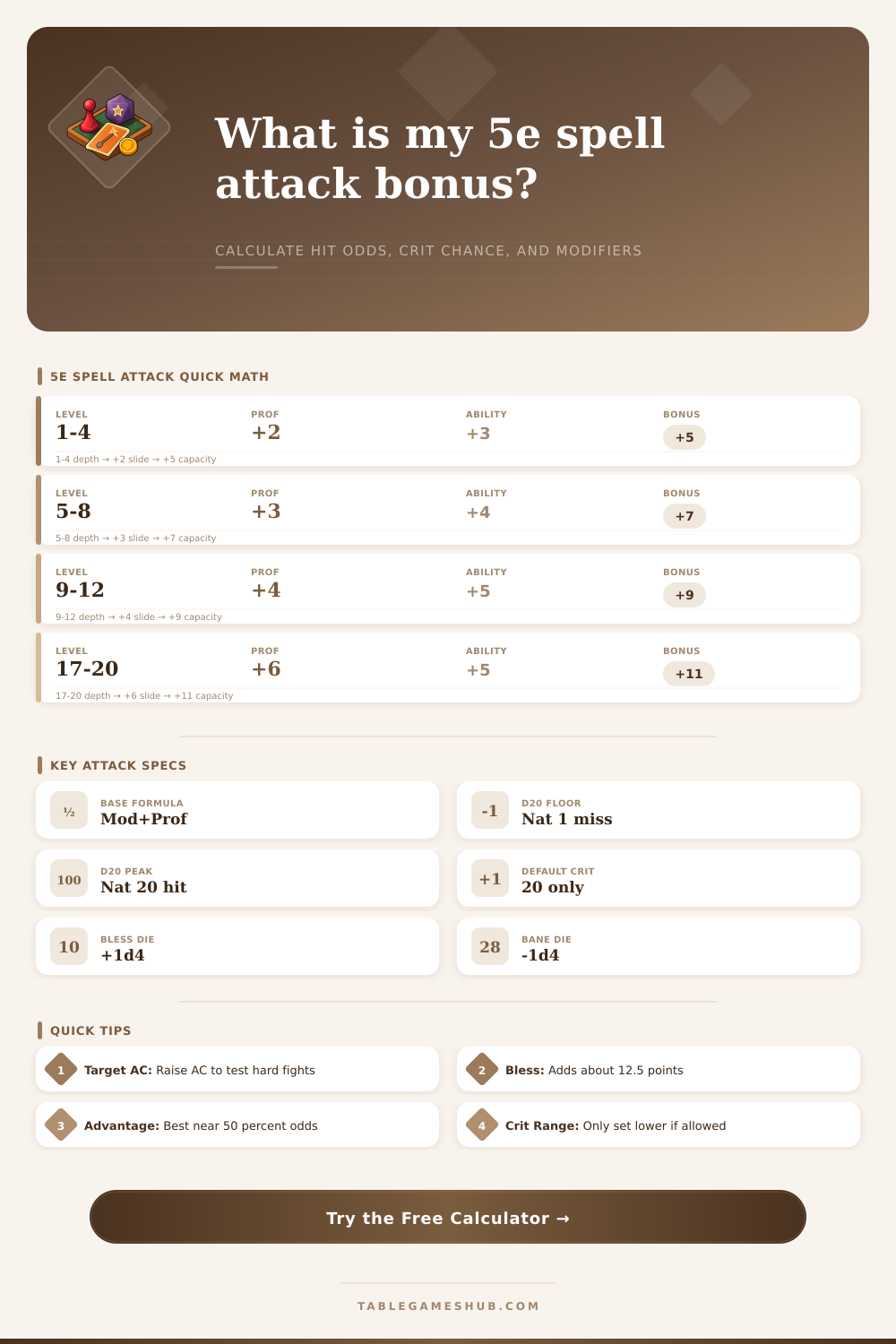
| 1 to 4 | +2 | +3 to +4 | +5 to +6 |
| 5 to 8 | +3 | +4 | +7 |
| 9 to 12 | +4 | +4 to +5 | +8 to +9 |
| 13 to 16 | +5 | +5 | +10 |
| 17 to 20 | +6 | +5 | +11 |
| Ability Score | Modifier | Spellcaster Note | Attack Bonus at Prof +3 |
|---|---|---|---|
| 14 to 15 | +2 | Low primary stat or off-stat spell | +5 |
| 16 to 17 | +3 | Solid early campaign casting stat | +6 |
| 18 to 19 | +4 | Strong mid-level casting stat | +7 |
| 20 to 21 | +5 | Usual maximum for many characters | +8 |
| 22 to 23 | +6 | Exceptional or item-supported stat | +9 |
| Needed d20 | Normal | Advantage | Disadvantage |
|---|---|---|---|
| 5+ | 80.0% | 96.0% | 64.0% |
| 8+ | 65.0% | 87.8% | 42.3% |
| 10+ | 55.0% | 79.8% | 30.3% |
| 12+ | 45.0% | 69.8% | 20.3% |
| 15+ | 30.0% | 51.0% | 9.0% |
| 18+ | 15.0% | 27.8% | 2.3% |
| Modifier Type | Input Field | Math Effect | Calculator Treatment |
|---|---|---|---|
| Spellcasting ability | Ability modifier | Adds a flat modifier | Included in base bonus |
| Proficiency | Proficiency bonus | Adds if proficient with spell attacks | Included in base bonus |
| Magic focus or feature | Magic item or feature | Adds a flat modifier | Included in base bonus |
| Bless style effect | Bonus die | Adds a rolled die | Enumerates every die face |
| Bane style effect | Penalty die | Subtracts a rolled die | Enumerates every die face |
💡Spell Attack Calculation Tips
A spell attack bonus are a mathematical value that is used to determine if a spell hit it’s target. The spell attack bonus is calculated by taking a character’s spellcasting ability modifier and adding there proficiency bonus to that modifier. While many player understand how to calculate the value of these two variables, calculating a character’s spell attack bonus can be more difficult with an inclusion of magic items and temporary buffs.
The spell attack bonus can be modified by various factor. For instance, a magic wand may provide a +1 bonus to the spell attack bonus, as may a temporary class feature. Since each digit on a twenty sided die represent a five percent shift in the chances of an event occurring, even small changes to the spell attack bonus have the potential to significant shift a character’s chance of successfully landing a spell on its target.
How Spell Attack Bonus Changes Your Chance to Hit
Thus, these small changes should of been accounted for in a character’s strategy, as any change to the spell attack bonus will impact the probability of the spell successfully hit its target. The concept of a hit window is used to describe which numbers on a twenty sided die represents a successful hit of a spell. Spells like Bless and Bane provides various effects to a character’s spell roll that alter the chance that the spell will land on its target.
For instance, Bless adds a small die to a character’s spell roll. This small die create a sliding scale of the probability of the spells hit; it does not add the average value of a die to the spell attack bonus. The player can calculate the outcome of a roll in order to provide players with an accurate idea of the true chance that a spell will hit its target.
Advantage and disadvantage is two game mechanics that alter the probability of an attack roll. With the advantage mechanic, two dice are rolled and the higher of the two value is used as the roll for the attack. This increases the chance that an attack will succeed with respect to landing on the target.
Disadvantage is the reverse of advantage; two dice are rolled and the lower of the two dice will be used for the attack roll. This disadvantage mechanic make it more difficult for the caster to successfully hit the target with the spell. Each of these mechanic can be understood in relation to the probability of each spells success.
Critical hits are those instance in which a spell hit is deemed to be successful and causes more increased damage to the target. A natural twenty is a standard critical hit, but some builds of characters allow for an expanded critical hit range; in these instance, a nineteen or an eighteen can also roll as a critical hit. However, only if the attack roll is high enough to hit the target’s armor class will these rolls by the caster result in a critical hit.
The reference tables can be used to determine how spell attack bonus modifiers changes as characters level up. Understanding the probability of a spell hit allow for different strategies with different enemy. For instance, a high probability of hitting an enemy with low armor can indicate a low probability of hit for spells with higher armor value.
Various armor class value can be tested to determine whether a character is optimized for specific type of enemies. If a character can determine which enemy have which armor values, they can better understand in what situations their current build is going to be efficient; they can stop guessing at success of spells, and begin to strategize according.