🃏 Rummy Probability Calculator
Calculate draw odds, meld probabilities & hand combinations for any rummy variant
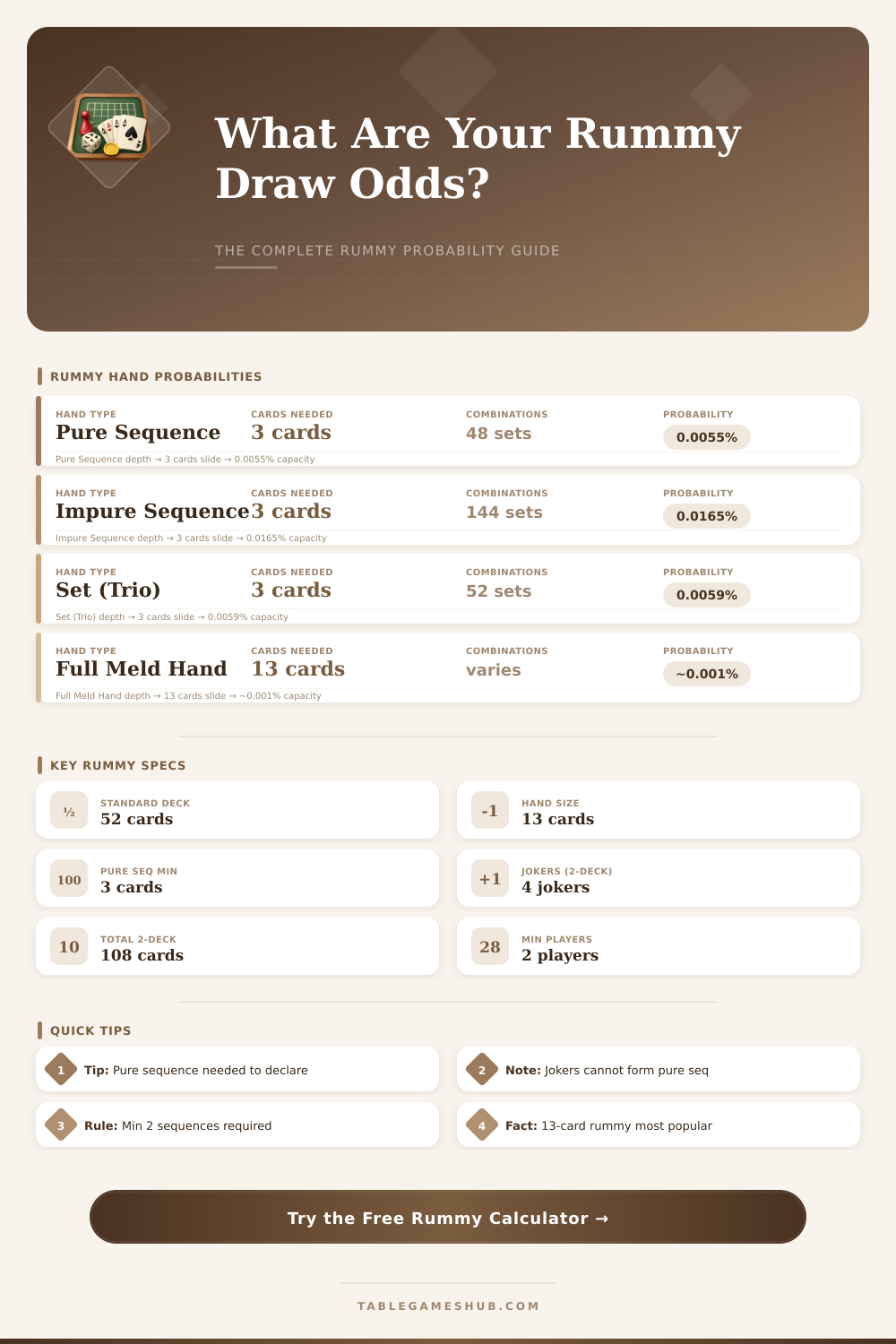
| Meld Type | Cards Needed | Combinations (1-deck) | Draw Probability | Joker Allowed |
|---|---|---|---|---|
| Pure Sequence (3) | 3 consecutive, same suit | 44 possible sets | ~2.5% per draw | No |
| Pure Sequence (4) | 4 consecutive, same suit | 40 possible sets | ~1.1% per draw | No |
| Impure Sequence (3) | 2 natural + 1 Joker | 192 possible sets | ~9.8% per draw | Yes |
| Set / Trio (3) | 3 same rank, diff suit | 52 possible sets | ~2.9% per draw | No |
| Set / Quartet (4) | 4 same rank, all suits | 13 possible sets | ~0.7% per draw | No |
| Impure Set (3) | 2 same rank + 1 Joker | 156 possible sets | ~8.0% per draw | Yes |
| Rummy (all melds) | All 13 cards melded | varies widely | <0.01% initial | Yes |
| Variant | Cards Dealt | Decks Used | Players | Avg Game Time |
|---|---|---|---|---|
| 13-Card Indian Rummy | 13 | 2 (+ jokers) | 2–6 | 20–40 min |
| Gin Rummy | 10 | 1 | 2 | 15–30 min |
| Rummy 500 | 13 (2p) / 7 (3+) | 1–2 | 2–8 | 30–60 min |
| Canasta | 11 | 2 (+ 4 jokers) | 2–6 | 45–90 min |
| Contract Rummy | 10–12 | 2 | 3–8 | 60–120 min |
| 7-Card Rummy | 7 | 1 | 2–6 | 10–20 min |
| Liverpool Rummy | 10 | 2 | 3–8 | 45–90 min |
| Draws Left | 1 Specific Card | Any of 4 Same Rank | Completing 3-Card Seq | Cumulative (4 draws) |
|---|---|---|---|---|
| 1 draw | ~2.56% | ~10.26% | ~5.13% | — |
| 2 draws | ~5.07% | ~19.51% | ~10.07% | — |
| 3 draws | ~7.53% | ~27.80% | ~14.81% | — |
| 4 draws | ~9.93% | ~35.18% | ~19.37% | ~35.2% |
| 5 draws | ~12.28% | ~41.73% | ~23.76% | ~41.7% |
| 10 draws | ~23.08% | ~65.13% | ~41.49% | ~65.1% |
| Players | Table Size (in) | Table Size (cm) | Surface Area (sq ft) | Space Per Player (in) |
|---|---|---|---|---|
| 2 Players | 36 x 24 in | 91 x 61 cm | 6.0 sq ft | 18 in |
| 3 Players | 48 x 30 in | 122 x 76 cm | 10.0 sq ft | 20 in |
| 4 Players | 48 x 36 in | 122 x 91 cm | 12.0 sq ft | 24 in |
| 6 Players | 72 x 36 in | 183 x 91 cm | 18.0 sq ft | 24 in |
| 8 Players | 84 x 42 in | 213 x 107 cm | 24.5 sq ft | 24 in |
Rummy became very popular during the last years. Thousands of folks join daily to play the online version of that classic card game. One gave it a fresh online side, what brought a whole wave of new players.
Simple knowledge about math for instance Probability, very helps in Rummy. Even newcomers that well understand Probability learn the game soon. Such clever players pick more winning tactics over time.
Why Probability Matters in Rummy
Why does Probability truly matter in Rummy? Chance simply shows the possibility that something will happen. In Rummy, the chance to receive a certain card depends on how many such cards stay in the deck.
Probability is only another way to express how likely something will happen. The cards in your hand, the pile of dumped and the secret cards all change those possibilities. Learning to count them truly can turn the game.
Math tips help players decide when to keep a card or dump it.
Here a fast sample. In two-player Rummy with each ten cards, assume that you need a heart to complete a series. You keep two hearts, but your opponent has none.
The possibility to recieve a heart here is one from 32. That kind of math is common during the game.
The codes behind Rummy are truly wonderful. There are more than 15 billion possible hands with ten cards. The not-dealt part gives eleven cards, what expands the possibilities to more than 60 billion different hands.
After the deal, every guess about a hand must base on the 41 staying cards.
You can see that cards other players take or dump. All of that gives clues about there plans and who combinations they intend. Because the main task is to create sequences, cards in your hand that link and belong to same colors or values give better chance to form such groups.
When you need a certain card in Indian Rummy, the chance to draw it is found by sharing the number of staying cards in the deck by the total number involved. Probability trees in Rummy help to study groups of picked cards to find the most likely order. All of that points to the player what cards to drop.
It also limits the choice of dumps, because they are less useful in the best possible combos.
Expert players go past basic percentages. They weigh every percentage against the gains and costs for every step in the hand. All of that sometimes is the biggest gap between a casual player and one who truly rules the game.
The amount of players at thetable also affects the math of chance to receive natural Rummy.