Progressive Tiebreak Calculator
Calculate Swiss tournament cumulative scores, optional progressive cuts, late byes, forfeits, opponent-score context, and comparison ranking for tied players.
| Round | Code | Round pts | Running score | Progressive contribution | Opponent final score | Flag |
|---|---|---|---|---|---|---|
| Choose a preset or calculate your entered round sequence. | ||||||
| Rank | Player | Final score | Progressive | Cut progressive | Opponent sum | Result path |
|---|---|---|---|---|---|---|
| Enter tied players and calculate to rank them. | ||||||
| Result code | Chess points | 3-1-0 points | Played? | Progressive note |
|---|---|---|---|---|
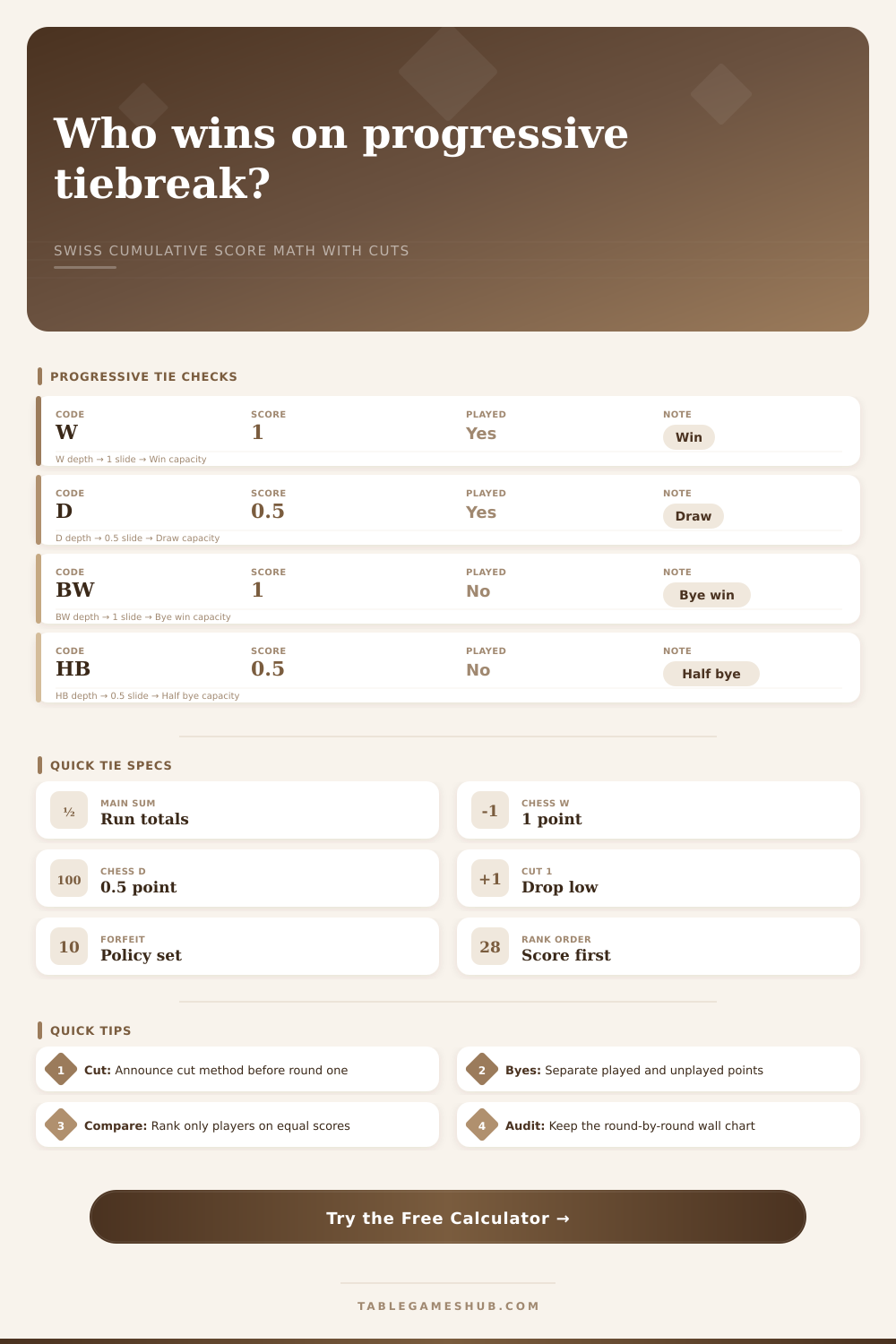
| W | 1 | 3 | Yes | Normal played win; adds to every later running total. |
| D | 0.5 | 1 | Yes | Normal played draw; cumulative impact depends on round timing. |
| L | 0 | 0 | Yes | Running score carries forward, so early losses keep later totals lower. |
| BW | 1 | 3 | No | Full-point bye; some events subtract this from cumulative tie-breaks. |
| HB | 0.5 | 1 | No | Half-point bye; common late-bye adjustment is a half-point subtraction. |
| FW | 1 | 3 | No | Forfeit win; counted or adjusted according to event regulations. |
| FL | 0 | 0 | No | Forfeit loss; remains zero and is flagged for organizer policy review. |
| N | 0 | 0 | No | Not paired or late-entry zero; may be excluded by local regulations. |
| Cut option | What is removed | Best use | Effect on early wins |
|---|---|---|---|
| No cut | Nothing | Simple cumulative standings | Maximum reward for early scoring. |
| Cut 1 low | Lowest running-score entry | Reducing one poor early round | Still favors strong starts, but softens one dip. |
| Drop high | Highest running-score entry | Organizer-only stress tests | Reduces late-round ceiling effects. |
| Drop high and low | One highest and one lowest entry | Long events with volatile starts | Moderates both runaway and slow-start paths. |
| After field cut | Rounds before cut stage | Events that reset or separate final pods | Early rounds qualify the player but do not score the cut stage. |
| Unplayed policy | Running-score treatment | Use when | Organizer assumption |
|---|---|---|---|
| Count as entered | Bye or forfeit points remain in cumulative totals | Event rules say unplayed results are normal scores | Simple wall-chart math. |
| Subtract unplayed | Running total includes score, then unplayed point value is deducted from progressive | Using common cumulative bye adjustments | Full bye subtracts full point; half bye subtracts half. |
| Zero unplayed | Unplayed rounds add zero before cumulative totals are built | Local rules do not reward unpaired rounds for tie-breaks | Final score may differ from progressive tie score. |
| Exclude unplayed | Running total counts the score, but that round is not summed | Organizer wants only played rounds in the progressive sum | Later rounds still carry the added bye value unless zeroed separately. |
| Ranking layer | Calculator field | Higher is better? | Why it appears |
|---|---|---|---|
| 1 | Final score | Yes | Progressive tie-breaks are normally applied only among tied final scores. |
| 2 | Selected progressive | Yes | Rewards the player who accumulated points earlier in the event. |
| 3 | Opponent sum | Yes | Shows strength-of-schedule context without replacing progressive score. |
| 4 | Player name | No | Stable display order if entered data remains numerically tied. |
A Swiss tournament ends with three players tied for first place, then comes the real deal. You’ve seen their boards; you’ve watched them play. But the pairings software only sees numbers, and now it has to sort the chaos. That’s what progressive tiebreaks are for.
It is not just about who won more games, but when they won them. The player who stayed ahead longest gets rewarded by math. Those who started shaky then surged late gets punished. A flat final score becomes a timeline of performance.
What Are Progressive Tiebreaks?
After entering the round results, calculator will handle cumulative math for you. It’s an exercise in addition, but hey, they can add up quickly so this saves you time from doing it yourself. The progressive score is sum of your standing after each individual round. So if you’re ahead early, that lead carries forward into all following totals. That means the final tiebreak is inflated. Losing early, such as in round one, is worse then losing late (such as round four) because it reduces the baseline for all rounds thereafter. Volatility gets punished by the system. Consistency trumps recovery.
This becomes a whole lot more complicated with byes and forfeits. A full bye gives you a point even if you don’t play, which increases your running score. But, in terms of tiebreaks, most organizers considers that an unearned advantage. With the tool, you can also assign other policies to these unplayed rounds. For example, do you want to include the byes as regular points? Do you want to deduct the byes from the cumulative total? Or do you want to not include the byes at all? Your ranking adjusts immediately based off the policy you select. If you opt to deduct the bye points, you’re effectively saying ‘How did the player perform when they had someone to compete against?’ It removes the convenience of the schedule and exposes the sheer competitive pressure.
The other dimension of strategy: Cut rules. A player can get off to a horrible start (due to some sort of anomaly) and play flawlessly after. A cut rule that drops lowest running score allows that player to shed that early baggage. It tamps down on the downside of a poor start. On the flip side, if you drop the highest score it limits the ceiling on those players who slaughtered their weak opponent early and ran away with the event. It is not commonly used in regular play, though it can be seen in things like stress tests or specific board game formats. Those are all laid out on page and make clear how each cut will impact the value of winning early.
Now, this has nothing to do with opponent strength (a different discussion entirely). The second consideration is your progressive method, with opponent strength acting as a secondary check to contextualize that score. That’s how we know whether you had a high progressive score because you crushed everyone…or because you were matched up against poor-performing fishers. A high progressive score with weak opponents is less impressive than a moderate score with strong resistance. Yours. So, the ranking grid first ranks by final score, second by the progressive score you chose and third by this opponent context. By doing so, it builds out an order of merit that tells the difference between strength and lucky scheduling.
Do review the rulebook before someone posts pairings for the 1st round. Most disputes that come up after the event involve ambiguity around how byes are handled. For example: does a player who has a couple byes end up losing tiebreaker position? Yes, if the rulebook says the bye(s) are subtracted from the score. And yes, even if this player goes on to have a flawless final score. It’s math. It sounds unfair, but it’s true.
Once you understand that tiebreakers reflect momentum rather than just points, you’ll be all set. You can also use the calculator to play out scenarios like the late entry or the junior bye presets. That way you can understand how those rules impact the podium.
The final score tells the story of the tournament. It is the pulse of the event. If someone gets to the top gradually, then his story is different than that of the one who falls behind and eventually claws back up. The progressive tiebreak is just a measurement of this story. It doesn’t judge the nature of the game or chess played, only the strength of the scoreline. And in the end, it shows you who held their nerve. The winner of the tiebreak is the one who was ahead. Most people don’t see this, they see the final number and forget how the player got there. You should of checked the math first.