📚 Paperback Word Value Calculator
Total the cents generated by a Paperback word, including card values, common-card use, score bonuses, double-word effects, length-track checks, bounty tokens, discounts, and buy planning.
1Named Turn Presets
Load a turn state, then adjust the word, card values, bonuses, length track, and intended purchases for your table.
2Word, Card, and Buy Inputs
3Formula Cards
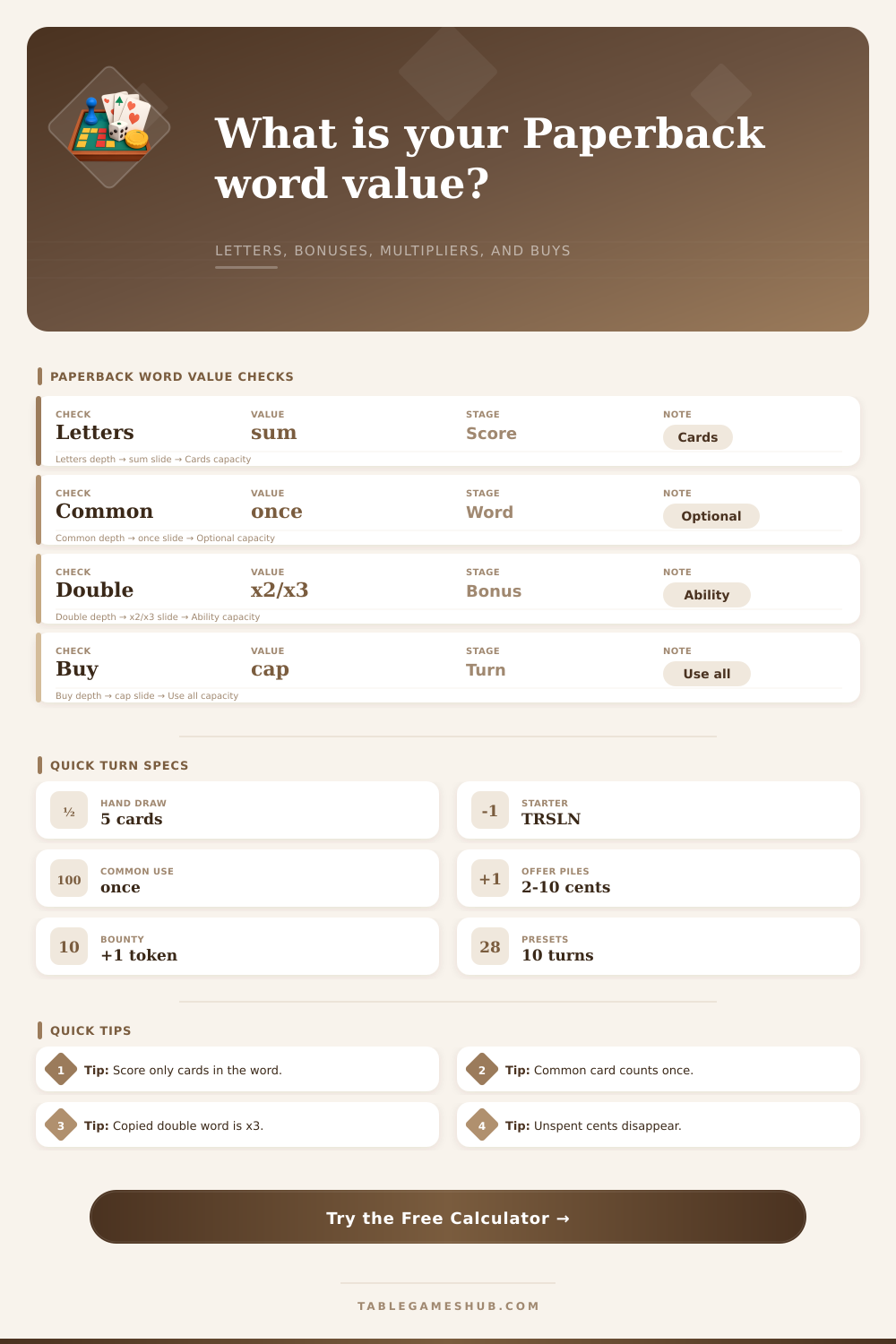
Add the upper-left score from every card used in the word, including the common card when used.
Add double-letter extra value and flat ability cents before applying a word-score multiplier.
Double Word Score doubles; copying that ability makes the total triple rather than quadruple.
Purchased cards can total up to the word score. Unused cents are not saved for later turns.
4Paperback Spec Grid
5Reference Tables
| Input | What it represents | Formula role | Common mistake |
|---|---|---|---|
| Card values in word | Upper-left cents on cards actually used. | Base sum before ability effects. | Including unused hand cards. |
| Common card value | Score printed on the common card if used. | Added once to the base sum. | Counting the common card twice. |
| Double-letter extra | Only the extra cents from doubled letter scoring. | Added before word multiplier. | Entering the full letter value again and also in the card list. |
| Flat ability bonus | Plus or minus cents from card text or table notes. | Added before multiplier in this calculator. | Mixing buy discounts into score bonuses. |
| Bounty tokens | Optional helper tokens cashed for +1 score. | Added after multiplier as turn buying power. | Saving token value across turns. |
| Offer target | Normal check | With discount token | Calculator field |
|---|---|---|---|
| Low letter pile | 2 to 4 cents often reachable from starter hands. | Alternate can fall by token count. | Target visible card cost. |
| Middle letter pile | 5 to 7 cents usually needs a stronger word or ability. | Discount makes tight buys possible. | Target discount tokens. |
| High letter pile | 8 to 10 cents usually needs multipliers or upgraded letters. | Discount may bridge one or two cents. | Planned purchase total. |
| Fame card | Buy if the total cost is within word value. | Discount rule applies to Alternate cards, not every Fame pile. | Offer plan result. |
| Multiple buys | Sum every purchased card cost. | Apply discounts to eligible targets before summing. | Planned purchase total. |
| Preset | Main lesson | Key input changed | Expected use |
|---|---|---|---|
| Starter TRSLN Word | Clean low-value opening word. | Simple one-cent letters. | Buy a cheap letter. |
| Common Card Gain | Length track check matters separately from cents. | Common card used and long word. | Gain common card. |
| Double Letter Push | Extra letter value increases buying power. | Double-letter extra cents. | Reach a mid pile. |
| Copied Double Word | Copied Double Word Score is x3. | Word multiplier set to three. | Audit large turns. |
| Tight Offer Plan | Discounts and planned spend can be checked together. | Target discount and spend. | Avoid overspending. |
| Source | Used for | Quality note | Link |
|---|---|---|---|
| Fowers Games Paperback product page | Game identity, word-building deck-building loop. | Publisher page. | Fowers page |
| Paperback Rules Google Doc | Turn sequence, score word step, buy step, common card, optional rules. | Public rule text linked in search results. | Rules text |
| BoardGameGeek Paperback listing | Cross-check title and publisher context. | Board game database listing. | BGG listing |
6Scorekeeper Tips
Separate word score from buy discounts. First total the word's generated cents, then reduce only eligible card prices for optional Discount tokens before checking the purchase plan.
Audit length independently. A long word can gain the common card even when its cents are modest, so check letter count and buying power as two different results.
When you spread out those five initial cards in Paperback, you’re being put to the test. They read: T, R, S, L, and N. They cost one cent each. Build words to create enough money to purchase better card. Use those improved cards to build longer word for even more money. It’s easy, right? Wrong.
When you actualy play, it never realy feels easy. You’re sitting there with your hand of cards, wondering whether to hoard what little cash you’ve made or spend it all on some shiny new card on the table. The above calculator take care of the math, so you don’t need to do any head counting while on the brink of an intense turn.
How to Play Paperback
That’s the basic math: Each turn, your only resource is what you’ve built, your word. Each card add its printed value to your word score. Got four cards with a cost of one cent? You’ve got four cents to spend. But the game soon adds levels of complication to this number. There are abilities that multiplies the value of letters, abilities that add extra points for building a long word, and a shared card that anyone can grab if their word is long enough.
Those modifiers shake things up: What was once a decent hand becomes a spending frenzy. Luckily, there’s no need to remember all of the edge cases; the page contains a handy reference table that shows you how it all shakes out. Length is one of the biggest rookie oversights in Paperback: it’s easy to look at a short word with some valuable letters in it and think it’ll get you more points up front than a long chain of low-value letters, but getting the long word gets you common card as well.
Getting the common card gives you another letter to play next turn, sometimes advances you along a bonus track, etc. It lets you know what kind of trade-off you’re making here (money now vs. Resources later). By splitting out the length-of-word indicator from the word-score indicator, this tool let you understand visually whether you’re grabbing a powerful letter for the short term, but leaving yourself stuck on the common card down the road.
Finally there are the optional rules (which include discount and bounty tokens). Discount tokens lower the price of certain cards in the offer pile. Bounty tokens let you pay with victory points or another resource to increase your score by a few extra points. This can bridge the gap between not having enough and being able to make a purchase.
These optional rules are more about fine tuning your economy than creating an economy from scratch. They become most relevant when you’re trying to grab a card that’s just out of reach. At that point you have to calculate how much the marginal gain is worth: will a one-cent boost from a bounty token bridge the gap to make this purchase? That’s precisely what the pre-set scenarios in the calculator show.
To make sense of this, think of Paperback like a Scrabble-style interface on top of a deck-builder. Normally, most deck-builders focuses on discarding weaker cards to strengthen your engine. With Paperback, you’ll keep all the letters in your hand until you’re able to assemble them into a word. You can’t just ditch crappy letters, you must find a way to work them into something. That means that your tactics become more about adaptation than pruning.
If you pull a lot of lower value consonants, you need some vowels to link them up. Likewise, pulling long words mean you must see if you can afford to play them. You can also splinter them by using the spacebar ability. Because each turn changes what’s in your hand, Paperback realy favors flexibility over inflexible planning.
Emptying any one of two random piles of wild letters triggers the endgame; there’s a race dynamic where suddenly people want to spend and spend fast (even if they’d rather be hoarding). Should I drop these letters and risk losing momentum? Or hold them back in hopes of an upgrade? How do I weigh the now vs. The later?
A high word value is useless if it doesn’t translate into progress on the fame track or clearing of key offers. That’s what the buy plan section of the calculator is for: simulating that last push. Does my projected score account for buying several items at once? It turns something that used to seem abstract, potential… Into something concrete: “Yes, I should of.”
In conclusion: Paperback is all about knowing how to read the board and understanding when to push your luck. Occasionally, it’s time to buy cheap upgrades that will build up your engine. Other times, it’s time to blow some cash on fame cards that will secure VP. There’s no wrong way to do this, just the right play for you given the current table and your hand.
Once you learn what each piece of input means, the math becomes simple. Just determine if you’re looking for a length bonus or a multiplier. That’s typically the line between a decent turn and a great one. Looking back on the game, you won’t remember the words you spelled; you’ll remember the cards you secured because of them.