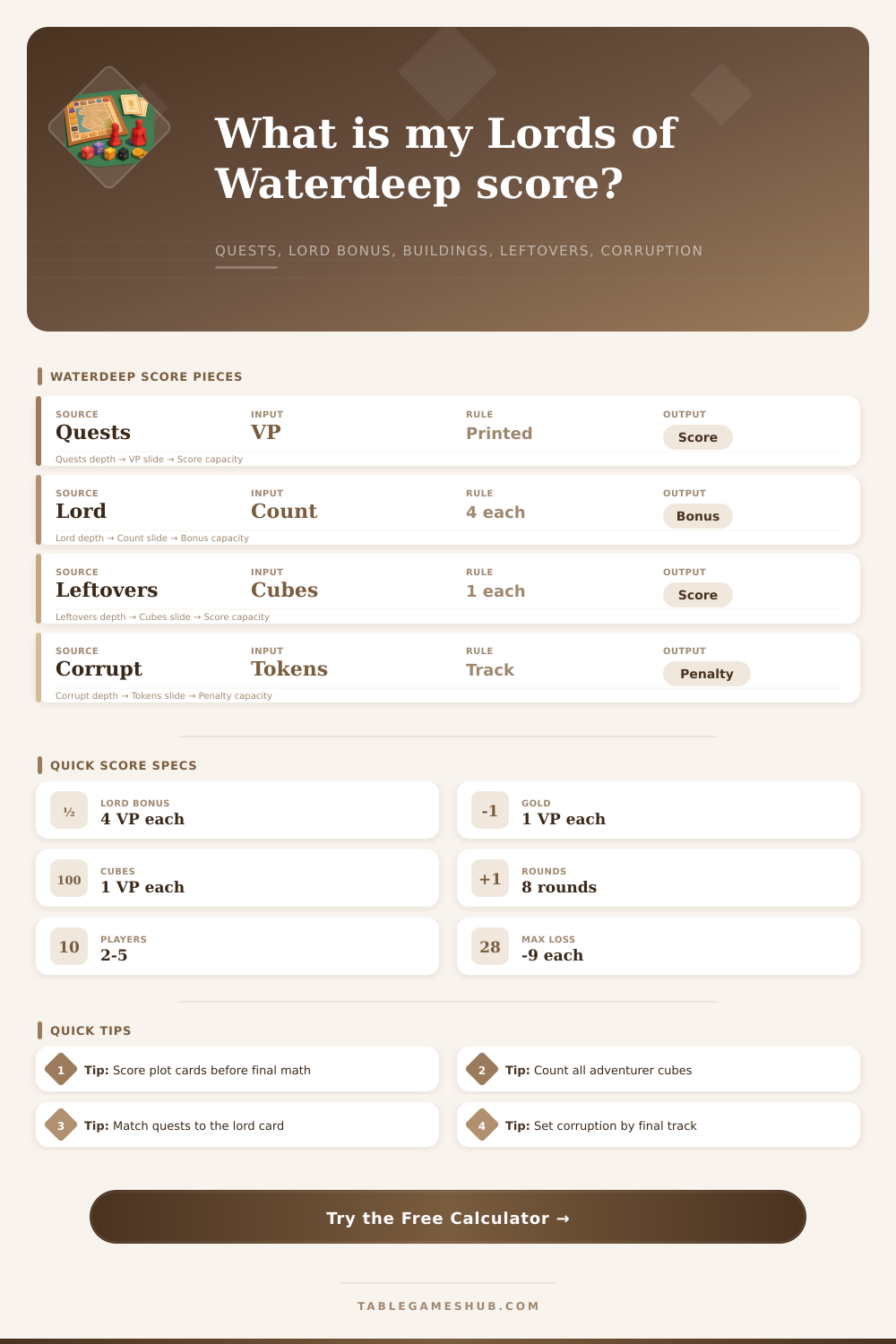
Lords of Waterdeep Score Calculator
Total quests, plot rewards, buildings, lord card bonuses, leftovers, intrigue points, and corruption penalties in one final scoring sheet.
| Score Source | When It Scores | Formula Used | Calculator Field |
|---|---|---|---|
| Completed quests | During play and final score track | Enter printed VP total from all completed quests | Printed VP from Completed Quests |
| Plot quest rewards | When plot text grants extra VP | Sum all ongoing and final plot rewards | Plot Quest and Ongoing VP Rewards |
| Owned buildings | From printed VP and owner rewards | Building VP plus any endgame owner reward | Building VP and Owner Rewards |
| Intrigue cards | When intrigue effects grant VP | Direct VP from played intrigue cards | Intrigue Card VP Rewards |
| Leftover resources | Game end cleanup | Unused adventurer cubes plus unused gold | Unused Adventurer Cubes and Gold |
| Corruption | After final corruption track is known | Tokens held multiplied by final penalty step | Corruption Tokens Held |
| Lord Bonus Profile | Matching Quest Types | Bonus Formula | Use Case |
|---|---|---|---|
| Piety plus Warfare | Piety, Warfare | 4 VP times matching completed quests | Temple and battle-focused lord cards |
| Arcana plus Warfare | Arcana, Warfare | 4 VP times matching completed quests | Wizard and military quest mix |
| Commerce plus Skulduggery | Commerce, Skulduggery | 4 VP times matching completed quests | Trade and covert quest mix |
| Arcana plus Skulduggery | Arcana, Skulduggery | 4 VP times matching completed quests | Spell and shadow quest mix |
| Commerce plus Piety | Commerce, Piety | 4 VP times matching completed quests | Merchant and temple quest mix |
| Builder profile | Owned buildings | 6 VP times owned buildings | Building-focused lord variant |
| Corruption Step | Penalty per Token | Example with 2 Tokens | Example with 5 Tokens |
|---|---|---|---|
| No penalty | 0 VP | 0 VP | 0 VP |
| Light penalty | -1 VP | -2 VP | -5 VP |
| Middle penalty | -3 VP | -6 VP | -15 VP |
| Severe penalty | -5 VP | -10 VP | -25 VP |
| End track pressure | -7 VP | -14 VP | -35 VP |
| Maximum penalty | -9 VP | -18 VP | -45 VP |
| Endgame Profile | Quest VP Range | Bonus Pattern | Score Watchpoint |
|---|---|---|---|
| Quest rush | 85 to 120 VP | Many completed quests, modest leftovers | Lord match count can decide the table |
| Plot engine | 65 to 95 VP | Plot cards add hidden endgame points | Track each plot reward separately |
| Builder table | 55 to 85 VP | Buildings and owner rewards climb late | Include printed VP and owner triggers |
| Corruption race | 75 to 110 VP | Large rewards with dangerous penalty risk | Final corruption step changes totals sharply |
| Intrigue swing | 70 to 100 VP | Intrigue VP and stolen tempo matter | Record direct VP from each card effect |
Scoring in Lords of Waterdeep involve several different category of victory points that can be earned from many different sources. Quest victory points must be calculated. The player must calculate plot rewards.
The player must calculate building owner bonuses. Leftover resource must be calculated. Intrigue cards must be calculated.
How to Count Victory Points in Lords of Waterdeep
The player must calculate corruption penalties. Finally, the lord card bonus must be calculated. Many players only calculate the victory point values that is printed on the quests.
However, the lord card bonus may change the final ranking of the players, so it is to the player’s advantage to use a scoring tool that ensures all categories are account for in the final game score. Such a tool helps the player to avoid overlooking any specific category of victory points. Before beginning to calculate victory points for the game, the player must collect all information that is necessary to determine the victory points for that game.
The player must determine the number of quest that they have completed in each category. Additionally, the player must determine the number of buildings that they own at the end of the game. The calculator will handle the mathematics of the game once the player enters all of this information.
The player should take note of the number of quests that they completed in each category because some lords provides bonuses for completing certain types of quests while other lords do not. For instance, a warfare lord will earn bonus points for completing warfare quests while they will not earn bonus points for completing commerce quest. Thus, the lord bonus calculator makes the comparison between the different types of lord bonuses visible to the player so that they do not have to rely upon there memory to remember the value of each type of quest.
The victory points for the leftover resources are scored according to a specific rule that is written in the game. All leftover resources provides victory points for the player that owns those resources. Any number of unused adventurer cubes are each worth one victory point.
Additionally, any number of unused gold token are each worth one victory point. Therefore, a player that has many leftover resources of either type will earn victory points for the game. However, corruption tokens are different in that they do not provide victory points.
Instead, they create a penalty for the player that has those many number of corruption tokens. The value of that penalty is based off the position of the corruption track on the game board. Additionally, the value of the corruption penalty can change between games.
A player that has three corruption tokens will lose victory points if the corruption track is at a high number on the corruption track but will lose more fewer victory points if that same player’s corruption track is at a low number on the corruption track. Thus, prior to calculating the final victory points for the game, the player must record the position of the corruption track. Plot cards and intrigue cards also provides victory points for the player.
Some plot cards provides victory points continuously throughout the game and some plot cards provide victory points at the end of the game. Additionally, some intrigue cards provides victory points directly to the player instead of providing resources to the player. The lord and quest victory point calculator will separate these victory points so that they are not added to the victory points that are earn from the quests.
This type of separate calculation for intrigue cards is important because two players can have the same number of victory points from completing quests yet one player may earn more victory points due to having more intrigue cards in their possession. Lastly, the buildings that the player owns also provide victory points for the player. The victory points from the buildings are calculated in more than one way.
First, the player can calculate the number of victory points from the printed value of victory points on the building card. Additionally, the owner reward of each of those building also provide victory points for the player. Those owner rewards can be earned at the end of the game.
Additionally, some lord cards also provide bonus points when the player that plays that lord owns a certain number of buildings. Thus, a player might earn few victory points from the quests but many victory points from the buildings that they own. As with most things in the game of Lords of Waterdeep, many players make mistakes during the scoring phase of the game.
For instance, many players may add the plot rewards to the quest victory points twice. Additionally, many players may count each quest that a player completed towards the bonus points for the lord that the player controls. Finally, many players may forget to set the corruption step on the track once the game is over and all of the corruption tokens have been return to the track.
Forgetting to set the corruption step will result in the corruption penalty points being calculated incorrect. These type of errors will seem to some players to be lucky outcomes in the game but are merely errors in the mathematics involved in scoring the game. The best way to remove any uncertainty for the player is to use the victory point calculator.
The calculator will collect all of the victory points that the player earned during the game including the lord bonus, the victory points from the leftover resources, the corruption penalties and the visible victory points. By collecting each of these variables, the score for each player will be represented in a single clear number. Thus, the final ranking for each player will be a matter of accurately calculating each player’s victory points and final ranking will be a matter of accurate accounting rather than a matter of potential arguments between the player.