Lords of Waterdeep Quest Reward Calculator
Estimate the full value of a quest reward by combining printed VP, lord category bonuses, resource refunds, intrigue cards, building owner rewards, and plot quest chains.
Quest Reward Projection
| Category | Typical reward shape | Lord match value | Calculator use |
|---|---|---|---|
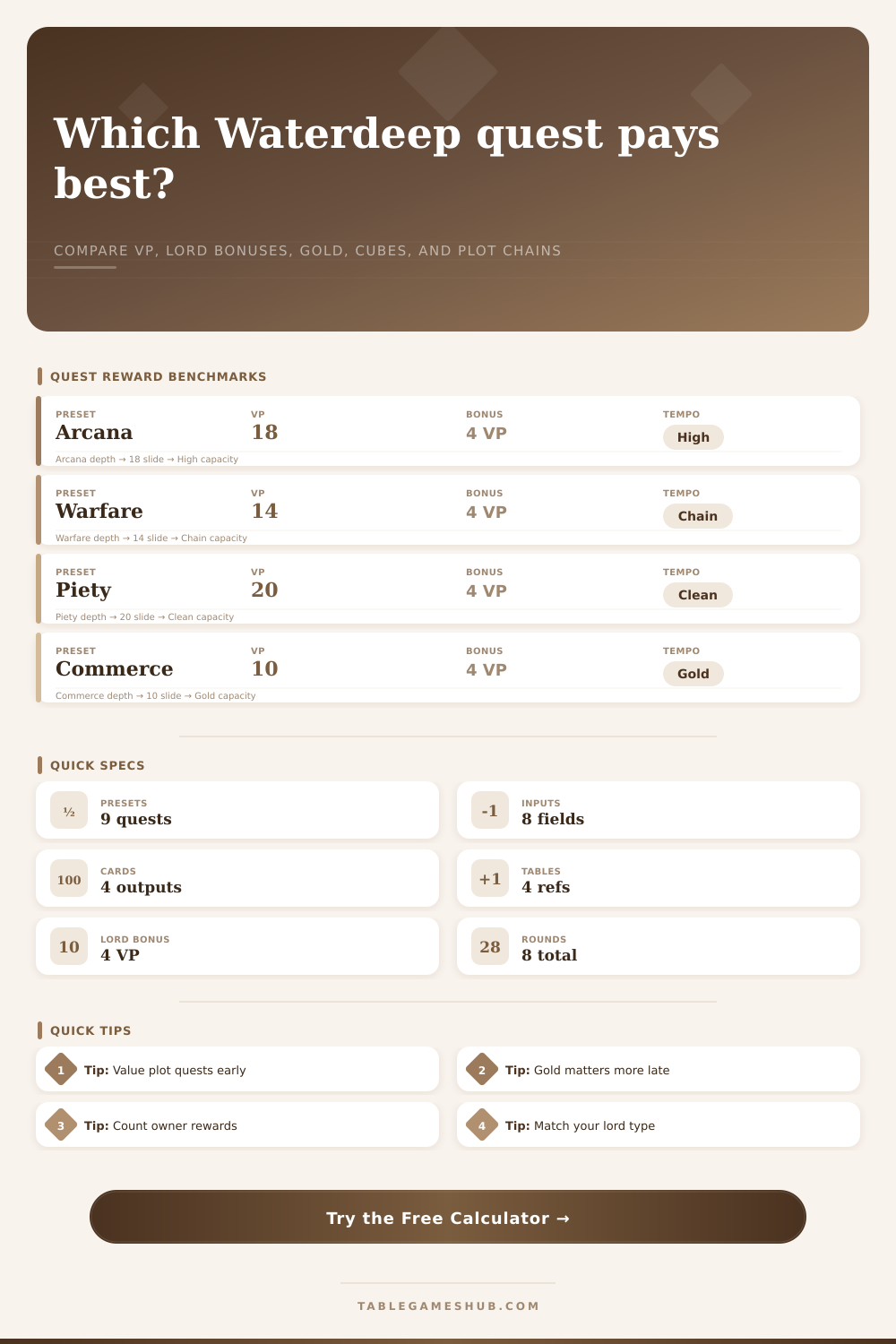
| Arcana | High VP, wizard-heavy costs | Usually +4 VP | Best for burst point quests with scarce cubes |
| Warfare | Fighter flow and chain rewards | Usually +4 VP | Use cube reward and plot chain together |
| Piety | Clean VP and cleric demand | Usually +4 VP | Often strong when printed VP is already high |
| Commerce | Gold, buildings, and flexible payoff | Usually +4 VP | Increase gold and owner reward fields |
| Skullduggery | Rogues, intrigue, and tempo | Usually +4 VP | Use intrigue and future fuel fields |
| Reward piece | Baseline value | When to raise it | When to lower it |
|---|---|---|---|
| Adventurer cube | 0.8 VP equivalent | You already hold matching quests | No future quest needs that color |
| Gold | 0.6 VP equivalent | Late game or Commerce focus | You lack ways to spend it |
| Intrigue card | 1.5 VP equivalent | You need tempo or disruption | Few turns remain to use it |
| Owner reward | 1.2 to 3.6 VP equivalent | Your building triggers repeatedly | Opponents avoid the space |
| Turns remaining | Small plot | Steady engine | Major enabler |
|---|---|---|---|
| 0 to 2 turns | 0.2 to 0.6 VP | 0.4 to 1.2 VP | 0.7 to 2.0 VP |
| 3 to 5 turns | 0.6 to 1.2 VP | 1.2 to 2.4 VP | 2.0 to 4.0 VP |
| 6 to 9 turns | 1.2 to 1.8 VP | 2.4 to 3.6 VP | 4.0 to 6.0 VP |
| 10+ turns | 1.8+ VP | 3.6+ VP | 6.0+ VP |
| Preset | Quest shape | Best input to watch | Priority signal |
|---|---|---|---|
| Arcana burst | Large printed VP | Lord category match | Great if it fits your Lord |
| Warfare chain | Moderate VP plus cubes | Plot quest chain | Best before the final rounds |
| Piety lord bonus | High VP plus match | Quest VP reward | Strong even without resource fuel |
| Commerce building payoff | Gold and owner triggers | Building owner reward | Good when gold converts quickly |
The brain short circuits when faced with two quest cards both promising some number of victory points. One has more raw points on its face value. The other provides intrigue potential, rogue cube and a bit of gold. Which do you take? That’s a typical Lords of Waterdeep trap. You’re chasing high number and wind up with nothing while someone else develop an engine that outstrips your points.
The calculator above eliminates all that noise. It turns all rewards into a common currency: something you can convert into something else. It translates card draws, cubes and gold into a common currency you can then compare across different reward. There’s more to printed victory points than meets the eye. You can often count them easily even if you aren’t getting the most out of them without looking at your board state.
Why Use a Calculator
And once you enter your information, you’re essentially posing a question: What is my opportunity cost? Accepting an easy-to-achieve quest that doesn’t replenish resources may satisfy for five seconds, but now you don’t have any agent available for the next round. On the other hand, a quest that produces gold or recycles adventurer cubes purchase time. Time is the game’s greatest currency, and the tool recognizes this by allowing you to change the value of future fuel depending on how many turns remain.
Things become more complicated with hidden lords. A ten point piety quest might look weak compared to an eighteen point warfare quest, but if your hidden lord is piety, that ten point quest sudden increases by four points. Piety also tends to require fewer cubes, or give you clerics that further fit into other synergies. The calculator does all this math for you and removes the emotional bias towards big numbers. It makes you consider the overall economic impact of the card. This is where many casual players fail because they focus too much on the end result different than how they get there.
The wildcard in all this are plot quests. Plot quests are wildcards that can make or break your late game strategy, but their value compounds much more if you trigger them early. But they compound their value very quickly if you have several turn to get them going early in the round. On the flip side, grabbing a major enabler with 2 rounds to go is almost always a wasted agent placement. This is where being good at estimating timing comes into play (the reference tables on the page help calibrate).
In the end, you’ve got to be cruel about this calculation: if the plot isn’t going to fire in time then it’s just dead weight.
But let’s examine gold and intrigue separately. Gold serves as liquid victory points, partcularly in the late game when you can spend it to finish quests that are otherwise out of reach. In addition, intrigue cards offer tempo by disrupting opponents’ flow or stealing agents outright. The calculator assigns baseline values to these assets, but your play style may alter the weight given to each one. If you’re building commerce towers gold is most important. If you’re running a strategy around stealing adventurers, intrigue is most important. Knowing which sliders to adjust based off your current board state differentiates a good move from a great one.
But really, this tool requires discipline. No longer are you going to pick up the gleaming quest because it’s shiny. You’re beginning to think of the game as an economy of efficient transactions. Do each one pay for itself? Does it provide immediate points? Critical resources? Long term engine building? Make the math work. You should of don’t guess anymore. The game will reward your point total later.