Istanbul Score Calculator
Track rubies, lira, Sultan goods, Gemstone Dealer timing, mosque tile pairs, wheelbarrow capacity, assistants, and late-game tiebreak strength.
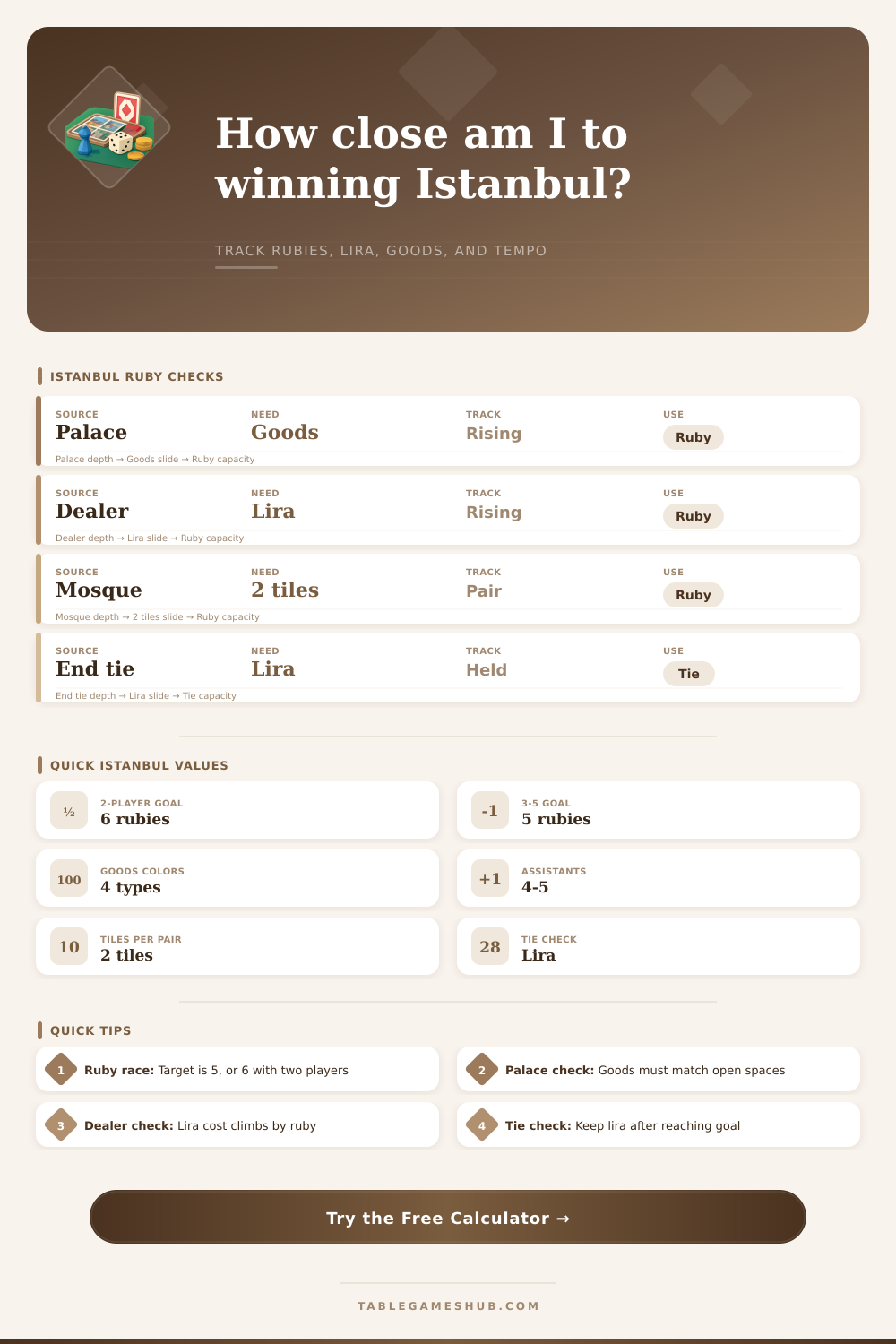
| Ruby Source | Tracked Input | Calculator Formula | Planning Signal |
|---|---|---|---|
| Sultan's Palace | Four required goods and four goods held | Shortest deficit = missing red + yellow + green + blue | Best when deficit is 0-1 and capacity can refill fast |
| Gemstone Dealer | Lira held and next dealer cost | Lira gap = next dealer cost minus lira held | Best when lira gap is 0-4 or bonus cards provide lira |
| Mosque Tile Pair | Completed same-mosque pairs | Potential ruby = completed pair count not already represented | Best when one tile pair completes without delaying movement |
| Final Round Tiebreak | Lira reserve and rival goal pace | Tie pressure = lira held minus 3 lira per rival on pace | Higher reserve helps if multiple merchants reach target |
| Wheelbarrow State | Per-Good Capacity | Best Use | Calculator Adjustment |
|---|---|---|---|
| Base Wheelbarrow | 2 goods | Small market sales and early palace rubies | Capacity penalty if Palace needs exceed 2 in a color |
| One Extension | 3 goods | Flexible midgame Palace and market planning | Neutral capacity rating for common requirements |
| Two Extensions | 4 goods | Late Sultan delivery with fewer refills | Positive tempo for warehouse-to-palace loops |
| Full Wheelbarrow | 5 goods | Maximum goods buffer and complete delivery range | Highest capacity score and no extension drag |
| Tempo Factor | Strong Position | Weak Position | Score Impact |
|---|---|---|---|
| Assistants under Merchant | 4-5 ready assistants | 1 ready assistant | Up to 18 tempo points |
| Bonus cards | Movement, lira, goods, or double-action card | No relevant card in hand | Up to 12 tempo points |
| Family member | Can be sent or already positioned | Locked at Police Station | Up to 8 tempo points |
| Route distance | 1-2 movement turns from ruby action | 5-6 turns from preferred stop | Up to 18 point swing |
| Game Situation | Likely Best Ruby | Watch Counter | Calculator Clue |
|---|---|---|---|
| Goods full, lira low | Sultan's Palace | Capacity by color | Palace deficit is lower than lira gap |
| Lira high, goods scattered | Gemstone Dealer | Rising dealer cost | Dealer gap is zero and tie reserve remains positive |
| Tile pair nearly done | Mosque ruby | Needed symbol count | Mosque pair count adds a possible ruby |
| Multiple players at target pace | Fastest legal ruby | Lira tiebreak | High urgency with low reserve warns against overpaying |
To win the game of Istanbul, a player must understand how to compare the different paths to acquiring rubies. A player must be able to measure the speed of each of the different paths to rubies that is available to the player; a player might have many different path to rubies available at the same time. Each of the paths to rubies has a cost associated with it; those costs includes the type of goods, the amount of lira, the number of mosque pair, and the tempo with which the merchant move across the game.
A player must be able to calculate which of the paths to rubies are the fastest for the player. One of the paths to rubies is the Sultan Palace. To obtain the Sultan Palace, a player must purchase four different kind of goods.
Compare Paths to Rubies
The wheelbarrow that a player use to purchase goods has a limited capacity for the amount of goods that can be transported. Thus, if a player is short on goods, a player will have to visit the warehouse to refill the wheelbarrow. However, visiting the warehouse use up one of the player’s movement turn; losing a movement turn could cause a player to lose the race.
Thus, a player must consider the capacity of the wheelbarrow when choosing there paths to rubies. Another path to rubies are from the Gemstone Dealer; however, the cost of the rubies increase the more rubies a player claim. Thus, if a player dont have enough lira to purchase the rubies from the Gemstone Dealer, a player must use a bonus card or the reward from a family member to obtain the lira.
A player can use the included calculator to determine how many lira is required from the Gemstone Dealer. Using the calculator help a player to determine how many lira to save; having more lira than another player can potentially help a player win the tiebreak between players with the same number of rubies. Another of the paths to rubies is the purchase of mosque tiles.
Unlike the other paths to rubies, the purchase of a mosque pair provide a ruby without requiring the purchase of goods or lira. However, to earn a mosque pair, a merchant must remain in one district for two turns. Thus, a player must calculate the movement cost of the mosque path compared to the other costs of the available paths; the mosque path could be the cleanest path to rubies if its movement cost are less than the other paths.
One of the other factors that can influence the player’s success in the game are the assistants and bonus cards. Assistants will reduce the number of recovery turn for a player, and bonus cards can reduce the number of movement turn that a player needs to take in order to reach a game element. In addition to these cards, the number of family member token that a player has can also affect the number of movement turns that a player must take to earn a reward.
These factors can help or hinder a player in the pursuit of the rubies; a player may appear to have fewer rubies then another player, but have sufficient assistants or bonus cards to win the game. One of the most common mistake that players make during the game is to only focus upon the next ruby that they will earn, and to forget about the tiebreak with other players. A player should of never spend all of their lira to obtain one of the rubies if they will end up with less lira than another player in the game.
Having more lira than another player during a tiebreak can help a player to win that tiebreak. Thus, a player should use the reference table to determine how many goods, lira, mosque pairs, and tempo turn a player will possess. Overall, a player win the game of Istanbul by comparing the different deficits that they have in the game.
A deficit can be in goods, lira, mosque pairs, or movement tempo. Therefore, the player with the shortest deficit will be the first to reach five or six rubies. A player can use a calculator to determine the players deficit by weighting the player’s goods, lira, mosque pairs, and movement tempo against one another.