Domino Topple Speed Calculator
Estimate toppling rate in dominoes per second and ft/sec with spacing, turns, surface drag, and alignment adjustments.
| Gap / Height | Spacing Factor | Speed Character | Use Case |
|---|---|---|---|
| 0.12 to 0.18 | 0.88x to 1.02x | High contact rate, possible binding | Short sprint tests |
| 0.22 to 0.34 | 1.05x to 1.18x | Fast and reliable DPS | Most tabletop lines |
| 0.35 to 0.45 | 0.92x to 1.04x | Lower DPS but more distance per domino | Visible display runs |
| 0.46 to 0.60 | 0.68x to 0.90x | Longer reach with higher miss risk | Large tiles and slow layouts |
| Profile | Height | Thickness | Base DPS | Rate Note |
|---|---|---|---|---|
| Mini travel | 1.5 in | 0.24 in | 14.5 | Quick contact rhythm, short pitch |
| Standard plastic | 1.9 in | 0.30 in | 12.8 | Balanced tabletop baseline |
| Competition show | 2.4 in | 0.32 in | 13.6 | Stable impact and fast curves |
| Thick wood | 2.0 in | 0.38 in | 10.6 | More mass, slower recovery |
| Giant floor | 5.0 in | 0.70 in | 5.4 | Low DPS, higher distance per hit |
| Surface | Factor | Primary Loss | Best Speed Use |
|---|---|---|---|
| Glass or acrylic board | 1.04x | Very low rolling and drag loss | Short demonstration sprints |
| Smooth wood or laminate | 1.00x | Neutral reference surface | General tabletop chains |
| Felt card table | 0.92x | Soft landing and fiber drag | Quiet practice runs |
| Rubber play mat | 0.86x | Grip slows sliding and rebound | Kid-safe layouts |
| Low carpet | 0.72x | Base tilt and pile resistance | Large, forgiving dominoes |
| Turn Type | Typical Angle | Loss per 90 Degrees | Speed Note |
|---|---|---|---|
| Sweeping curve | 30 to 60 degrees | 3% to 5% | Best for preserving DPS |
| Quarter turn | 90 degrees | 5% to 9% | Common table corner estimate |
| Tight square corner | 90 degrees | 9% to 14% | Use smaller gaps before the corner |
| Back-and-forth maze | Many 90 degree turns | 10% to 18% | Cumulative loss can dominate speed |
The speed at which domino toppling can occur is an measurement that is difficult to calculate manually. Furthermore, the knowledge of the variable that relate to the falling dominoes is necessary to avoid the potential for a failing domino line. If variables like spacing between dominoes are incorrect, or if the surface fails to provide the proper amount of force to each dominoes in the line, those dominoes may stall at a corner or fail altogether.
Due to the difficulty in managing these variables, it is useful for a person to utilize a calculator that estimates the speed at which a domino line will fall based off those different variable. The rate at which the domino line fall is not calculated as the total length of the line divided by the total time for which the line fell. Instead, the falling speed is calculated as the number of dominoes that fell in a unit of time (dominoes per second), which can be converted to the number of linear feet of the domino line that fell in that same unit of time (linear feet per second).
How to Calculate Domino Falling Speed
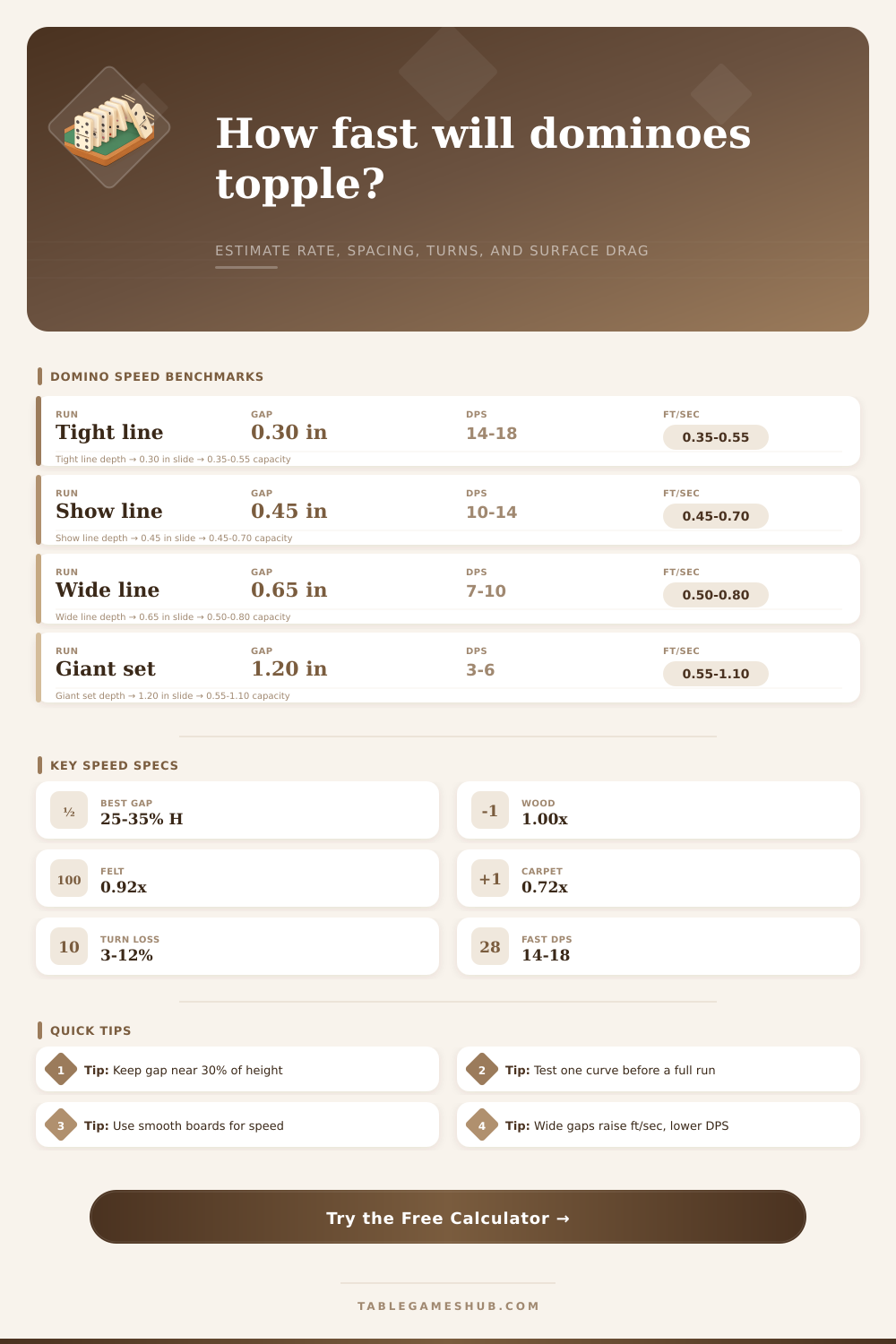
These two values is different from one another due to the possible different spacing of the dominoes. If the spacing of the dominoes is short, there will be more point of contact per second between dominoes but the line will travel further distance with each contact between dominoes. If the spacing is increased, there will be fewer point of contact per second but each contact will allow the dominoes to travel further distances before the next contact between dominoes.
The calculator can account for each of these variables. The type of surface upon which the dominoes will be placed can affect the falling speed of the line of dominoes. Surfaces with high amount of friction, like glass or polished wood, will return more of the impact between each domino than softer surfaces like carpet or thick mats of felt.
Because these softer surfaces absorb the motion of the falling domino line, they will slow the line of dominoes. Furthermore, the alignment of the dominoes may also impact the falling speed. If the dominoes are not aligned good, they may be hit in only a portion of one of the dominoes instead of the flat side of that domino.
These inaccuracies in the alignment of the dominoes will also reduce the speed at which they fall. The calculator can also account for each of these variables. The turns that exist in the line of dominoes will also reduce the speed at which the dominoes fall.
Curves of certain size will reduce the falling speed of the dominoes by some small percentage, while corners that are of a sharp ninety-degree angle may dramatically reduce the speed at which the dominoes fall. The calculator can account for the number of turns and the angle of each turn. Furthermore, the percentage at which the line of dominoes is expected to slow at each turn will allow the design of the line to ensure that the dominoes dont encounter any difficulty after the first few dominoes are toppled.
The spacing between dominoes is one of the variable that those who create lines of falling dominoes easily underestimate. The gap between the falling of one domino and the next should be set to between twenty-five and thirty-five percent of the height of each domino. If the gap is too low (less than twenty-five percent of the domino height), the falling dominoes may not be able to topple the next domino in the line.
If the gap is too high (more than thirty-five percent of the domino height), the falling of one domino may not make contact with the next domino in the line. The calculator can account for the spacing between dominoes. Furthermore, the size of each domino in a line may impact the speed at which the dominoes fall.
If the dominoes are mini-dominoes, there may be more room for the dominoes to fall than with giant floor dominoes. The calculator can account for each of these sizes. Some additional variables that may impact the falling speed of dominoes in a real-world scenario include humidity, slope of the line of dominoes, and even the temperature of the plastic of plastic dominoes.
For instance, humidity can cause the wooden dominoes to swell, which may change how the two faces of each domino meet each other. If the line of dominoes is built on a slope that allows the falling dominoe to have a boost in momentum, the incline of the slope can be accounted for. Finally, the temperature at which they are created or used may impact plastic dominoes because the plastic may become more flexible when warmer or become more rigid when cooler.
The creators of a line of dominoes may account for each of these variables prior to building the line. The result that is obtained from the calculator can be used to create the design of a line of falling dominoes. For instance, if the calculated result is that fourteen dominoes will fall in a second on a smooth surface, then the line of dominoes will have a lively falling rate.
However, a result of eight or nine dominoes per second indicate that the design of the line of dominoes is focused upon visual appearance rather than falling speed. Furthermore, the linear feet per second value will provide the number of linear feet that will be covered by the falling line of dominoes. Each of these values can aid the creator of a line of dominoes in understanding the line that will be created.
A person can achieve a better understanding of the falling speed of a line of dominoes if that person treats the falling speed of the line as one of the design choices for the creation of the line. Thus, the calculator remove the need for the person to manually calculate the mathematical equations associated with each of these variables. Furthermore, after the line of dominoes has reached the last placed domino without hesitation, it is certain that such a line was created with an understanding of the relationship between each of these variables.