🏏 Cricket Bowling Speed Calculator
Convert bowling speeds between KPH & MPH, classify your pace, and compare to professional standards
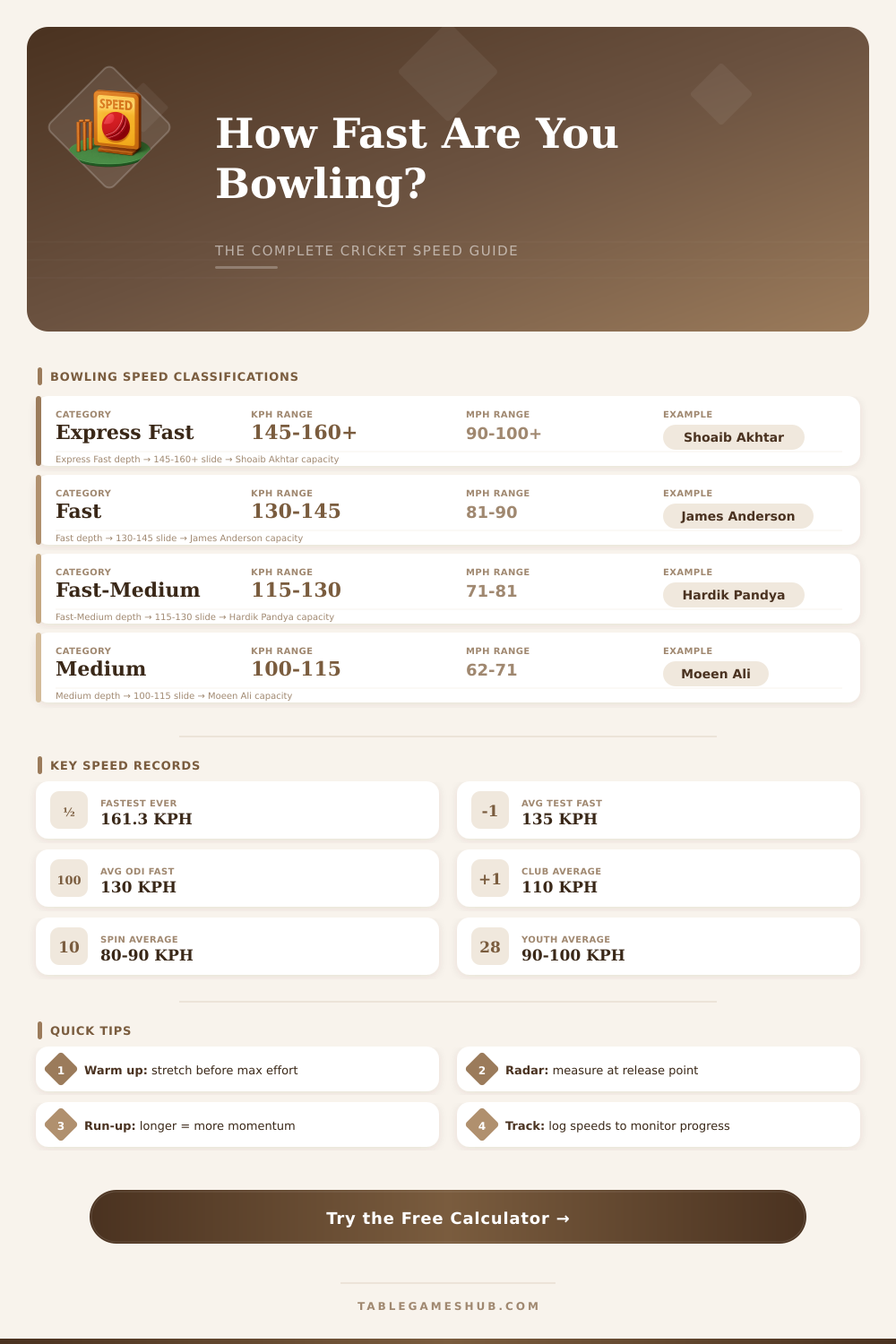
| Category | KPH Range | MPH Range | Ball Flight (sec) | Example Bowler | Match Level |
|---|---|---|---|---|---|
| Express Fast | 145 – 161+ | 90 – 100+ | 0.45 – 0.50 | Shoaib Akhtar | Elite International |
| Fast | 130 – 144 | 81 – 89 | 0.50 – 0.56 | James Anderson | International |
| Fast-Medium | 115 – 129 | 71 – 80 | 0.56 – 0.63 | Hardik Pandya | International / Club |
| Medium | 100 – 114 | 62 – 70 | 0.64 – 0.72 | Moeen Ali | Club / Regional |
| Medium-Slow | 85 – 99 | 53 – 61 | 0.73 – 0.85 | Part-time seamer | Club / Youth |
| Slow / Spin | 60 – 84 | 37 – 52 | 0.86 – 1.20 | Rashid Khan | All Levels |
| Bowler | Country | Speed (KPH) | Speed (MPH) | Year | Format |
|---|---|---|---|---|---|
| Shoaib Akhtar | Pakistan | 161.3 | 100.2 | 2003 | ODI |
| Brett Lee | Australia | 160.8 | 99.9 | 2005 | ODI |
| Jeff Thomson | Australia | 160.6 | 99.7 | 1975 | Test |
| Shaun Tait | Australia | 161.1 | 100.1 | 2010 | T20I |
| Mitchell Starc | Australia | 160.4 | 99.7 | 2015 | Test |
| Mark Wood | England | 157.7 | 98.0 | 2023 | Test |
| Kagiso Rabada | South Africa | 153.0 | 95.1 | 2022 | Test |
| Jasprit Bumrah | India | 153.4 | 95.3 | 2022 | IPL |
| Format | Avg Fast (KPH) | Avg Fast (MPH) | Avg Spin (KPH) | Ball Flight (s) | Run-Up (m) |
|---|---|---|---|---|---|
| Test Cricket | 135 – 145 | 84 – 90 | 80 – 90 | 0.50 – 0.54 | 18 – 22 |
| ODI | 130 – 142 | 81 – 88 | 82 – 92 | 0.51 – 0.56 | 17 – 21 |
| T20 International | 128 – 140 | 80 – 87 | 80 – 90 | 0.52 – 0.57 | 16 – 20 |
| IPL / BBL | 130 – 145 | 81 – 90 | 80 – 88 | 0.50 – 0.56 | 16 – 20 |
| Club / Amateur | 100 – 125 | 62 – 78 | 60 – 80 | 0.58 – 0.72 | 12 – 18 |
| Women's International | 110 – 130 | 68 – 81 | 72 – 85 | 0.56 – 0.65 | 14 – 19 |
| Under-19 | 100 – 120 | 62 – 75 | 65 – 78 | 0.60 – 0.72 | 12 – 17 |
Cricket Bowling Speed in high speed ranks between the most exciting moments of the sport. One calls it fast bowling, or simply fast launch, when the ball flies with big force. The strongest bowlers cast it down at more than 86 miles an hour so around 138 kilometers an hour.
Those that manage that, call fast bowlers or only speedsters.
Cricket Bowling Speed and How We Measure It
Definitions about fast bowling range a bit. Everything above 141 km/h (88 mph) is considered real fast launch. Speeds of 130 to 141 km/h (81, 88 mph) belong to the medium-fast category.
The middle fast range is between 120 and 130 km/h (75; 81 mph). Under 120 km/h (75 mph) it simply is middle speed. Even so there is no official rule that sets those groups.
Through most of Cricket past, no one could use devices to control the speeds.
Bowlers that reach 140 km/h, one widely considers proper fast bowlers. Who succeed 145 km/h, those deserve the name real speedsters. And 150 km/h marks the used standard for lasting power.
To reach more than 140 km/h, you need steady growth of push, method and recovery.
In international Cricket, a typical swing bowler sends the ball at about 80 mph, so 128 km/h. Fast bowlers usually can pass 90 mph, although most of their balls land beetween 85 and 90 mph. Really everything that separates them is the talent to throw an even stronger ball.
The fastest launch in Cricket history reached 161.3 km/h, or 100.2 mph. Shoaib Akhtar did that against England during the World Cup of 2003. Mark Wood from England commonly launches at 150 km/h and belongs to the strongest active players.
Mayank Yadav from India can also reach 150. In the Indian T20-League of 2022, one bowler regularly passed 150 km/h and took the crown of the fastest in India that year.
The Bowling Speed is measured by a radar gun, that works like a tool for checking the speed of a car. It combines a receiver and a sender, sending waves that reflect back. The scene speed relates to the ball in flight, when it leaves the hand of the bowler.
Today, one does not count the speed after the ball touches the ground.
There are also apps that try too estimate Bowling Speed. The idea is to film the bowling move, choose the frame where the ball exits the hand, then the one where it arrives at the stumps or the batter. The distance from the crease to the bat is 20.12 metres, although it ranges a bit based on the situation.
Even so using a timer is tricky, because human reaction is weak and mistakes build during starting and stopping thetime. The radar gun however stays the safest method. The ball force is key for the impact of a fast bowler.