🔎 Clue Probability Calculator
Estimate suspect, weapon, and room envelope odds from eliminated cards, shown cards, hand sizes, passed players, and the latest suggestion response.
| Deduction step | Value | Formula | Interpretation |
|---|
| Category | Total cards | Envelope count | Base probability per card |
|---|---|---|---|
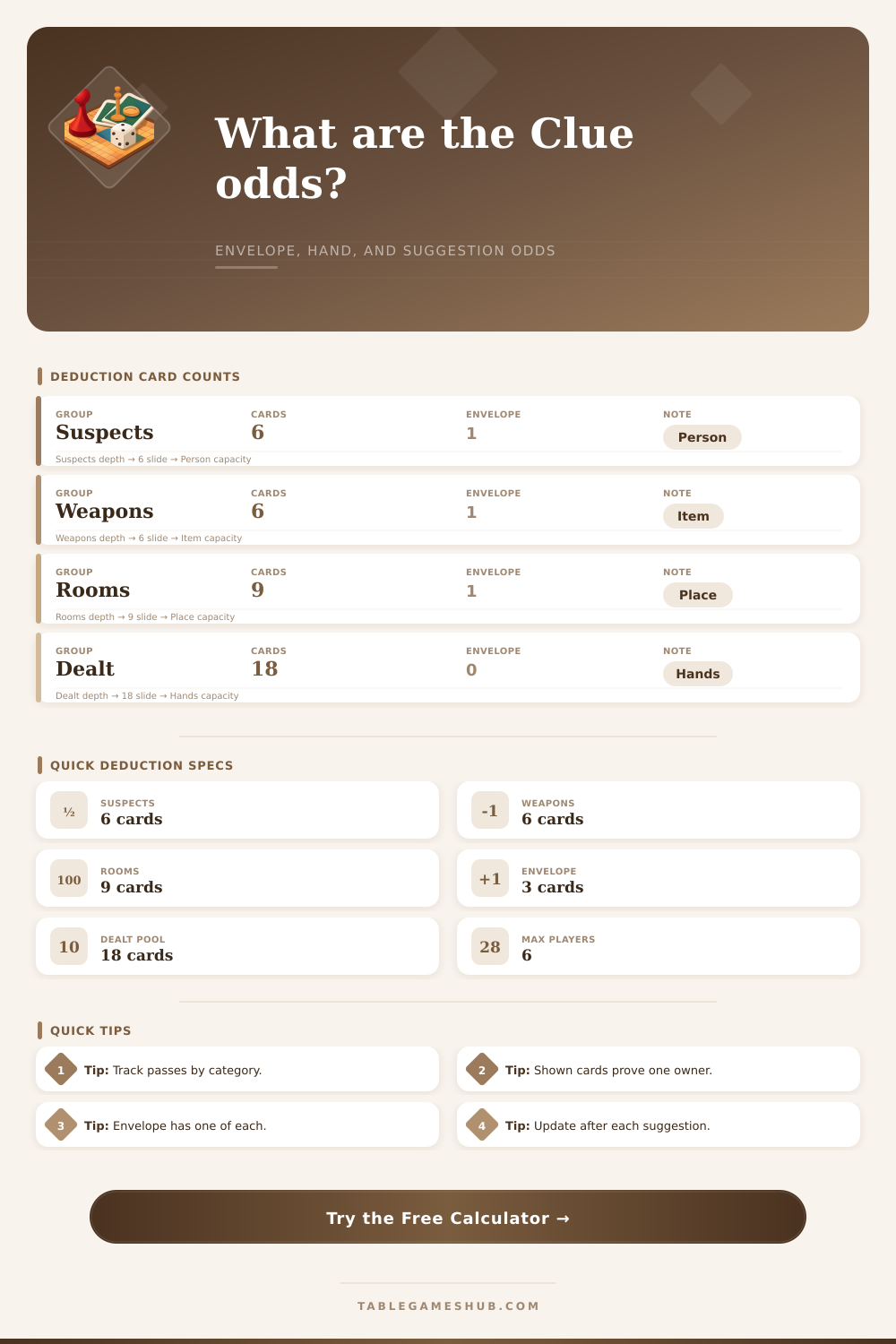
| Suspects | 6 | 1 | 16.7% before any eliminations. |
| Weapons | 6 | 1 | 16.7% before any eliminations. |
| Rooms | 9 | 1 | 11.1% before any eliminations. |
| Envelope | 3 | 3 | One card from each category. |
| Player hands | 18 | 0 | All remaining cards are distributed to players. |
| Players | Dealt cards | Typical hand sizes | Deduction effect |
|---|---|---|---|
| 3 players | 18 | 6, 6, 6 | Large hands make each player more likely to block a suggestion. |
| 4 players | 18 | 5, 5, 4, 4 | Uneven hand size matters when tracking responder capacity. |
| 5 players | 18 | 4, 4, 4, 4, 2 | Short hands can be exhausted by confirmed shown cards. |
| 6 players | 18 | 3 each | Passing information spreads faster around the table. |
| Suggestion outcome | Suspect card | Weapon card | Room card |
|---|---|---|---|
| No response from anyone | Envelope chance rises | Envelope chance rises | Envelope chance rises |
| One card shown | One of three may be owned | One of three may be owned | One of three may be owned |
| Player passed | That player lacks it | That player lacks it | That player lacks it |
| Card revealed later | Remove if same card | Remove if same card | Remove if same card |
| Evidence mark | Meaning | Calculator treatment | Best use |
|---|---|---|---|
| Eliminated | Known outside envelope | Sets the selected card chance to zero. | Your hand, shown cards, confirmed reveals. |
| Still possible | No direct proof yet | Uses category base odds after eliminations. | Neutral notebook cells. |
| Passed by all checked | Seen players do not hold it | Adds an envelope lift for that suggestion card. | Sequential suggestion records. |
| Responder may have shown | Responder owns one of the three | Splits shown-card likelihood across live suggestion cards. | Face-down card response notes. |
Separate category odds
Because the envelope contains one suspect, one weapon, and one room, never compare a room card directly to a suspect without using its category size.
Record negative evidence
Every passed player removes ownership possibilities. The strongest notebook rows often come from who could not answer, not only from who showed a card.
Probability thinking is an process of determining the likelihood that a specific combination of cards is within the envelope. The envelope contains one of each type of card: a suspect, a weapon, and a room. Because the envelope contains one of each of these types of cards, the mathematical probabilities changes with every player that passes or reveals a card.
Thus, players must always consider the impact that every pass or reveal have upon the probabilities for the remaining cards within the envelope. Because there are not the same number of cards within each of the three category, each category does not have the same chance of being represented within the envelope. For instance, there are six suspect and weapon cards, but there are nine room cards.
How the probability calculator works
Thus, the elimination of one of the room cards does not have the same impact upon the probability that any specific room is within the envelope as does the elimination of one of the suspects or one of the weapon. The calculator can calculate both of these probabilities using these starting numbers for each category. Furthermore, the calculator can also show the player which of the three categories have the highest chance of possessing the cards within that category, and whether the three cards that are being suggested as the answer is realistic or impossible.
The information from the other players have a much greater impact upon the probabilities than the information contained within your own hand. For instance, if a player passes upon a suggestion of three cards, it is known that the player does not have any of those three suggested cards. Thus, those three suggested cards have a higher probability of being within the envelope.
The calculator accounts for the number of passes before the responder speaks, as well as the number of unknown cards that the responder may have in there hand. Thus, the more unknown cards that a responder has in their hand, the higher the chance that they have the suggested card. Mathematical probabilities also change when the responder chooses to reveal a card.
When the responder discloses a card, it is unknown as to which of the three suggested cards is the one that was revealed. Thus, each of the three suggested cards have a decreased chance of being within the envelope. The calculator calculates the product of each of these new probability to determine the chance that the three suggested cards are within the envelope.
Thus, although players may believe that the showing of a card is neutral information, it actualy increases the chance that the two cards that were not revealed actualy is within the envelope. Other factors that impact the probabilities are the size of each player’s hand and the number of players in the game. In most games, the dealer distributes cards to each player such that there are five cards for each of the two players, and four cards for each of the other two players.
Thus, the players with four cards in their hand will run out of unknown cards more quick than the other players. Thus, the player can input the size of their own hand and the number of players into the calculator to determine how many cards are remaining in the game that are yet to be revealed. Furthermore, each player must also mark their own cards as eliminated in the calculator, since the number of cards within the hidden pool change with each revealed card.
The outcome of the suggestion will impact the mathematical results of the calculation. If all of the players pass upon the suggestion, the probability of each of the three suggested cards increases, as each player does not have any of those suggested cards. If only some of the players pass, the players that pass are removed from the group that might have the suggested cards, while the responder is still variable in relation to the suggestion.
Thus, each of the three suggested cards can be marked as passed, shown, or unknown in the calculator. The quality of the notes that are taken during the game will also impact the interpretation of the probability score. If the suggested cards have clean and confirmed notes regarding their ownership by other players, then the readiness score will be higher.
If the notes regarding the other players cards are rough or of mixed notabilities, the readiness score will be lower. Thus, if rough notes are entered into the calculator, the calculator will apply a penalty to the readiness score to ensure that the percentage does not indicate a higher chance than the player truly have of the responder having one of the three suggested cards. Thus, the player must decide at any point in the game whether to make another suggestion or to act upon the calculation to accuse the responder of having the three suggested cards.
It is important to update the probability calculator after each turn in the game. Each pass of a player, each revealed card from a responder, and each card that is eliminated from a player’s hand will impact the probability calculations. Thus, by running the calculation after each turn, players can avoid introducing errors created through the use of mental math calculations.
Thus, the value of the calculator is that it provide a static score to the dynamic game of cards, and helps to indicate to the players at any point in the game when the cards have been narrowed to the point that the game can be concluded.